Money And Tipping In Sibiu: Lei, Cards And ATMs
Sibiu runs on the Romanian leu, and a handful of sourced prices, a new accommodation tax and a few card and cash habits are all a visitor needs to plan the spending side of the trip.
Short answer
Sibiu uses the Romanian leu (RON, lei), at about 5.3 lei to the euro. Cash in lei covers buses, small museum tills and market stalls, cards are common in the old town, and since 1 January 2026 hotels add a 2 percent tourism tax to the accommodation bill.
Sibiu, the Saxon-founded city in central Transylvania on the Cibin river, runs on the Romanian leu, and the money side of a visit here is simpler than it looks. Prices are moderate, the old town is compact enough that walking costs nothing, and the figures that matter, museum tickets, bus fares, the new accommodation tax, are all published. This page from the Sibiu Travel Guide lays out what is sourced and what is not, so the wallet decisions are made before the plane lands.
What Currency Does Sibiu Use?
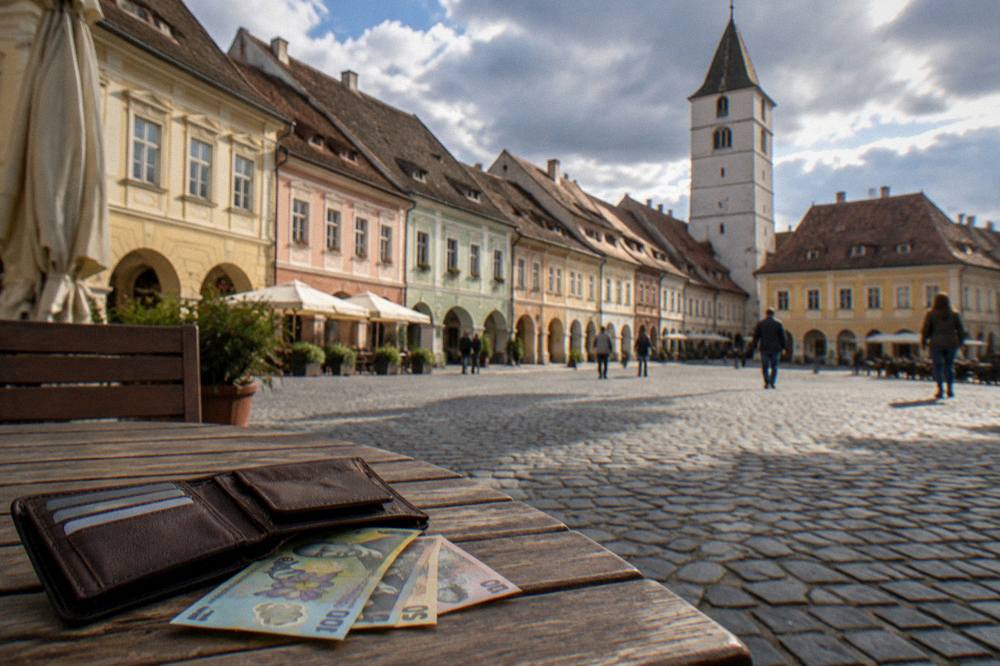
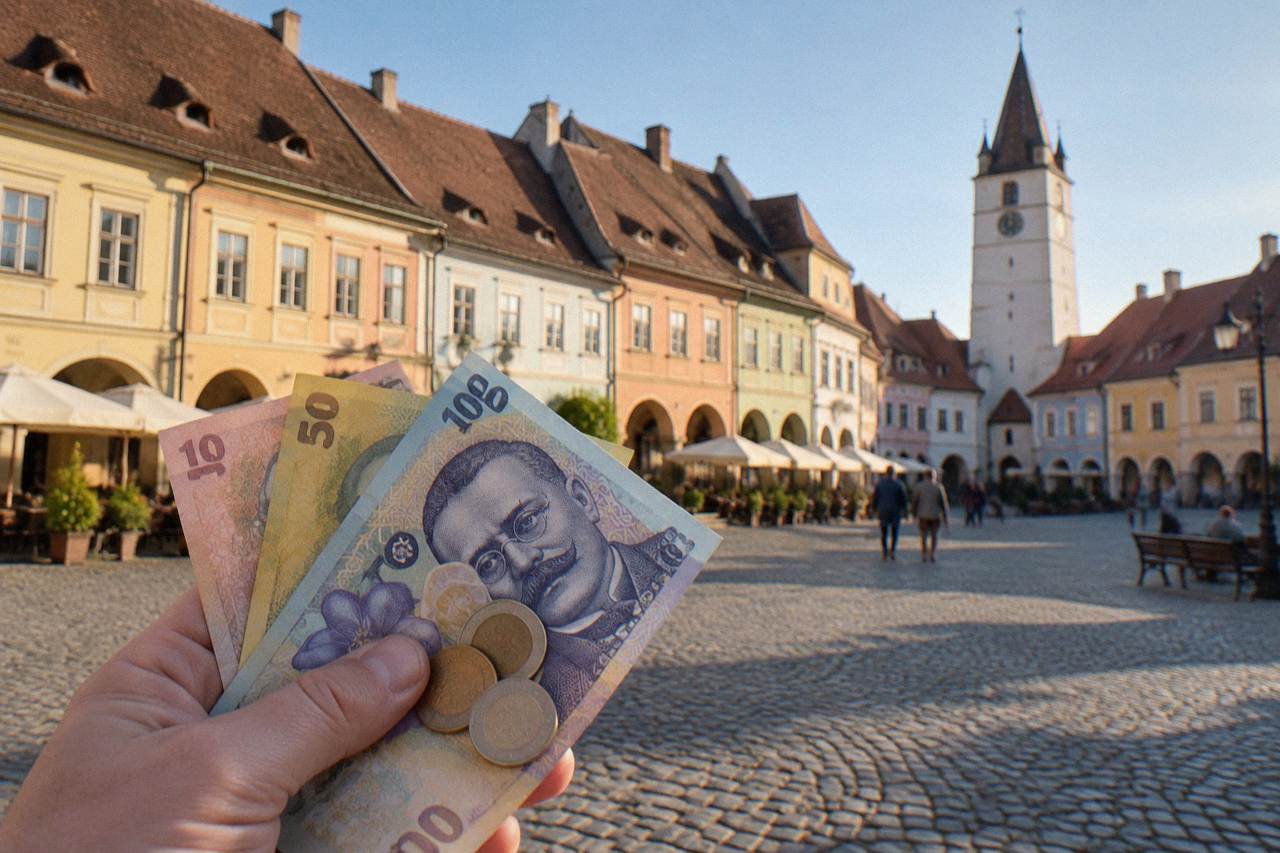
The currency in Sibiu is the Romanian leu, plural lei, with the international code RON, and no shop, museum or restaurant in the city prices in anything else. The euro moves against it at roughly 5.3 lei to the euro, but that is a reference rate, not a street price, so exchange a little or withdraw locally rather than paying in euros and letting the till decide the math.
The leu is issued by the National Bank of Romania in a range of note and coin denominations, with 100 bani to the leu. Small change matters more than visitors expect: the city bus takes a contactless payment of 3.5 lei, market stalls in the Lower Town deal in coins, and a museum cashier will not enjoy breaking a large note. Romania is a full Schengen member, with land border checks with Hungary and Bulgaria lifted on 1 January 2025, so there is no currency declaration theatre on arrival from inside the zone.
A note on rounding. A price of 10 lei and 50 bani is often quoted as "10 50", and receipts separate the amounts cleanly. The language is Romanian, though German and English are widely spoken in tourist areas, so the word to watch on a till screen is "lei" and on a card terminal "aprob" for an approved transaction.
How Much Cash Should You Carry In Sibiu?
A sensible cash float in Sibiu is small: enough lei for a bus ticket at 3.5 lei, a museum cashier that prefers notes, a market stall and a coffee, with the rest of the trip on a card. The main Brukenthal ticket desks, the ASTRA Museum and the established old town businesses all take cards, but the published fare structure shows where notes and coins still do the work.
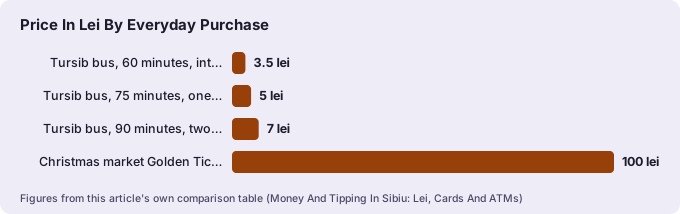
The city bus system, which is the cheapest way in from the airport on line 11, prices a 60-minute internal ticket at 3.5 lei, a 75-minute ticket with one transition at 5 lei and a 90-minute ticket with two transitions at 7 lei, bought contactless on the bus or through the app. The FlixBus run to Bucharest is reported from about 46 RON one way, and long-distance coach tickets like that are the kind of purchase where cash is never needed. For the rest, getting around Sibiu without a car is close to free once the arrival is handled.
Where cash earns its place is the small stuff. The Evangelical Cathedral tower, the open viewpoint in the city since the Council Tower closed for restoration on 19 January 2026, charges 10 RON at the door. The Christmas market in Piața Mare sells a Golden Ticket at a reported 100 lei for the wheel, carousel and mini-train. Neither of those is a place to rely on a card terminal working.
| Everyday purchase | Price in lei | Where the figure comes from |
|---|---|---|
| Tursib bus, 60 minutes, internal | 3.5 lei | Tursib fare page |
| Tursib bus, 75 minutes, one transition | 5 lei | Tursib fare page |
| Tursib bus, 90 minutes, two transitions | 7 lei | Tursib fare page |
| FlixBus Sibiu to Bucharest, one way | from about 46 RON | Operator listing, confirm at booking |
| Christmas market Golden Ticket | 100 lei (reported) | Market organizer, confirm on site |
A practical pattern that fits the city: withdraw a modest amount of lei once, spend it down on buses, towers and market stalls, and let the card carry hotels, restaurants and booked tours. Prices on the operator's live listing are always charged in the currency shown at checkout, so a day trip booked in advance does not need wallet space at all.
Do Hotels In Sibiu Add A Tourist Tax?
Yes. Since 1 January 2026 Sibiu levies a special tourism-promotion tax of about 2 percent of the total accommodation value, collected through the hotel or guesthouse rather than at a desk, so the room bill carries a small percentage on top. It is not a fixed per-night amount in lei or euros, and the rate was set by the local council decision approved on 30 December 2025.
The money is earmarked for tourism promotion and reinvestment, and the collection works like a city tax anywhere in Europe: it appears on the hotel invoice or is absorbed into the quoted rate depending on the property. Because it is a percentage, a mid-range room and a budget room pay different amounts, and no published table of per-night figures exists to quote. The honest instruction to a traveller is to confirm the line item at booking, since how it displays varies by property.
This tax sits on top of the room rate, not inside it, which matters when comparing where to stay in Sibiu. Two percent is small, but on a week-long stay it is a real line on the bill, and it is charged on the accommodation value, not on meals or extras booked at the same desk.
Can You Pay By Card In Sibiu?
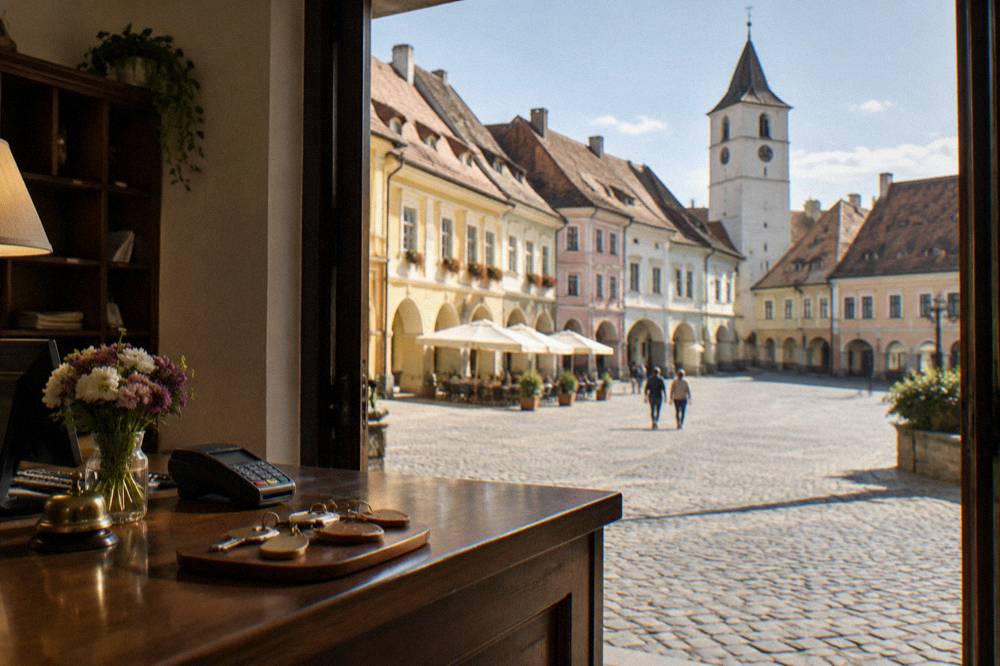
Card payment is normal across Sibiu's hotels, restaurants and ticket desks, and Romania's banking system is fully integrated with European card networks, but no official source publishes a figure for card acceptance coverage in the city, so the working rule is simple: cards work in established businesses, cash covers the street, the bus and the small tills, and neither method alone is enough.
What can be stated is structural. The Brukenthal National Museum sells tickets online through its own site, which means the largest museum institution in the city handles card payments by default. The Tursib bus network takes contactless payment on board for its 3.5 lei ticket, which is a strong signal of how normal tapping a card has become at even the smallest price point. The airport's transport page describes exactly that contactless flow for arriving passengers.
What cannot be stated is a coverage percentage, an ATM fee, or which individual shops take cards, because no trusted source was found for any of those figures. A visitor who keeps a card and a small float of lei loses nothing. A visitor with only a card will meet the tower cashier or the market stall eventually.
For arrivals, the practical money sequence is described in how to get to Sibiu: tap a card on bus line 11 at the airport terminal stop, and withdraw lei from a bank-branded machine in the centre rather than the first machine in the arrivals hall, a habit that travels well across Romania and beyond.
Where Should You Exchange Money Or Withdraw Lei In Sibiu?
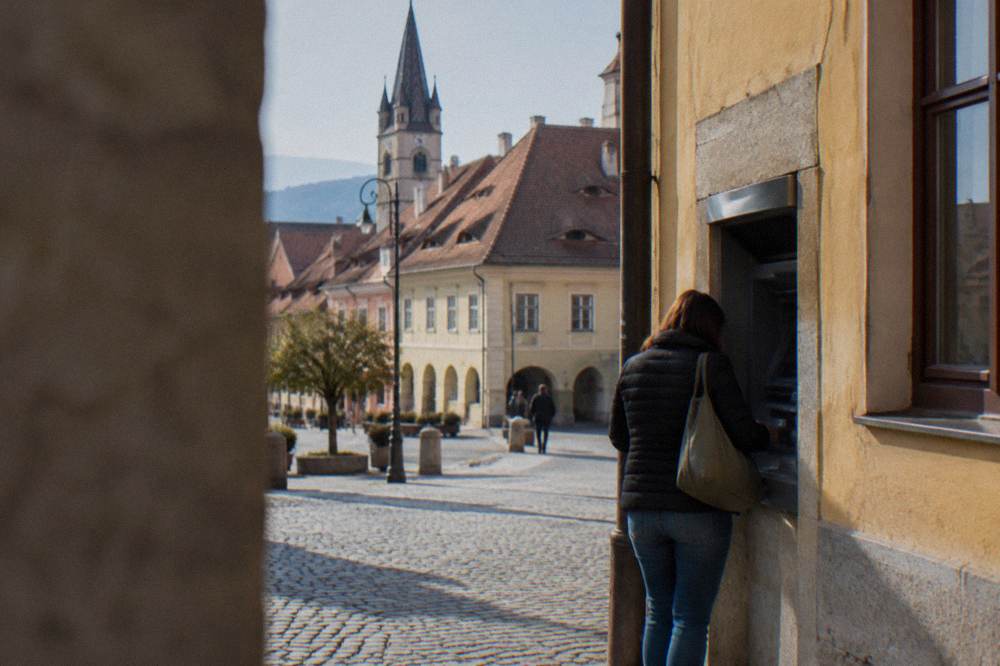
Withdraw lei from a bank-branded ATM in Sibiu rather than exchanging cash at a bureau or at the airport, because the leu is a freely traded currency and Romanian bank machines dispense it at the interbank rate plus whatever the visitor's own bank charges. No published comparison of Sibiu exchange offices or ATM fees exists, so no specific operator, rate or fee can be recommended here.
The honest position on fees is that they are unknowable in advance: they depend on the visitor's home bank, the machine operator and any dynamic-currency-conversion prompt on the screen. The defence is procedural rather than numerical. Decline the machine's offer to be charged in your home currency, always choose to be charged in lei, and prefer machines attached to a visible bank branch. These steps cost nothing and avoid the worst outcomes.
Exchanging euro banknotes is possible in the old town, but the "about 5.3 lei to the euro" reference rate is a National Bank midpoint, not a promise, and no licensed office in the city publishes its margin in a way a visitor can compare in advance. If notes must be exchanged, do it in one transaction at a bank counter rather than dribs at a bureau.
A last practical point: coins cannot be exchanged back. Spend the bani down in the final days on buses and market stalls, because the 50 bani pieces left in a pocket on the flight home are souvenirs, not currency.
What Do Sibiu's Museums And Sights Cost In Lei?
The Brukenthal National Museum's own price page lists its Palace art gallery at 50 RON, the History Museum at Casa Altemberger at 36 RON, Natural History at 20 RON, Pharmacy History at 16 RON and Contemporary Art at 15 RON, with a 48-hour combined ticket at 120 RON, while the Evangelical Cathedral tower charges 10 RON and the ASTRA open-air museum 50 RON for an adult.
Those are the published official figures, current on the museum's price page under an order dated 2023, and the reductions are worth knowing before buying. Pensioners pay half at the Brukenthal sites, for example 25 RON at the Palace and 60 RON on the 48-hour ticket, and pupils, students and Euro26 holders pay a quarter, 12.50 RON at the Palace and 30 RON on the combined ticket. A guided tour in Romanian or English costs 200 RON per 60 minutes at Brukenthal. Confirm current prices on the museum's own site before booking, because press reporting in May 2026 discussed a possible rise that the official page does not yet show.
Two structural money traps sit inside the same institution. The main Brukenthal museums are closed Monday and Tuesday, so a 120 RON combined ticket bought on the wrong day buys nothing, and the Contemporary Art Museum runs Monday to Friday only, closing at weekends. The Hunting Museum is closed for an indefinite period and opens only to pre-booked groups, so its 12 RON ticket is effectively off the menu. The details are laid out in the guide to the Brukenthal National Museum.
| Sight | Adult price | Concessions | Notes |
|---|---|---|---|
| Brukenthal Palace (art galleries) | 50 RON | pensioners 25, students 12.50 | Closed Mon and Tue, Wed to Sun 10:00 to 18:00 |
| Brukenthal 48-hour combined ticket | 120 RON | pensioners 60, students 30 | Covers the open Brukenthal sites |
| History Museum, Casa Altemberger | 36 RON | half and quarter rates | Closed Mon and Tue |
| Natural History Museum | 20 RON | half and quarter rates | Closed Mon and Tue |
| Pharmacy History Museum | 16 RON | half and quarter rates | Piața Mică 26 |
| Contemporary Art Museum | 15 RON | half and quarter rates | Open Mon to Fri only |
| Evangelical Cathedral tower | 10 RON | pupils, students, pensioners 5 | Open viewpoint while the Council Tower is closed |
| ASTRA open-air museum | 50 RON | pensioners 20, pupils and students 10 | Autumn schedule to 26 Oct 2026, last entry about 16:00 |
The ASTRA Museum in the Dumbrava forest is the one big-ticket item outside the centre, and its prices are 50 RON adult, 20 RON pensioner and 10 RON for pupils and students, with group rates below that. Its winter schedule had not been announced when the autumn hours were published, so anyone visiting after late October should check the museum's own program page first.
What Do Day Trips From Sibiu Cost To Enter?
Entry prices for the classic day trips are published at each site: the Biertan fortified church charges 20 RON, the Sighișoara Clock Tower history museum 50 RON with the Weapons Museum at 20 RON, the Torture Room at 10 RON and the Church on the Hill at 20 RON, and Bran Castle's own ticket page lists a Guided Royal Tour Plus Fast Pass from 150 RON, with the standard Bran adult price to be checked on the official page.
The Sighișoara figures come from the citadel's own visitor information, and the hours matter as much as the prices: the Clock Tower runs 09:00 to 17:30 midweek and from 10:00 at weekends between 15 May and 15 September, then shorter winter hours to 15:30 midweek, and it is closed Monday. Biertan opens daily with a lunch break from 13:00 to 14:00 in the shoulder season and switches to Tuesday to Sunday, 11:00 to 15:00, from November to March. Alba Iulia's citadel grounds are free to walk, which makes it the cheapest full day out in the region, though museum prices inside remain unlisted.
One driving cost deserves its own line. The Transfăgărășan's alpine section reopened for the 2026 season on 12 June, running 07:00 to 21:00 daily, but by rule it can be closed on any day from 20 October, and the fines for driving the closed stretch run from 10,000 to 30,000 lei, sums that dwarf every other figure on this page. Check the live road status before committing the day, a point expanded in the Transfăgărășan guide.
| Day trip destination | Entry cost in lei | Source of the figure |
|---|---|---|
| Biertan fortified church | 20 RON adult | sibiu-turism.ro listing, confirm before you go |
| Sighișoara Clock Tower | 50 RON | citadel visitor site, confirm before you go |
| Sighișoara Weapons Museum | 20 RON | citadel visitor site |
| Sighișoara Torture Room | 10 RON | citadel visitor site |
| Sighișoara Church on the Hill | 20 RON | citadel visitor site |
| Bran Castle, Guided Royal Tour Plus Fast Pass | from 150 RON | The castle's own ticket page |
| Alba Iulia citadel grounds | Free, open access | Tourism listing |
For anyone weighing the drive against a booked excursion, the road distances from Piața Mare are computed at about 102 minutes and 96 km to Sighișoara, about 154 minutes and 142 km to Brașov, and about 154 minutes and 138 km to Bran Castle. Booked day trips, including the Sighișoara day trip options, price their tickets and transport together on the operator's live listing, which is where the current figure belongs rather than on this page.
Is Tipping Expected In Sibiu?
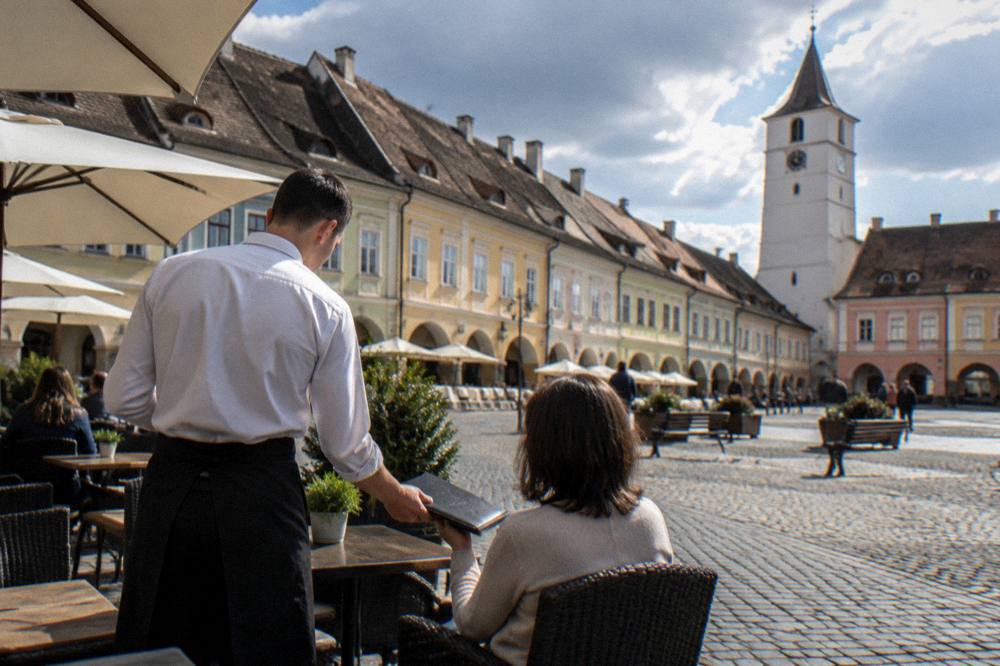
No official Romanian source publishes tipping norms, no percentage was found in any trusted reference for Sibiu, and Romanian law requires service to be included in the billed price, so tipping in Sibiu is a voluntary reward for good service rather than an obligation with a going rate. Any guide that prints an exact percentage for restaurants, taxis or guides in this city is filling a gap with a guess.
What can be said without a number: rounding up a restaurant bill is a common courtesy, leaving the small coins from the change is normal at a café counter, and a booked tour guide who has done well can be thanked in cash at the end. None of that is compulsory, and none of it carries a published rate. The city's tourism site, which does state basics such as the 112 emergency number, publishes no tipping guidance at all, which is itself the honest answer.
Two adjacent money habits are also unquantified in trusted sources, so they get the same treatment: card surcharges and service charges on bills are whatever the printed bill says they are, and a visitor should read the bill rather than assume a norm. The money picture in Sibiu overall is best planned from the published ticket and transport figures rather than from folklore about percentages.
How Does Seasonal Timing Change The Spending Plan?
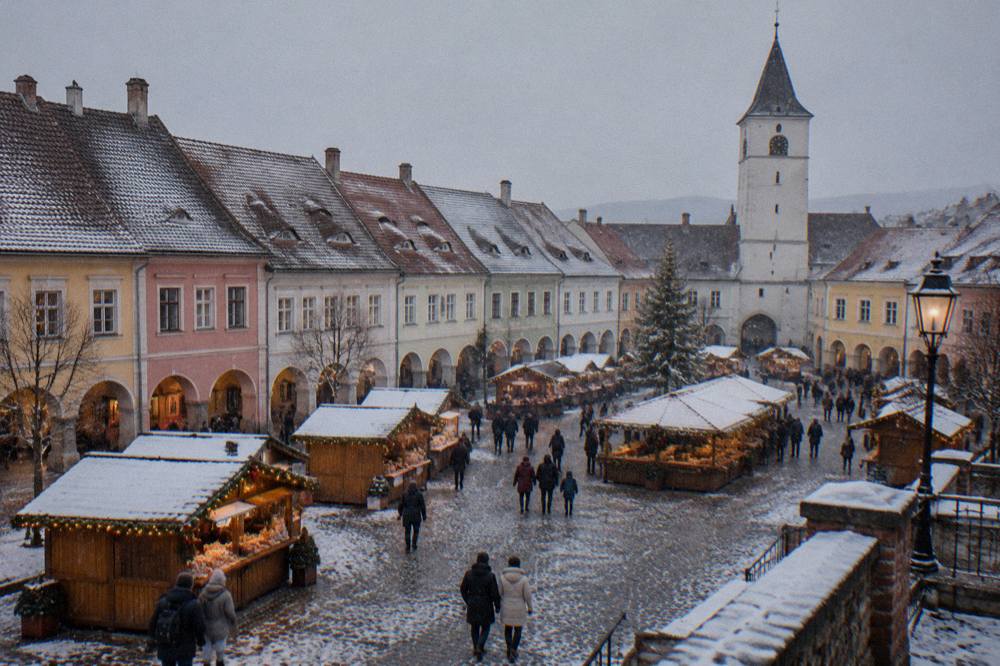
Sibiu's calendar shifts where the lei go rather than how many are needed: the Christmas market runs 13 November 2026 to 3 January 2027 in Piața Mare with free entry and a reported 100 lei Golden Ticket, the Păltiniș ski season opens on 28 November 2026, and the summer festival season from FITS in June to Artmania in July fills the same squares with free-access programming.
The winter money shape is market-shaped. Entry to the Christmas market costs nothing, the 600 square metre ice rink hires skates on site, and the Golden Ticket, reported by the market's organizer, bundles the wheel, carousel and mini-train at 100 lei. Combine that with the 2 percent accommodation tax and a weekend in December, the season covered in Sibiu in December, is mostly a cash-and-stalls affair. One warning that costs nothing to heed: the market's Golden Ticket price is a reported figure, so confirm it at the market itself.
The summer shape is transport-shaped. The Transfăgărășan window from mid-June, the Bâlea Lake cable car, which runs on its own schedule with prices not confirmed for publication, and the Făgăraș hikes all pull spending out of the city and into the mountains, while Artmania's 2026 edition in Piața Mare was billed as free access. The shoulder months of May, June, September and October are the ones tourism sources name as the comfortable middle, and the best time to visit Sibiu guide works through that trade-off in full.
| Season | What the money goes on | Sourced figure |
|---|---|---|
| Winter (late Nov to early Jan) | Christmas market stalls, Golden Ticket, ice rink hire | Market runs 13 Nov 2026 to 3 Jan 2027, free entry |
| Winter (from 28 Nov 2026) | Păltiniș ski passes and rental | Season opening date announced; prices not published here |
| Spring and autumn | Museums, day trips, villages | Brukenthal 48-hour ticket 120 RON |
| Summer (from mid-June) | Transfăgărășan fuel, Bâlea cable car, festivals | Road open 07:00 to 21:00, closable from 20 Oct |
The airport calendar matters too. Wizz Air's winter 2026-27 schedule from 25 October cuts Sibiu to 17 flights a week, down from 20, which can shift arrival days and therefore hotel nights, each one carrying the 2 percent tax. The details sit in the Sibiu airport guide.
What Should A Daily Money Routine In Sibiu Look Like?
A workable routine is one card, a modest float of notes and coins, contactless for the Tursib bus at 3.5 lei a ride, cash at tower and market tills, online tickets for Brukenthal where the 48-hour option at 120 RON rewards planning, and a nightly check of the next day's opening hours, because the Monday and Tuesday museum closures are the single easiest way to waste money in Sibiu.
Start with the sight plan. The Brukenthal museums and the Sighișoara Clock Tower share a closed-Monday pattern, and the Contemporary Art Museum in Sibiu inverts the week by closing Saturday and Sunday, so two days of a trip can be structured entirely around what is open. The one-day and multi-day itineraries on this site already sequence the open days; the money version of that advice is simply to buy the 120 RON combined ticket only on a Wednesday or later, when all 48 hours of it are usable.
Then layer the transport. The 3.5 lei bus ticket covers the airport on line 11 and the whole internal network for an hour, so the arrival spend is smaller than in almost any comparable European city. From there the old town is pedestrian, and the free things to do in Sibiu, from the Bridge of Lies to the Stairs Passage and the city walls, cost nothing at all, which is why a money plan for this city can stay lean without feeling thin.
Finally, the guided layer. A booked walk prices itself on the operator's live listing, and the daily sightseeing tour that anchors this site's city coverage can be checked in seconds:
The same applies to the castle day trips, where entry tickets at Bran and the guided extras are separate line items from transport, and the operator's listing states exactly what the from-price covers. Check availability rather than assuming, because the bundled and unbundled versions of the same day trip differ.
Common Questions About Money In Sibiu
Should I exchange money before travelling to Sibiu?
No large amount is needed. The leu is best withdrawn locally from a bank-branded ATM at about 5.3 lei to the euro as a reference rate, and cards handle hotels and restaurants. Bring a small amount if it is convenient, and confirm any exchange-office margin on the spot, because no published comparison exists.
Is there a tourist tax in Sibiu?
Yes. Since 1 January 2026 the city levies a tourism-promotion tax of about 2 percent of the total accommodation value, collected by the hotel or guesthouse. It is a percentage, not a fixed per-night amount, so confirm how it appears on your bill at booking.
Can I pay with a card everywhere in Sibiu?
Cards are normal in hotels, restaurants, museum desks and even on the city bus, which takes a 3.5 lei contactless payment, but no official figure for acceptance coverage exists. Keep a float of lei for tower tills, market stalls and anything small.
What is the tipping custom in Romania?
No trusted source publishes a tipping percentage for Sibiu or Romania. Service is included in billed prices by law, so rounding up or leaving change for good service is a voluntary courtesy rather than an obligation with a fixed rate.
Are euros accepted in Sibiu shops?
No. The city prices everything in lei (RON), and paying in euros means accepting whatever rate the individual business applies. Withdraw lei or pay by card and let your bank handle the conversion, always choosing to be charged in lei on any terminal.
How much do the main museums cost?
Per the Brukenthal National Museum's own price page, the Palace is 50 RON, History 36, Natural History 20, Pharmacy 16 and Contemporary Art 15, with a 48-hour combined ticket at 120 RON; the ASTRA open-air museum is 50 RON. Confirm current prices on each museum's own site before booking.
The leu does not need to be a research project. Carry a card, carry a modest float, respect the Monday and Tuesday closures, confirm the prices above on the doors where they are charged, and the money side of Sibiu takes care of itself, leaving the trip's budget for the parts worth remembering.