What Is The Best Time Of Year To Visit Transylvania?
The best time to visit Transylvania, judged from Sibiu's climate data, festival calendar, road openings and Christmas market dates, with month-by-month guidance.
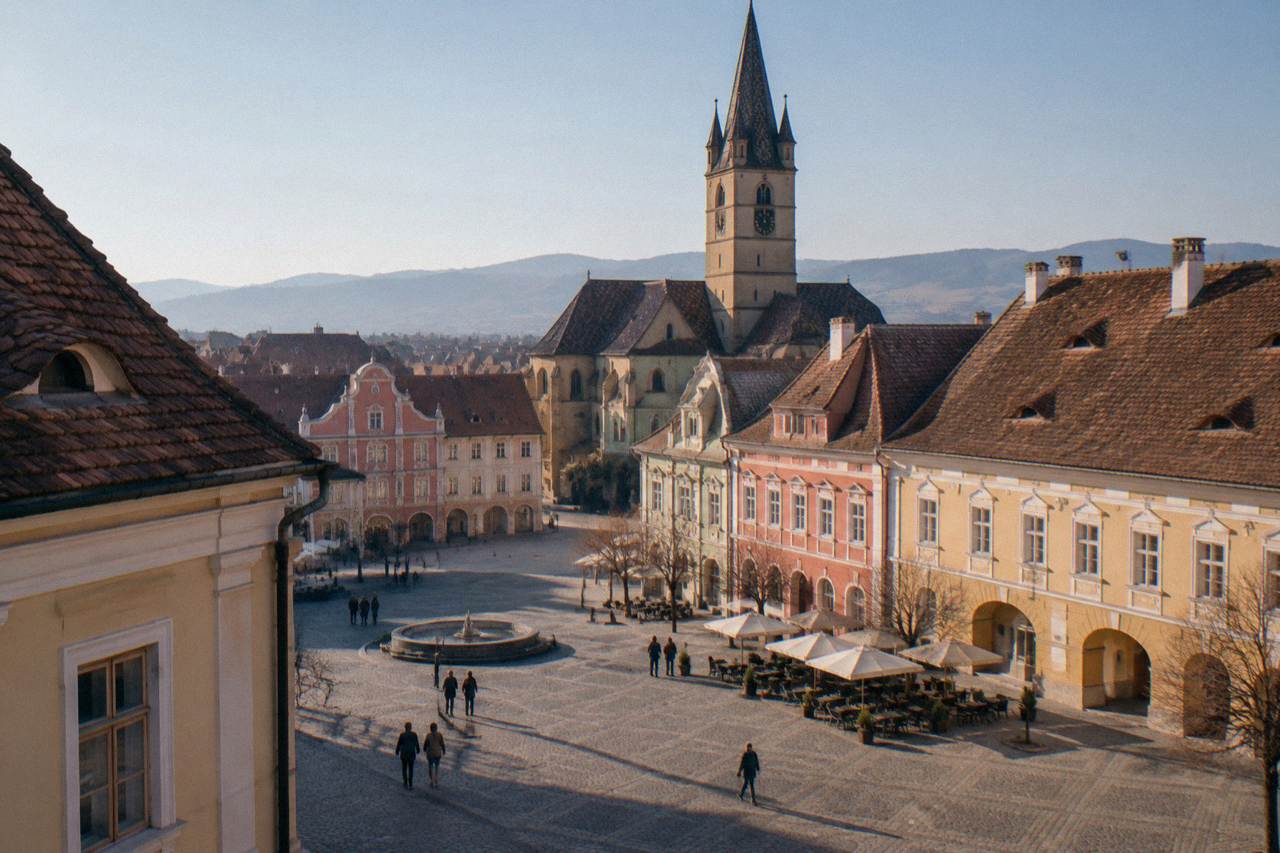
Transylvania is a large region, but the question of when to visit it is answered well from one place: Sibiu, the Saxon-founded city on the Cibin river that sits at the centre of the region's tourist geography. From Sibiu the Făgăraș mountains, the Transfăgărășan road, the ski resort of Păltiniș and the fortified-church villages of the Mărginimea Sibiului are all day trips. That means the best time of year for Transylvania is largely the best time for Sibiu plus the opening seasons of the mountain roads, and those windows do not fully overlap. This page sets out what the climate data, the event calendar and the 2026 road situation actually say.
What Is The Best Time Of Year To Visit Transylvania?
The best time of year to visit Transylvania is late May through June, or September through the first half of October, based around Sibiu. Tourism sources for the region name May, June, September and October as the best months, the mountain roads are open in that window, and the ERA5 reanalysis, 1991-2020, shows daytime highs of 19 to 25 C in those months. December has its own case, because the Sibiu Christmas Market runs 13 November 2026 to 3 January 2027 in Piața Mare.
The reasoning matters more than the verdict. Transylvania's sightseeing splits into two kinds: the old towns and museums of cities such as Sibiu, Sighișoara and Brașov, which are walkable year round, and the high mountain roads and alpine lakes, which are not. The Transfăgărășan's 2026 season opened on 12 June and, by rule, the alpine stretch can be closed on any day from 20 October. Anyone whose picture of Transylvania includes Bâlea Lake at 2,034 m has a season roughly from mid-June to mid-October, and no amount of good weather in April changes that.
For a city-first trip the net widens considerably. Sibiu's squares, the Bridge of Lies, the Lower Town and the ASTRA open-air museum can all be enjoyed in spring and autumn, and the Brukenthal National Museum's Palace gallery keeps Wednesday to Sunday hours of 10:00 to 18:00 through the colder months. The one thing to avoid, if museum time matters, is turning up on a Monday or Tuesday, when the main Brukenthal museums are closed.
What The Sibiu Climate Data Shows Month By Month
Sibiu has a temperate continental climate with a mean annual temperature of 8.9 C and mean annual rainfall of 662 mm, per the city's official figures, and the ERA5 reanalysis, 1991-2020, puts July and August daytime highs at 24.2 and 24.5 C against January lows of -5.7 C. Snow falls from November to March and peaks in January, and modelled sunshine runs from 5.6 hours a day in December to 12.8 in July.
Winter is real winter, not a damp shoulder season. The January mean high of 2.2 C and the December snowfall of 20.8 cm in the ERA5 reanalysis are what makes the Christmas market and the late-November ski opening at Păltiniș coherent: this is a region where snow on the rooftops of an old town is a reasonable expectation rather than luck. The trade-off is daylight. December offers about 8.7 hours of it, against 15.7 in June.
| Month | Mean high C | Mean low C | Sun h/day | Snowfall cm |
|---|---|---|---|---|
| Jan | 2.2 | -5.7 | 6.2 | 23.3 |
| Feb | 4.3 | -4.4 | 7.1 | 22.3 |
| Mar | 8.7 | -0.8 | 8.7 | 18.2 |
| Apr | 14.6 | 4.0 | 10.4 | 7.9 |
| May | 19.1 | 9.0 | 11.3 | 0.3 |
| Jun | 22.4 | 12.9 | 12.4 | 0.0 |
| Jul | 24.2 | 14.6 | 12.8 | 0.0 |
| Aug | 24.5 | 14.8 | 11.8 | 0.0 |
| Sep | 19.6 | 10.5 | 9.7 | 0.1 |
| Oct | 14.5 | 5.7 | 8.0 | 2.7 |
| Nov | 8.7 | 0.9 | 6.4 | 13.0 |
| Dec | 3.1 | -3.9 | 5.6 | 20.8 |
These are modelled grid-cell values from the ERA5 reanalysis, 1991-2020, not a weather-station record, and they describe the Sibiu area at roughly 430 m elevation. The city's own official page gives the mean annual rainfall as 662 mm, with June the wettest month at 113 mm and February the driest at 26.7 mm. In practical terms: summer rain comes as heavier June falls, and by September the totals drop while daytime highs stay near 20 C, which is exactly why the shoulder months are recommended.
For travellers basing themselves in the city, the season question is explored in more detail in Sibiu's best months explained, and the wider case for the trip is set out in whether Transylvania is worth visiting.
Is Summer The Best Time To Visit Transylvania And Sibiu?
Summer, from late June to August, is the season with the warmest weather and the full mountain-road access, with ERA5 highs of 24.2 to 24.5 C in July and August and 12-plus hours of sunshine a day, but it is also when the region's festival calendar takes over Sibiu's squares and when June carries the wettest month of the year at 113 mm in the city's official record.
The case for summer is access. The Transfăgărășan is fully open, Bâlea Lake is reachable by road as well as by cable car, and every hiking, biking and village tour in the region runs its full schedule. The daylight is generous, about 15 hours in late June. Against that stand two realities: June is the wettest month in the official city record, and July and August concentrate the festival traffic, with Artmania taking Piața Mare on 24 and 25 July 2026 and the Sibiu International Theatre Festival running 19 to 28 June. Whether those are a reason to come or a reason to steer around them is a matter of taste; what is not in dispute is that they fill the city.
The mountains deserve a summer caveat. Snow does not vanish from the high Făgăraș just because the road is open, and the same high-altitude weather that closes the road from 20 October can put winter conditions on it in September, as it did on 23 September 2026. A day tour with a local operator absorbs that risk better than a self-driven plan, because the operator tracks the road status. The Transfăgărășan and Bâlea Lake tour with Avrig is one such option, covering the road, the lake and a park at Avrig in a single guided day, and its live listing shows what is included. Check availability
When Do The Mountain Roads Open And Close?
The Transfăgărășan high section runs roughly mid-June to mid-October, reopening on 12 June 2026 with daily hours of 07:00 to 21:00 and becoming closable on any day from 20 October by rule, with fines of 10,000 to 30,000 lei for driving the closed stretch. The Transalpina reopened on 29 May 2026 and had its hours cut to 09:00 to 18:00 from 26 September 2026, reported by road-status sources.
Those two roads, plus the Păltiniș ski season that opens on 28 November 2026, define three different versions of Transylvania: an alpine one in summer, a citadel-and-museum one that runs all year, and a winter one built on snow and the Christmas market. A trip planned for April can be excellent in Sibiu, Sighișoara and Brașov and still miss Bâlea Lake entirely, and that is worth knowing before flights are booked. The live status question is covered in detail in whether the Transfăgărășan road is currently open.
Is Winter A Good Time To Visit Transylvania?
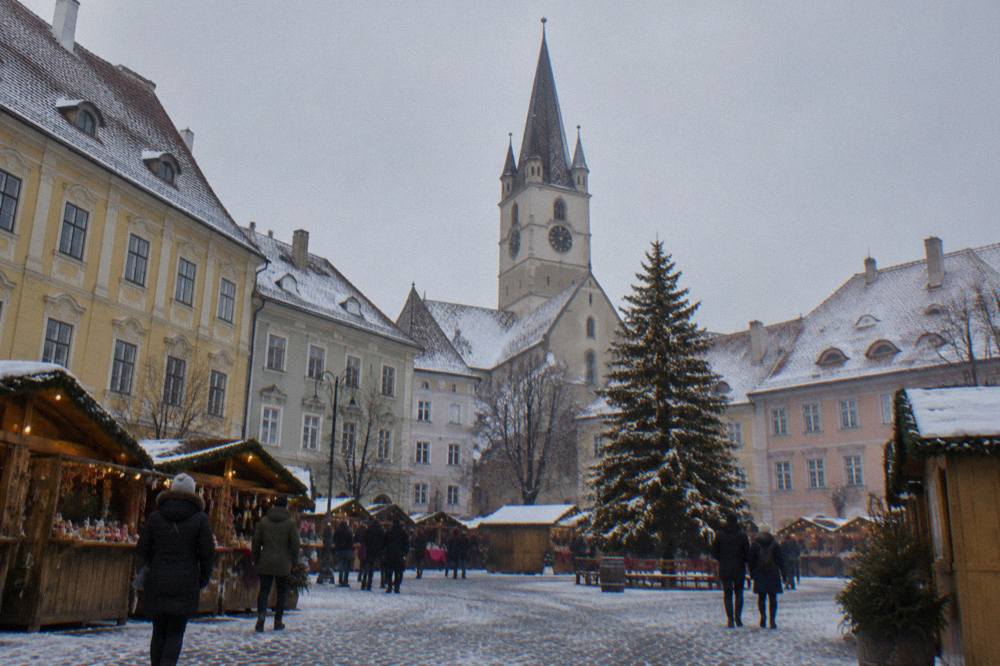
Winter is a strong time for the old-town version of Transylvania: the Sibiu Christmas Market runs 13 November 2026 to 3 January 2027 in Piața Mare with free entry and a 600 sqm ice rink, Păltiniș opens its ski season on 28 November 2026, and the ERA5 reanalysis shows December highs of 3.1 C with 20.8 cm of snow, but daylight drops to about 8.7 hours a day and the alpine roads are shut.
The winter case rests on three fixed points. The Christmas market fills Piața Mare for 52 days with 120 or more exhibitors, per the market's own site, and its reported Golden Ticket at 100 lei covers the wheel, carousel and mini-train. The ski season at Păltiniș begins on 28 November 2026, about 32 km and 40 minutes from the city, ahead of the 1 December National Day mini-break. And the cold is the reliable kind: snow on the ground from November through March, peaking in January at 23.3 cm in the modelled record.
What winter costs is the mountains above the tree line and some daylight. The Transfăgărășan's alpine stretch is closed until roughly June, and Bâlea is reachable by cable car rather than by road in that period, on the operator's own schedule, which should be confirmed before relying on it. Museums soften the short days: the Brukenthal Palace gallery is open Wednesday to Sunday, and the Evangelical Cathedral tower, at 10 RON for an adult, is the open viewpoint in the city centre, since the Council Tower has been closed for restoration since 19 January 2026. For the broader December picture, see whether December is a good month for Romania and the Sibiu Christmas Market in detail.
Which Sibiu Events Should Shape The Timing?
The Sibiu International Theatre Festival runs 19 to 28 June in its 2026 edition and 18 to 27 June in 2027, the Sibiu Jazz Festival ran 2 to 6 September 2026, and the ASTRA Film Festival ran 17 to 21 October 2026, so June and September bring festival energy to the city while October belongs to documentary film.
FITS is the event with real trip-planning weight. It is one of the largest theatre festivals in the region, it takes over squares and churches across the city for ten days, and its 2027 dates are already announced as 18 to 27 June with the theme "Lumină". Travellers who want the city at its liveliest should aim at that window; travellers who want Piața Mare to themselves should not. The smaller events, Artmania's free Piața Mare edition on 24 and 25 July and the jazz festival in early September, sit inside the recommended shoulder-and-summer months, so they cost nothing in weather terms.
October's ASTRA Film Festival lands just as the mountain season ends, which makes early October a genuine sweet spot: the Transfăgărășan was still open in late September 2026, the film programme was running, and the ERA5 mean high for the month is 14.5 C. Anyone combining the city with the Saxon villages or the Dracula-and-castles circuit in late October should watch both the road-status pages and the calendar.
How Do The Shoulder Seasons Compare For A Sibiu Base?
May, June, September and October are the months tourism sources for the region name as the best, and the data backs them: ERA5 mean highs of 19.1 C in May, 19.6 C in September and 14.5 C in October, snowfall effectively absent, and 8 to 12 hours of daily sunshine, with the mountain roads open from mid-June and again through late September.
| Window | Daytime high (ERA5) | Mountain roads | Signature draw |
|---|---|---|---|
| May | 19.1 C | Closed to mid-June | Blossom, quiet squares, village walks |
| June | 22.4 C | Open from 12 June 2026 | FITS festival, full day-trip access |
| September | 19.6 C | Open, closures possible late month | Jazz festival, film festival start |
| October | 14.5 C | Closable any day from 20 Oct | Autumn colour, ASTRA Film |
| December | 3.1 C | Closed | Christmas market, Păltiniș skiing |
May is the quietest of the recommended months and the one that misses the high roads, which makes it the village-and-citadel month: Rășinari about 18 minutes away by road, Cisnădie about 14, and the fortified churches of the Mărginimea all in easy reach. September does everything May does and adds Bâlea Lake. The one-day, two-UNESCO-sites circuit to Sighișoara and Biertan, about 102 minutes and 96 km to Sighișoara from Piața Mare, works in every one of these windows, and it is the single best day trip for a first visit, which is why this site features it. Check availability
One autumn caveat for anyone driving: the A1 motorway towards Bucharest is unfinished, and the Sibiu to Boița section is closed from 5 October to 19 December 2026 with traffic diverted onto DN7. It does not affect the day-trip region around Sibiu, but it matters for any itinerary that continues east or south by car. More on the city's own timing logic, including how many days to allow, is in how many days you need in Sibiu.
Common Questions About The Best Time To Visit Transylvania
What Is The Best Time Of Year To Visit Transylvania?
Late May to June and September to early October, based around Sibiu. Tourism sources for the region name May, June, September and October as the best months, and the Transfăgărășan runs roughly mid-June to mid-October, reopening 12 June 2026 and becoming closable from 20 October by rule.
Is Transylvania Good In Winter?
The old towns are. The Sibiu Christmas Market runs 13 November 2026 to 3 January 2027 in Piața Mare, Păltiniș opens its ski season on 28 November 2026, and snow falls from November to March in the climate record. The alpine roads are closed and daylight drops to about 8.7 hours a day in December.
When Does The Transfăgărășan Open And Close?
The 2026 season opened on 12 June with daily hours of 07:00 to 21:00 on the high stretch, and by rule the road can be closed on any day from 20 October. Fines of 10,000 to 30,000 lei apply for driving the closed section. Check the live road status before planning a drive.
What Is The Rainiest Month In Sibiu?
June, at 113 mm, per the city's official figures, which give mean annual rainfall of 662 mm with February the driest month at 26.7 mm. Summer rain in Transylvania tends to fall in heavier bursts rather than all-day drizzle.
Does It Snow In Sibiu?
Yes, from November to March, peaking in January at 23.3 cm in the ERA5 reanalysis, 1991-2020. January mean highs are 2.2 C and mean lows -5.7 C, so packed winter clothing is the norm in deep winter.
When Is The Sibiu Christmas Market?
13 November 2026 to 3 January 2027, in Piața Mare, with free entry, a 600 sqm ice rink and 120 or more exhibitors, per the market's own site. A reported Golden Ticket at 100 lei covers the wheel, carousel and mini-train.
The months you choose decide which Transylvania you get: the alpine one of June to September, the golden one of early October, or the snowy market square of December. Sibiu's own pages on this site, starting with Sibiu Travel Guide, carry the detail for each of those windows, including the museum days to avoid and the roads to check the night before.
