Does It Snow In Sibiu, Romania?
Yes, it snows in Sibiu, Transylvania: snow falls from November to March, the old town turns white most winters, and Păltiniș opens its ski season in late November.
Sibiu, the Saxon-founded city on the Cibin river in Transylvania, Romania, lies inland at 415 to 431 m of elevation, with the Carpathian foothills rising to its south. That geography answers the weather question before any table does: this is a temperate continental climate, the same one the city's official page summarises as cold winters, warm summers and a mean annual temperature of 8.9 C. Snow here is not a rarity or a surprise. It is a scheduled feature of the year, and this page lays out exactly what the records say about when it falls, how much settles, and what it does to a visit. The Sibiu Travel Guide winter coverage collects the rest.
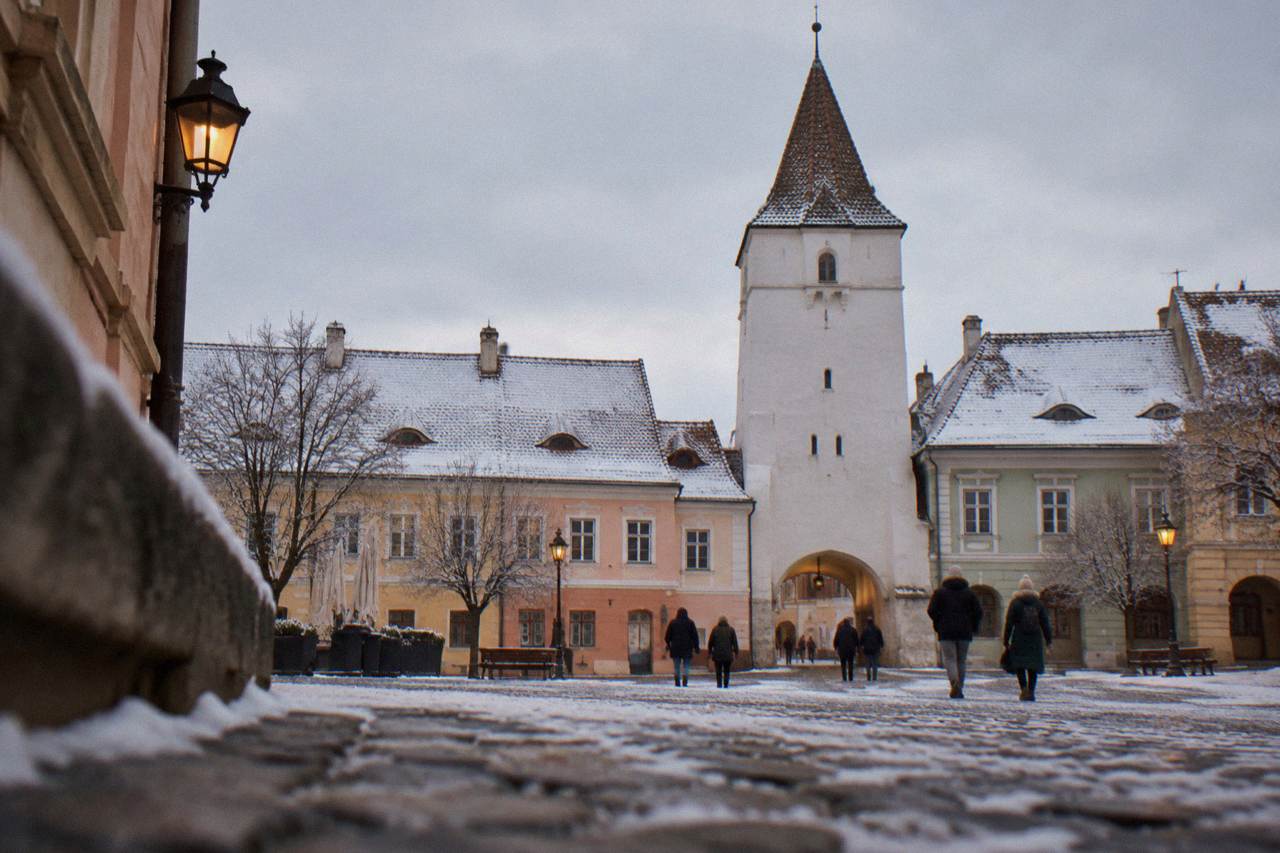
Does It Snow In Sibiu, Romania?
Yes, it snows in Sibiu, Romania, reliably every winter: the ERA5 reanalysis for Sibiu, 1991 to 2020, shows snowfall in every month from November to March, with a modelled 108.5 cm across the year and January the snowiest single month at 23.3 cm. Snow is effectively absent from June to August, and December, at 20.8 cm, is nearly as white as January.
The city's own climate summary agrees on the shape: cold winters, warm summers, 662 mm of mean annual rainfall per the official page, with February named the driest month and June the wettest. Rain and snow are different questions, though. A month can be dry overall and still deliver snow, because a small number of cold outbreaks does the work. February in Sibiu is the example: the driest month by the city's rainfall figure, yet the ERA5 reanalysis still assigns it 22.3 cm of snowfall.
One honest caveat belongs here. The ERA5 reanalysis is a modelled grid cell near Sibiu, not a weather-station record, and it is used for shape rather than totals. Any single winter can run well above or below these normals. What the thirty-year average supports is the plain claim that snow in Sibiu is normal, recurring and concentrated in a five-month window.
When Does Snow Fall In Sibiu?
Snow falls in Sibiu from November to March, with the depth of it landing between December and February: the ERA5 reanalysis, 1991 to 2020, gives November 13.0 cm, December 20.8 cm, January 23.3 cm, February 22.3 cm and March 18.2 cm, while October averages 2.7 cm and the summer months zero. January is the month with the most snow on the modelled record.
Month by month, the pattern is a slow ramp and a slow fade rather than one deep freeze. November usually delivers the first settling snow of the season; daytime highs still average 8.7 C, so much of it melts again in the town. By December the mean high drops to 3.1 C and the mean low to -3.9 C, which lets snow lie. January's means are 2.2 C by day and -5.7 C by night: that is the month when the old town's roofs, the "eyes of Sibiu" dormers and the squares hold their white cover longest.
| Month | Mean High (C) | Mean Low (C) | Snowfall (cm) | Sunshine (h/day) |
|---|---|---|---|---|
| Nov | 8.7 | 0.9 | 13.0 | 6.4 |
| Dec | 3.1 | -3.9 | 20.8 | 5.6 |
| Jan | 2.2 | -5.7 | 23.3 | 6.2 |
| Feb | 4.3 | -4.4 | 22.3 | 7.1 |
| Mar | 8.7 | -0.8 | 18.2 | 8.7 |
All five rows are ERA5 reanalysis, 1991 to 2020 values, and the table shows why the question is usually answered "yes, and often". Sunshine is the trade-off: December's modelled 5.6 hours a day is the low point of the year, climbing back above eight hours by March.
Does Snow Settle In Sibiu's Old Town?
Snow does settle in Sibiu's old town, and it lasts: December through February the mean daily low stays below freezing (-3.9, -5.7 and -4.4 C respectively, ERA5 reanalysis, 1991 to 2020), so once snow arrives it tends to hold on the squares, roofs and cobbled lanes of the Upper Town and Lower Town rather than melting off the same day.
Piața Mare, Piața Mică and the Stairs Passage are all free, open-air ground, and in a normal January they read as a postcard: white square, coloured facades, steam from the market stalls. The December edition of that scene is the Sibiu Christmas Market, which in 2026 runs from 13 November to 3 January 2027 in Piața Mare, with free entry, a 600 sqm ice rink and roughly a third of the exhibitors new this edition, per the market's own announcement. The market does not depend on snow falling, but snow is statistically on its side from December onward. The Christmas market question gets its own full answer elsewhere.
Two practical notes for a snowy old town. First, the Council Tower has been closed to visitors since 19 January 2026 for a restoration of about 24 months, so the classic view over a white city currently comes from the Evangelical Cathedral tower instead, which charges 10 RON for an adult ticket. Second, a white city is a walking city: bring footwear that grips, because the cobbles and the Stairs Passage get polished by foot traffic.
What Is Winter In Sibiu Like Beyond The Snow?
Winter in Sibiu is cold, quiet and short on daylight: December averages 3.1 C by day and -3.9 C by night with 5.6 modelled hours of sunshine, January is slightly colder at -5.7 C overnight, and daylight itself shrinks to between 8.7 and 9.1 hours a day in December and January, per the ERA5 reanalysis, 1991 to 2020. Snow and grey go together more often than snow and blue sky.
The compensation is that the city is built for it. Museums carry the indoor load, and Sibiu has depth there: the Brukenthal National Museum alone runs the Palace art gallery at 50 RON, the History Museum in Casa Altemberger at 36 RON, the Natural History Museum at 20 RON and the Pharmacy Museum at 16 RON, with a 48-hour combined ticket at 120 RON, all per the museum's own price page. Two planning traps matter in winter: the main Brukenthal museums are closed Monday and Tuesday, and the Contemporary Art Museum is now open weekdays only. The Hunting Museum is closed for an indefinite period.
| Winter fact | Figure | Source basis |
|---|---|---|
| Mean annual temperature | 8.9 C | Official city climate page |
| Mean annual rainfall | 662 mm | Official city climate page |
| Jan mean low | -5.7 C | ERA5 reanalysis, 1991-2020 |
| Modelled annual snowfall | 108.5 cm | ERA5 reanalysis, 1991-2020 |
| Clocks go back | Sunday 25 October 2026 | Europe/Bucharest rule |
If the question behind the question is "is winter a good time to come", the honest answer is that it depends on what the trip is for. Tourism sources describe May, June, September and October as the best months for the city itself, but the Christmas market window from mid-November turns Piața Mare into the reason to visit, snow or no snow. The winter itinerary sequences the whole cold season.
Can You Ski Near Sibiu When It Snows?
You can ski near Sibiu at Păltiniș, a mountain resort about 32 km and roughly 40 minutes by road from the city, whose Păltiniș Arena ski season is announced to open on 28 November 2026 and aims to run into March 2027, with the same number of slopes as last season and lift prices rising by at most about 5 percent, per the resort's announcement.
That is the confirmed skeleton. The lifts are shut until the opening date, there is no snow guarantee, and ski pass and rental prices remain unavailable, so confirm current prices at the resort before committing a day. What the road distance does promise is that Păltiniș is a genuine half-day or day trip from Sibiu rather than an expedition: about 40 minutes of driving each way.
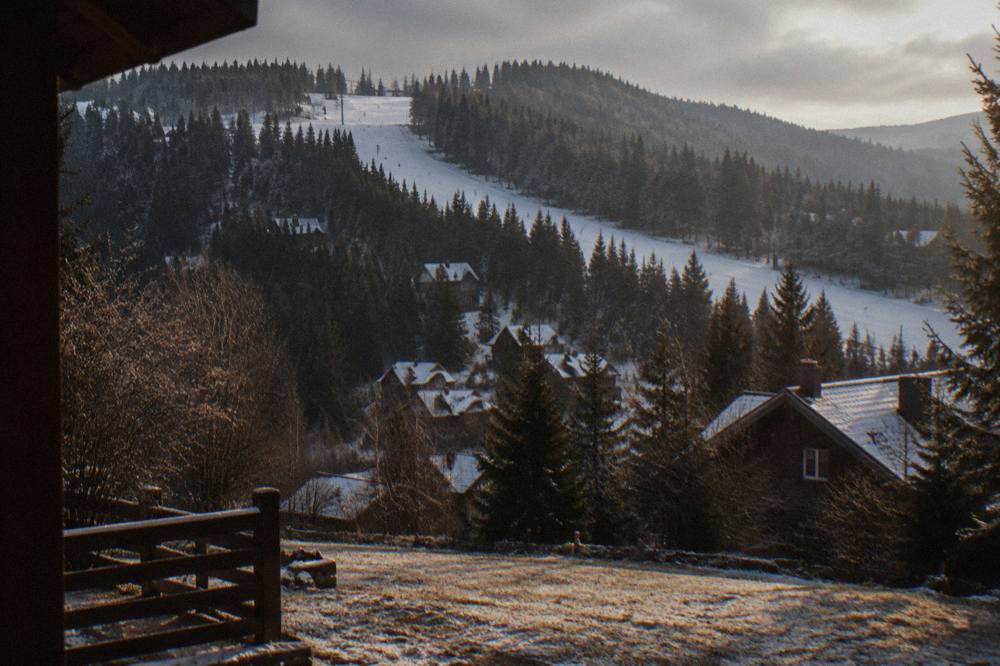
The snow physics also favour the hill over the valley. Sibiu town sits at 415 to 431 m; Păltiniș sits far above it on the Cindrel slopes, so the same precipitation event that leaves slush in Piața Mare usually leaves snow on the ski slopes. A city base with a ski day attached is a standard winter shape here, and the Sibiu in winter guide covers how to build it.
Does It Snow At Bâlea Lake And On The Transfăgărășan?
It snows heavily and early at Bâlea Lake, at 2,034 m on the Transfăgărășan, and that snow is exactly why the road closes: the high section can be shut on any day from 20 October by rule, the 2026 season had run daily 07:00 to 21:00 since its 12 June reopening, and driving the closed section carries fines of 10,000 to 30,000 lei, so the mountain is a summer-to-mid-autumn destination, not a winter one.
In practice, the lake is a snowfield from late autumn through spring, and winter access is by the Bâlea cable car, which runs on its own schedule outside the road season. No cable car price can be quoted here; check the operator's live listing. For anyone planning the mountain around the snow line rather than the calendar, the Transfăgărășan road status question is the one to read, and the broader answer on how many days you need in Sibiu explains why the mountain deserves its own day rather than a rushed detour.
The season matters for hiking too. The Carpathian Heights guided hike to Bâlea Cascada and Bâlea Lake, which this site features, only works when the trails are clear, so it belongs to the June-to-September window rather than the snow months. Check availability if the plan is the mountain in green season.
What Should You Pack For Snowy Sibiu?
Pack for temperatures between roughly -6 and 3 C in the core winter months: the ERA5 reanalysis, 1991 to 2020, puts January means at 2.2 C by day and -5.7 C by night and December at 3.1 C and -3.9 C, so insulated layers, a real winter coat, a hat and gloves are warranted from late November through February, plus grippy footwear for the cobbles.
Cold snaps can push below those means, and the wind across Piața Mare has nothing to slow it, so the layering advice is not padding. Thermal base layers earn their place in January. Sunglasses are less silly than they sound on a low winter sun on snow. And because the reward for cold evenings is the market and the food, the winter dishes do the warming from the inside: sarmale, ciorbă, mici and papanași are the standard Transylvanian cold-weather list, and no venue needs naming for that to be true.
A last practical flag for anyone booking winter accommodation: since 1 January 2026 Sibiu hotels collect a 2 percent tax on the accommodation value, so the price you settle at check-out may sit slightly above the headline rate. Confirm the total when booking.
Common Questions About Snow In Sibiu
Does it snow in Sibiu, Romania?
Yes. Snow falls somewhere between November and March almost every winter, and the ERA5 reanalysis for Sibiu, 1991 to 2020, shows snowfall in each of those five months, peaking in January at 23.3 cm on the modelled record.
What is the snowiest month in Sibiu?
January, on the modelled record: 23.3 cm of snowfall in the ERA5 reanalysis, 1991 to 2020, ahead of February at 22.3 cm and December at 20.8 cm.
Does it snow in Sibiu at Christmas?
Statistically it is likely: December averages 20.8 cm of snowfall with a mean low of -3.9 C, and the Christmas market runs in Piața Mare from 13 November 2026 to 3 January 2027. No single Christmas is guaranteed, but the odds and the cold both point the same way.
Is there skiing near Sibiu?
Yes, at Păltiniș, about 32 km and roughly 40 minutes by road from the city. The Păltiniș Arena ski season opens on 28 November 2026 and aims to run to March 2027; check the resort for current lift and rental prices.
Does it snow in Sibiu in October or April?
Rarely and lightly: the ERA5 reanalysis, 1991 to 2020, gives October 2.7 cm and April 7.9 cm, with May down to 0.3 cm. Real snow that settles and stays is a November-to-March story.
Snow in Sibiu is close to a certainty somewhere in the five months from November to March, January is when it piles deepest, and the whole cold season is built around it rather than surprised by it.
