Stairs Passage: The Medieval Link Between Upper And Lower Town
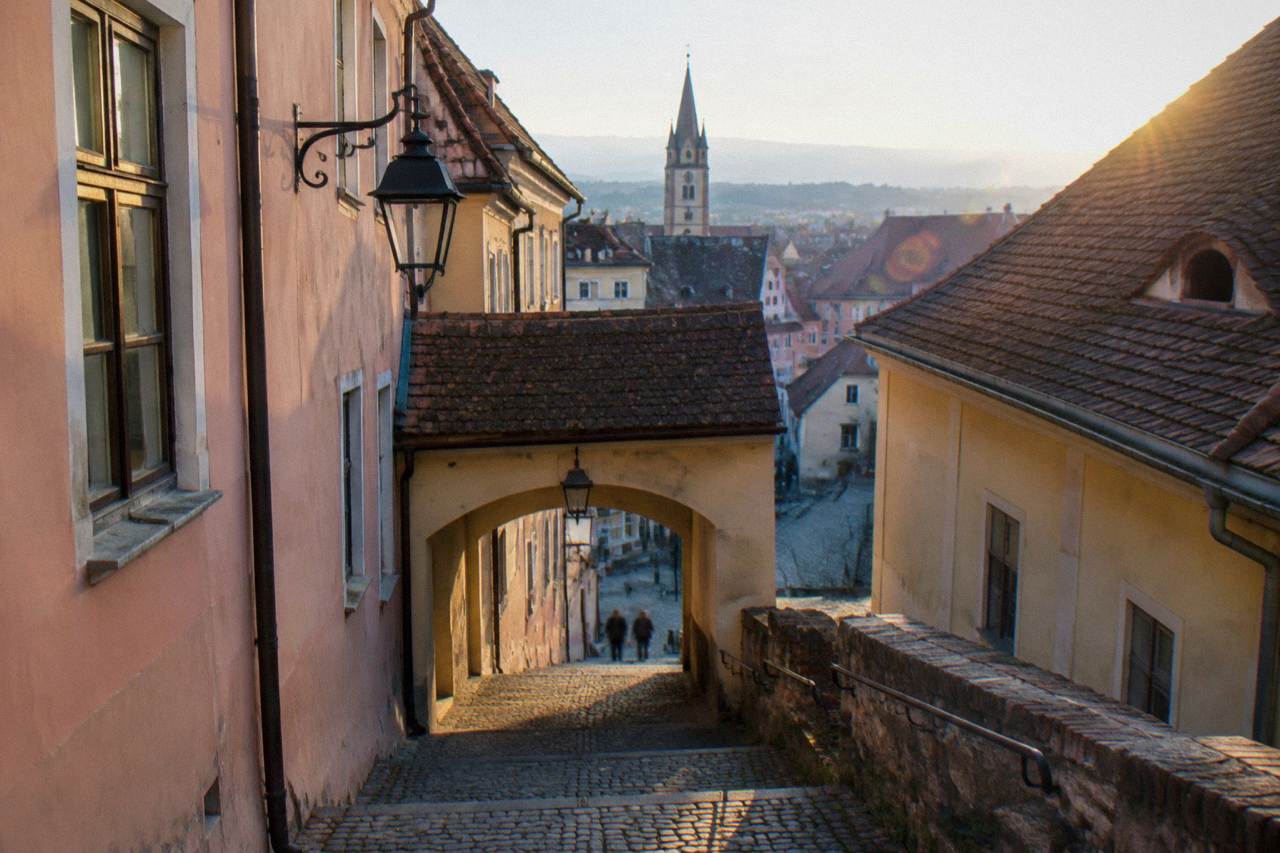
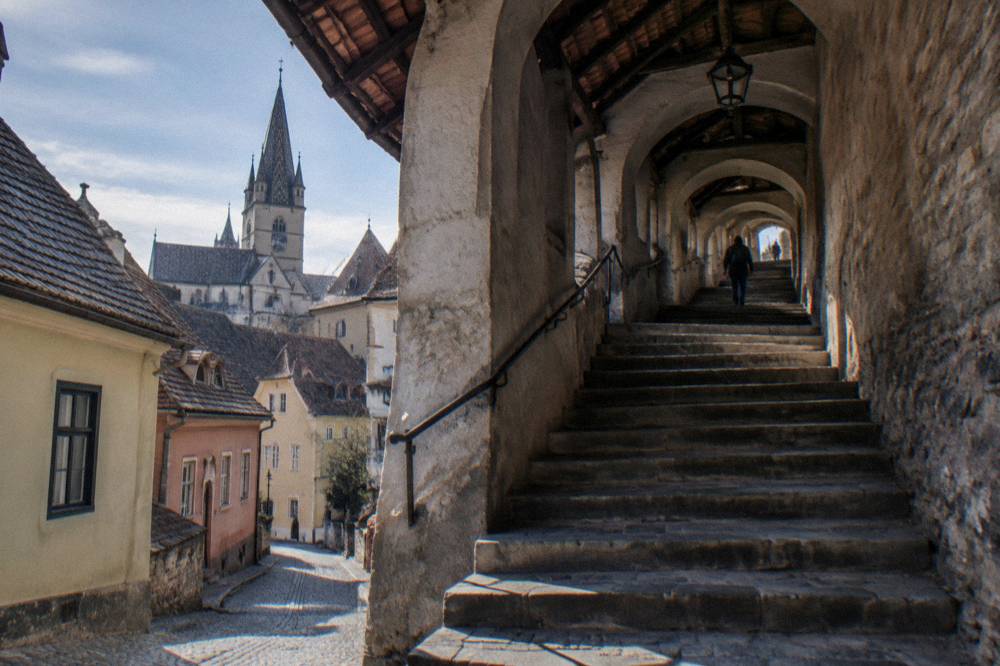
The Stairs Passage is the stepped street that carries you from the Lower Town of Sibiu up to Piața Mică and the Upper Town, free to walk at any hour and packed with photo stops along the way.
Short answer
The Stairs Passage (Pasajul Scărilor) in Sibiu is a free, open-air staircase street linking the Lower Town to Piața Mică in the Upper Town. It has no tickets and no opening hours, and it is the classic walking route between the two levels of the medieval Saxon city.
The Stairs Passage, known locally as Pasajul Scărilor, is the covered stone staircase that climbs from the Lower Town of Sibiu to Piața Mică in the heart of the Upper Town. Sibiu is an inland Saxon-founded city in Transylvania, central Romania, first documented in 1191 as Cibinium, and its old centre splits into two levels: the plateau of the Upper Town with its grand squares, and the Lower Town by the Cibin river, once the quarter of craftsmen and traders. The passage is the link between them, a steep pedestrian lane of steps threaded between old houses, and it costs nothing to walk at any hour of the day. This guide from the Sibiu Travel Guide desk covers what the passage is, what waits at either end, and how to fit it into a visit.
What Is The Stairs Passage In Sibiu?
The Stairs Passage is a stepped public lane in Sibiu that connects the Lower Town to Piața Mică in the Upper Town, forming part of the fortifications that once ringed the Saxon settlement, a city first documented in 1191. It is an open-air pedestrian route with no ticket, no gate and no opening hours, open around the clock. It is an open-air pedestrian route with no ticket, no gate and no opening hours, and its steps are the reason the Upper Town plateau and the lower streets feel like two separate worlds. The passage, together with the old walls and towers around it, belongs to the layer of fortifications that once ringed the Saxon settlement. Walking it from bottom to top takes you between the two historic levels of a city that first appears in documents in 1191.
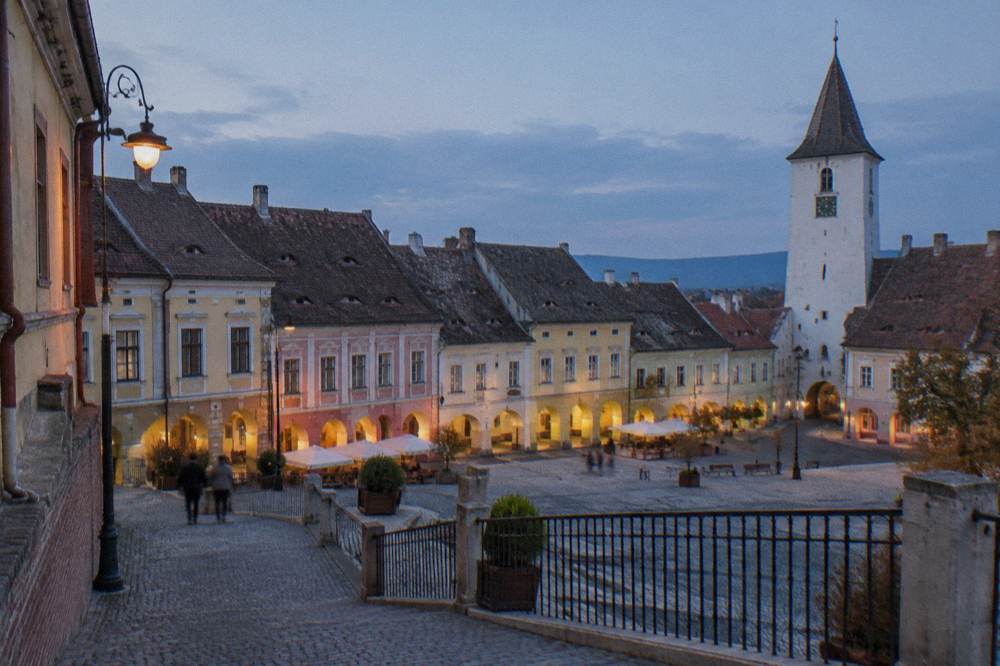
The passage sits within a short walk of the three great squares. At the top you arrive near Piața Mică, the Little Square, with the Bridge of Lies at its far end and the closed Council Tower framing the passage into Piața Mare beyond. At the bottom, the streets of the Lower Town fan out toward the Cibin river, a district of smaller houses and quieter lanes that was historically the tradesmen's quarter. The vertical jump between the two is exactly what makes Sibiu's old centre so compact yet layered: the whole walk from bottom step to Piața Mare can be done on foot in a few minutes.
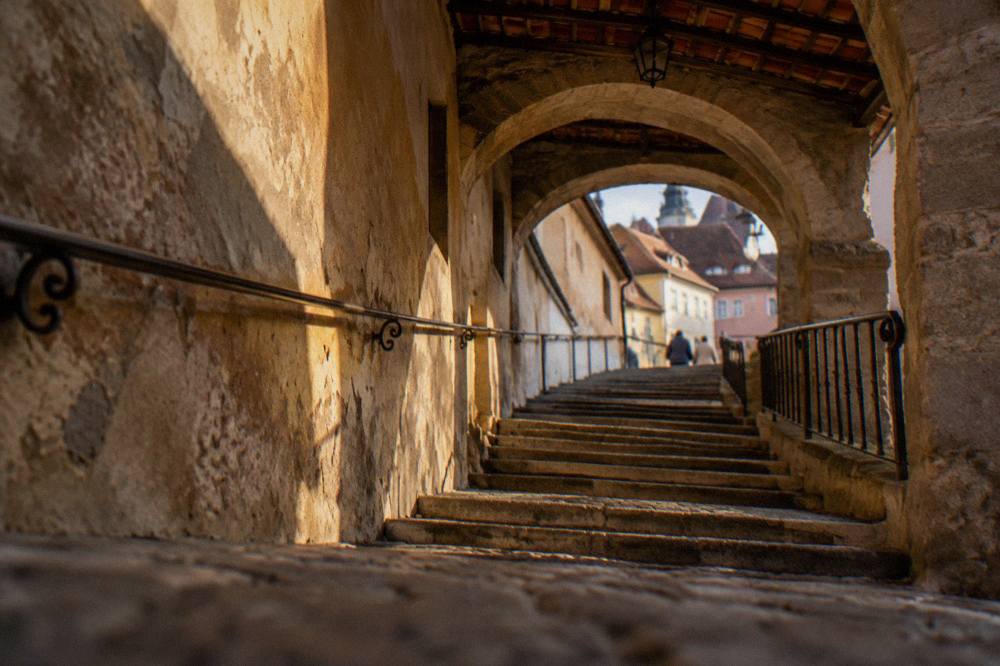
The passage is also one of the free sights that define a visit here, alongside Piața Mare, Piața Mică, Piața Huet and the surviving city walls and towers. None of these has a ticket or a schedule. The Stairs Passage, the Potters' Tower and the Arquebusiers' Tower that stand near it are public space, open around the clock, which makes them the connective tissue of any walking route through the old town rather than sights you queue for. For orientation before you arrive, the site's Sibiu map guide lays out how the squares, the passage and the walls fit together.
How Do You Walk The Stairs Passage In Sibiu?
Walk it bottom to top, starting from the Lower Town streets below the wall and climbing the steps until you emerge beside the towers at the edge of Piața Mică, a route of a few minutes on foot that needs no ticket and no guide. The steps are continuous, stepped and covered in stretches, so the climb is sheltered in parts but never flat. Comfortable shoes matter more than timing: there is no lift or ramp on this route, and the Upper Town is simply not step-free by way of the passage. Anyone who prefers a level approach can reach the Upper Town squares by road instead.
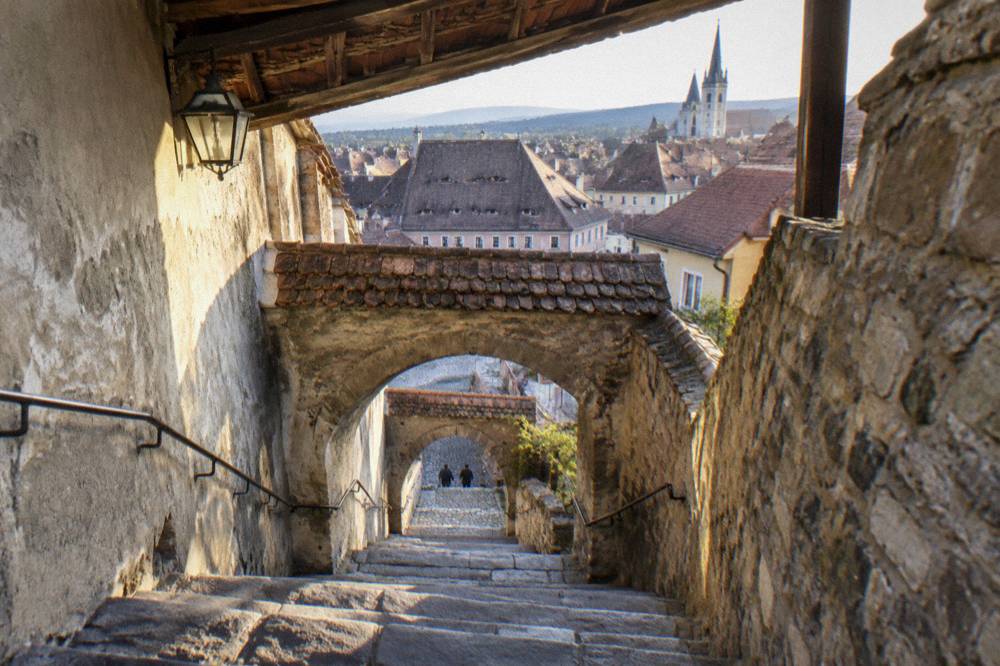
The direction you choose changes the experience. Going up, the houses frame the towers above you and the light narrows between walls, which is why photographers tend to shoot upward from the lower steps in the morning and downward from the top in the late afternoon. Going down, you get the full sweep of the Lower Town rooftops below, with the Cibin valley opening out beyond. Either way, the passage is short enough to walk more than once in a day, and quiet enough at off-peak hours that a second pass costs nothing but the climb.
A natural loop pairs the passage with the free squares. Start in Piața Mică, cross the Bridge of Lies, walk through to Piața Mare, then double back and descend the passage into the Lower Town, returning by the walls and towers. The whole circuit is under two kilometres on foot. Guided options exist for travellers who want the route explained: the Sibiu walking tour guide on this site covers what a guided old-town loop includes.
What Sights Sit At Either End Of The Stairs Passage In Sibiu?
At the top of the passage sit Piața Mică, the Bridge of Lies, the Council Tower (closed for restoration since 19 January 2026) and the path to Piața Mare; at the bottom spread the Lower Town lanes, the surviving city towers and the streets toward the Cibin river. The passage is therefore less a single sight than a hinge: every walk through the old town passes through its gravity. The Pharmacy History Museum in Piața Mică, at 16 RON for an adult ticket per the Brukenthal National Museum's price page, is the nearest paid sight to the top of the steps.
The Upper Town end rewards the climb. Piața Mică itself is a free public square lined with coloured houses, and from there the Bridge of Lies, described as the first cast-iron bridge in Romania and reportedly built in 1859, crosses toward the Council Tower. That tower has been closed to visitors since 19 January 2026 for a restoration planned at about 24 months, with completion reported around January 2028, so the open viewpoint in the old town is now the tower of the Evangelical Cathedral, which costs 10 RON for an adult ticket. The cathedral stands a short walk further, in Piața Huet.
| Sight | Position relative to the passage | Access |
|---|---|---|
| Piața Mică | At the top of the steps | Free, no hours |
| Bridge of Lies | One minute from the top, over Piața Mică | Free, no hours |
| Council Tower | Between Piața Mică and Piața Mare | Closed since 19 January 2026, restoration planned to about January 2028 |
| Pharmacy History Museum | Piața Mică 26 | 16 RON adult, per the Brukenthal price page; closed Monday and Tuesday |
| Evangelical Cathedral tower | About 5 minutes beyond Piața Huet | 10 RON adult, 5 RON reduced |
| Potters' and Arquebusiers' towers | Along the walls near the passage | Free, open-air |
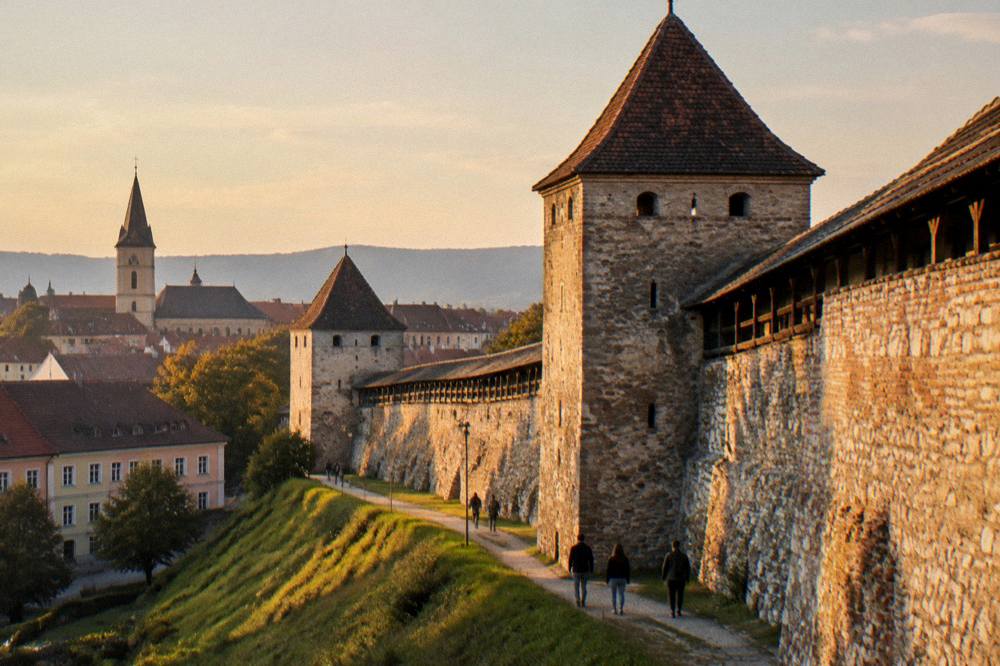
The Lower Town end is quieter but no less photogenic. The lanes below the passage belong to the historic craftsmen's quarter, and the walls and towers that once defended the upper plateau still stand along the line the steps follow. For travellers building a longer stay, the Upper Town and Lower Town each have their own character, and the site's where to stay in Sibiu guide explains the trade-offs between the two levels, from the 0.1 kilometres that separate the Upper Town core from Piața Mare to the 0.4 kilometres of the Lower Town.
Is The Stairs Passage In Sibiu Free To Visit?
Yes, the Stairs Passage is free to visit, with no ticket, no gate and no opening hours, because it is an ordinary public street made of steps. Like Piața Mare, Piața Mică, Piața Huet and the old city walls, it is open-air public space in the city's tourism listings; no city card or tourist pass covering Sibiu's sights was found. Like Piața Mare, Piața Mică, Piața Huet, the Bridge of Lies and the old city walls, it is open-air public space in the strict sense of the city's own tourism listings. Nothing about the passage itself costs money, and no city card or tourist pass covering Sibiu's sights was found, so budget planning should focus on the paid museums and towers around it rather than on the route between them.
The money question in Sibiu is really about what surrounds the free core. The Brukenthal National Museum operates several sites with separate tickets, all listed on the museum's own price page, and the main museums are closed Monday and Tuesday. The Hunting Museum is closed for an indefinite period, and the Contemporary Art Museum is open Monday to Friday only. For a visitor based near the passage, the Pharmacy History Museum in Piața Mică is the closest paid branch at 16 RON, and the 48-hour combined ticket at 120 RON covers all the open Brukenthal sites.
| Brukenthal site | Adult ticket | Notes |
|---|---|---|
| Palace, Piața Mare 4-5 | 50 RON | Closed Monday and Tuesday |
| History Museum, Casa Altemberger | 36 RON | Closed Monday and Tuesday |
| Natural History Museum | 20 RON | Closed Monday and Tuesday |
| Pharmacy History Museum, Piața Mică 26 | 16 RON | Nearest paid site to the passage |
| Contemporary Art Museum | 15 RON | Monday to Friday only |
| Hunting Museum | 12 RON | Closed indefinitely |
| 48-hour combined ticket | 120 RON | Covers the open sites |
Confirm current prices on the museum's own site before you go, since the museum has spoken in the press about possible adjustments. Reduced tickets run at half for pensioners and a quarter for pupils and students. A guided Upper Town walk is the simplest paid add-on to the free route, and the site's things to do in Sibiu overview places the passage among the free sights that anchor a first visit.
Can You Avoid The Stairs On The Way To Upper Town Sibiu?
Yes, the Upper Town can be reached by road without using the steps, because the Stairs Passage is a pedestrian shortcut between two levels rather than the only route, though no step-free, lift or ramp provision along the passage itself was found in any source this desk consulted. The streets around the plateau allow a gentler approach from the side, and taxis and ride-hailing services operate in Sibiu for travellers who prefer not to climb at all. Visitors with mobility needs should contact their accommodation and each venue they plan to enter, since accessibility details for the museums, the cathedral and the passage were not found in any source this desk consulted.
The geometry is the honest constraint. The Upper Town sits on a plateau at about 431 metres and the Lower Town at about 415 metres per the city's own presentation, and the passage exists precisely because the two levels were joined by steps rather than by a gentle road. What the sources do confirm is that the squares at the top, Piața Mare, Piața Mică and Piața Huet, are level with one another once you are up there, so the climbing is concentrated on the approaches. The site's Sibiu accessibility guide gathers what is and is not known about step-free access across the city.
For families, the free squares at the top make the climb worthwhile even with children in tow. There is no child price for the passage itself because there is no price at all, and the Brukenthal reductions apply to pupils and students rather than to a separate child band. Further afield, Dumbrava forest and the open-air ASTRA Museum are the family stops the sources support, with adult tickets at 50 RON, pensioners 20 RON and pupils or students 10 RON per the museum's own ticket page; its autumn 2026 schedule ran to 26 October with last entry about 16:00, and the winter schedule had not been announced, so check before you go.
What To Do Near The Stairs Passage In Sibiu In Half A Day?
A half day built around the passage covers Piața Mică and the Bridge of Lies, the Pharmacy History Museum, the walk through to Piața Mare and the Brukenthal Palace, the Evangelical Cathedral tower viewpoint for 10 RON, and the descent back through the walls into the Lower Town, all within a walk of under two kilometres. That loop captures the free squares, one or two paid museums and the one open tower viewpoint, in an order that avoids backtracking. The only fixed constraint is the Monday and Tuesday closure of the main Brukenthal museums, which shapes which day the walk lands on.
Start at the bottom of the passage in mid-morning, climb to Piața Mică, and use the square as a base. The Pharmacy History Museum on the square is a short visit at 16 RON. Cross to Piața Mare and the Brukenthal National Museum palace if it is Wednesday to Sunday, then continue to Piața Huet and the cathedral tower, the open viewpoint since the Council Tower closed for its restoration. Finish by descending the passage again into the Lower Town and walking the line of the walls while the afternoon light is on the rooftops.
| Stop | Time to allow | Ticket |
|---|---|---|
| Stairs Passage, both directions | 15 minutes | Free |
| Piața Mică and the Bridge of Lies | 30 minutes | Free |
| Pharmacy History Museum | 30 to 45 minutes | 16 RON adult |
| Piața Mare and Brukenthal Palace | 1 to 2 hours | 50 RON adult, palace only |
| Piața Huet and the cathedral tower | 45 minutes | Tower 10 RON adult |
| Lower Town lanes and the walls | 45 minutes | Free |
Two practical notes shape the day. First, the contemporary art branch of Brukenthal is closed at weekends, so a Saturday or Sunday half day should lean on the palace and the free squares instead. Second, food stops are easy to find around the squares without any named recommendation from this desk; dishes to look for by name rather than by venue include Sibiu salad, papanași, ciorbă, mici and sarmale, and the what to eat in Sibiu guide covers them. A gastronomy walk is the other way to pair the route with local food.
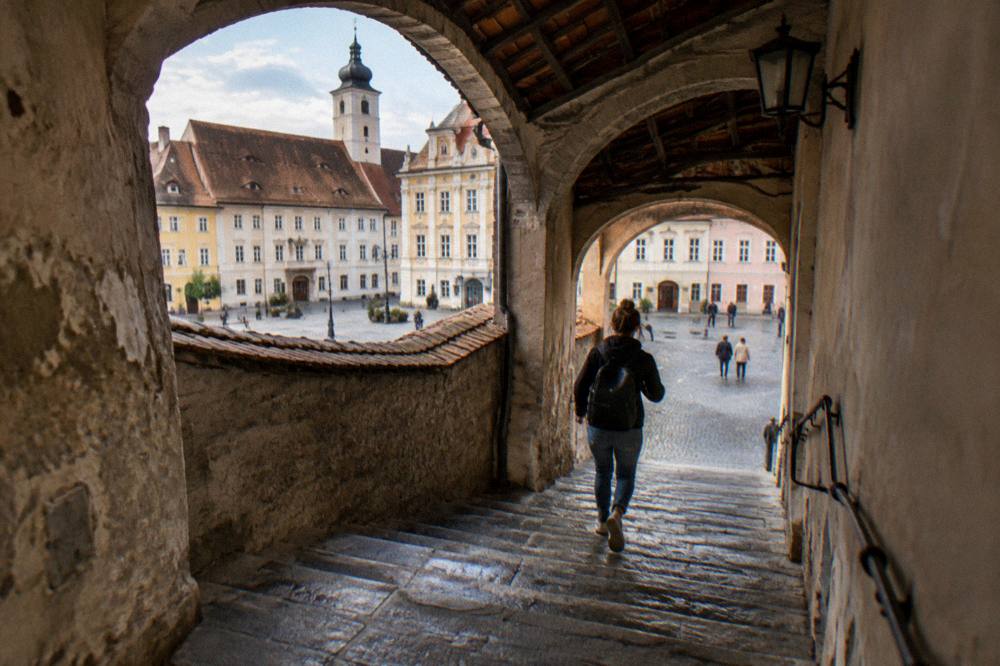
When Is The Best Time To Walk The Stairs Passage In Sibiu?
Late spring and early autumn are the comfortable months to walk the Stairs Passage, with May and June and September the months tourism sources name for Sibiu, because the ERA5 reanalysis, 1991-2020, shows July and August mean daily highs around 24 C while January lows sit near -6 C. The passage itself is walkable year round, since it is a public street with no season, but ice and snow change the footing between November and March, when the reanalysis shows snowfall in every month of that stretch, peaking at 23.3 cm in January. Mid-morning and late afternoon are the light windows photographers prefer.
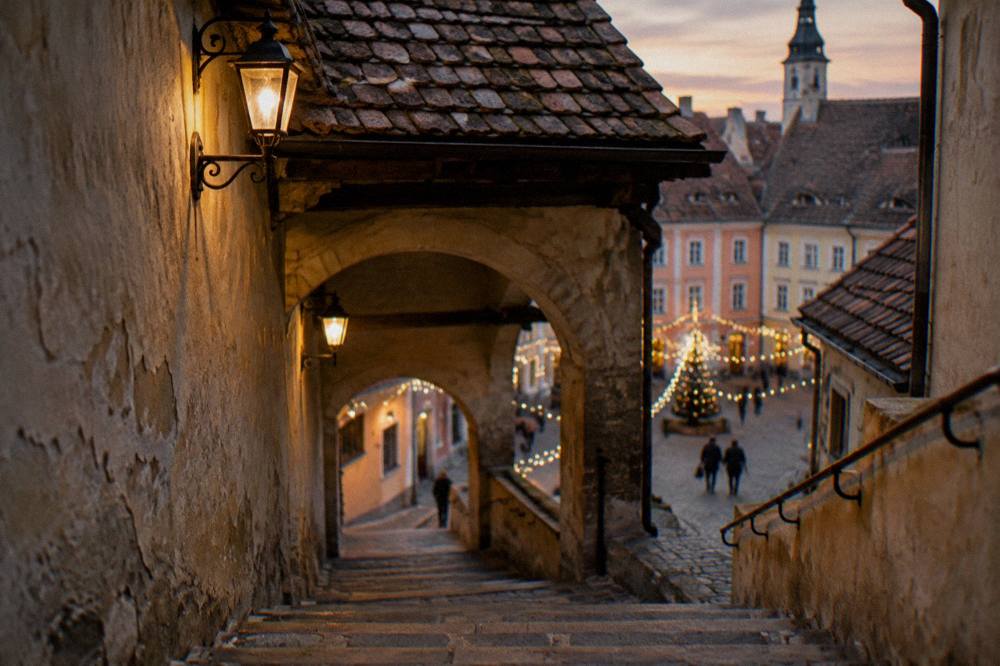
Winter has its own draw, and it is not just the cold. The Sibiu Christmas Market runs 13 November 2026 to 3 January 2027 in Piața Mare, a few minutes from the top of the passage, with free entry and a 600 square metre ice rink, and a reported Golden Ticket at 100 lei covering the wheel, carousel and mini-train. Climbing the steps toward a lit square in December is the seasonal version of the walk, and the Sibiu in winter itinerary builds a full plan around it, with the Păltiniș ski season announced to open on 28 November 2026.
| Month | Mean high C (ERA5 1991-2020) | Mean low C | Snowfall cm |
|---|---|---|---|
| March | 8.7 | -0.8 | 18.2 |
| May | 19.1 | 9.0 | 0.3 |
| June | 22.4 | 12.9 | 0.0 |
| July | 24.2 | 14.6 | 0.0 |
| September | 19.6 | 10.5 | 0.1 |
| December | 3.1 | -3.9 | 20.8 |
The festival calendar also picks dates for you. FITS, the Sibiu International Theatre Festival, ran 19 to 28 June 2026 and its 2027 edition is announced for 18 to 27 June, and the Artmania Festival took Piața Mare on 24 and 25 July 2026 with free access. During those weeks the squares at the top of the passage hold stages and crowds, which suits travellers who want atmosphere and not those who want empty steps at dawn. The Sibiu festivals guide lists what is dated and what is not.
How Does The Stairs Passage Fit Into A Longer Sibiu Stay?
The passage fits a longer stay as the daily connector between your accommodation and the Upper Town sights, and as the departure point for day trips toward the Saxon villages, Sighișoara at about 102 minutes by road, or the mountains, none of which are part of the city itself. Sibiu's old centre is compact, so the passage recurs naturally in any itinerary: the site's Sibiu itinerary guide and the three days in Sibiu plan both thread the squares, the passage and the walls through successive days while reserving the others for the countryside.
The day trips define what a longer stay adds. The Saxon fortified-church country lies south and east of the city: Rășinari about 18 minutes and 13 km away, Cisnădie about 14 minutes and 10 km, Sibiel about 36 minutes and 25 km, and Biertan's UNESCO-listed fortified church about 76 km away, with an adult ticket reported at 20 RON and seasonal hours, so confirm before you go. Sighișoara, itself a UNESCO site, is about 96 km and 102 minutes by road. The Transfăgărășan, reachable in about 69 minutes to the Bâlea Cascadă area, reopened for its 2026 season on 12 June with daily hours of 07:00 to 21:00, and by rule the high stretch can be closed on any day from 20 October, with fines of 10,000 to 30,000 lei for driving the closed section: check the live road status before setting out.
| Day trip | Road distance from Piața Mare | Drive time, free flow |
|---|---|---|
| Cisnădie | 10 km | about 14 minutes |
| Rășinari | 13 km | about 18 minutes |
| Sibiel | 25 km | about 36 minutes |
| Păltiniș | 32 km | about 40 minutes |
| Biertan | about 76 km | about 1 hour 15 to 1 hour 30 |
| Sighișoara | 96 km | about 102 minutes |
| Brașov | 142 km | about 154 minutes |
Practical boundaries matter for the road legs. The A1 motorway toward Bucharest is unfinished, and the Sibiu to Boița section is closed from 5 October to 19 December 2026 with traffic diverted onto DN7, so allow extra time on southern routes. Hotels in the city have added a 2 percent tax on the accommodation value since 1 January 2026. Romania is a full Schengen member, the currency is the leu at about 5.3 lei to the euro, the emergency number is 112, and clocks go back on Sunday 25 October 2026. Medieval towns beyond Sibiu are compared in the site's answer on medieval towns in Romania, including Sighișoara and Brașov.
Common Questions About The Stairs Passage In Sibiu
Is the Stairs Passage in Sibiu free?
Yes. The passage is an open-air public street with no ticket, no gate and no opening hours, like Piața Mare, Piața Mică and the city walls. Only the museums and towers around it charge entry, such as the Pharmacy History Museum at 16 RON and the Evangelical Cathedral tower at 10 RON.
Where does the Stairs Passage start and end?
It runs from the lanes of the Lower Town, below the old wall line near the Potters' and Arquebusiers' towers, up to Piața Mică in the Upper Town. From the top it is a one-minute walk to the Bridge of Lies and a few minutes more through to Piața Mare.
Can you see the Council Tower from the Stairs Passage?
Yes, the Council Tower stands between Piața Mică and Piața Mare and frames the view from the top of the steps, but the tower itself has been closed to visitors since 19 January 2026 for a restoration planned at about 24 months. The open viewpoint is the Evangelical Cathedral tower in Piața Huet.
Is the Stairs Passage accessible for wheelchairs or prams?
No step-free route over the passage exists, since it is a staircase by definition. The Upper Town can be reached by road instead, but details of ramps or lifts at the surrounding sights could not be found, so travellers with mobility needs should contact each venue and their accommodation directly.
When is the Stairs Passage open?
Always. As a public street it has no opening hours and no closed days, in contrast to the Brukenthal museums around it, which close on Monday and Tuesday. Ice and snow can make the steps slippery from November to March, when the ERA5 reanalysis, 1991-2020, shows snowfall in every month.
How long does it take to walk the Stairs Passage?
The climb itself takes only a few minutes at a steady pace, with a handful of landings on the way. Allow longer for photographs, especially shooting down over the Lower Town rooftops from the upper steps in late afternoon light.
The Stairs Passage remains the simplest free pleasure in a city built on two levels: a few minutes of steps that join the craftsmen's lanes below to the squares above, open at any hour and busiest only when the festival stages fill Piața Mare.
