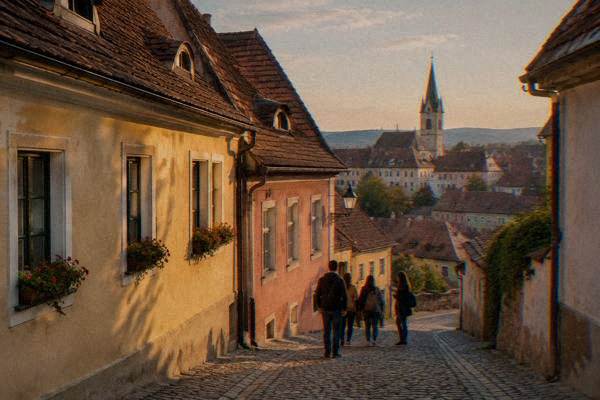
City Walls And Towers: Potters' Tower, Carpenters' Tower And The Citadel
The Sibiu city walls ring the old Saxon town with towers raised by medieval guilds, free to walk at any hour and best paired with the viewpoints and day trips around Transylvania.
Short answer
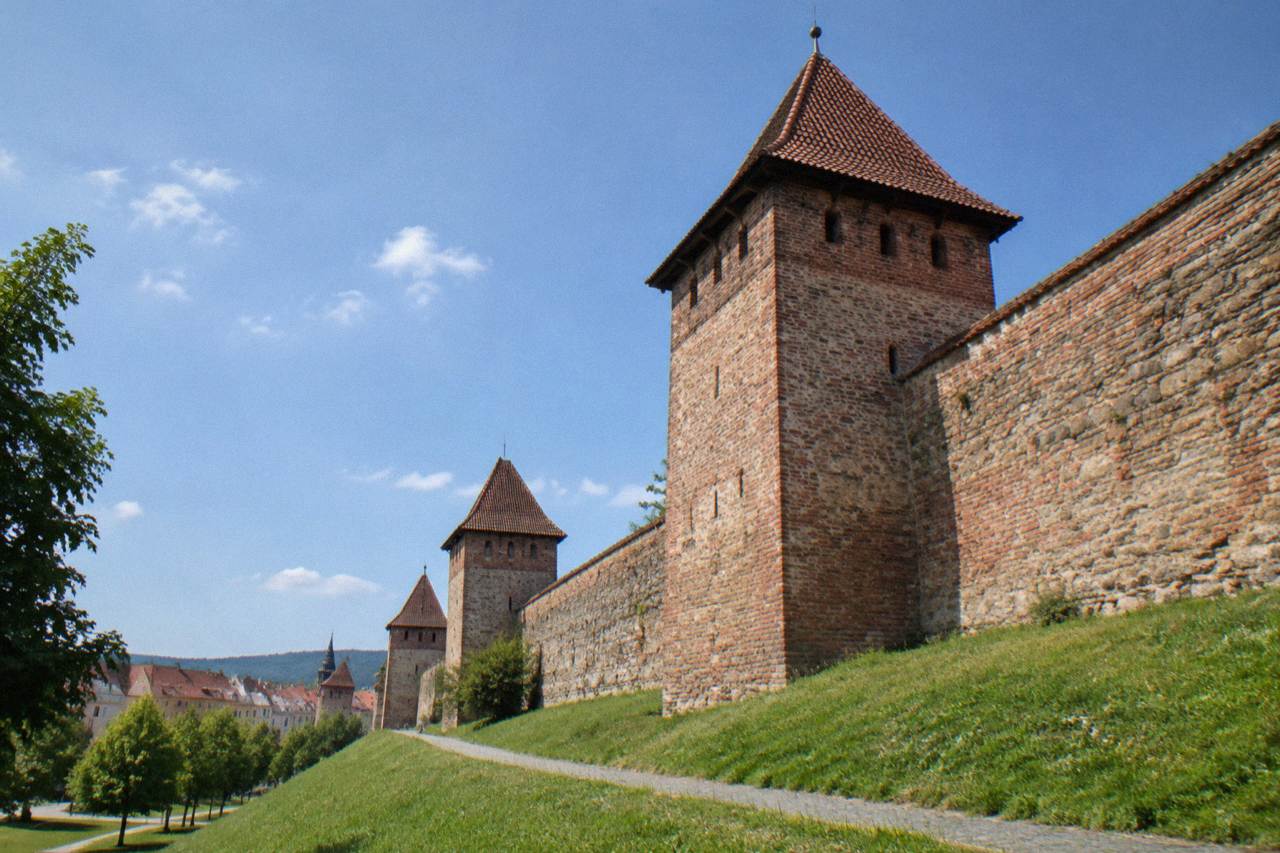
The Sibiu city walls and their towers, including the Potters', Carpenters' and Arquebusiers' towers, are free open-air public spaces with no ticket and no opening hours. The Council Tower inside the walls is closed for restoration until about January 2028, so the open viewpoint is the Evangelical Cathedral tower at 10 RON.
Sibiu, a Saxon-founded city in central Transylvania on the Cibin river, keeps one of the more legible medieval defence systems in Romania: a ring of walls and guild towers that separates the Upper Town from the Lower Town and frames the squares at the city's heart. The fortifications were built and extended over centuries by a community of Transylvanian Saxons, settlers reported to have arrived from the Moselle area in the 12th century, and each tower still carries the name of the trade guild that once manned it. The city's own history page documents the settlement from 1191, when it appeared as Cibinium. Today the walls are open-air public space, free to walk at any hour, and this guide covers what survives, how to read it, and how it connects to the rest of a Sibiu visit.
The wall circuit matters for planning because it is the spine of any walk through the old town. Things to do in Sibiu cluster almost entirely inside or against this ring, from Piața Mare to the smaller squares below it, and the walls give the walk a natural shape: up one side, along the defences, and down through the Stairs Passage. Nothing on the circuit needs a ticket, which makes it the backbone of a budget day as much as a sightseeing one.
What Are The Sibiu City Walls And Where Do They Run?
The Sibiu city walls are the medieval defensive ring of the old Saxon town, running around the Upper Town and down toward the Lower Town, with surviving sections, towers and gates between Piața Mare, Piața Mică and the streets below. The circuit is open-air public space with no ticket and no opening hours, per the city's tourism site. Sibiu's fortifications were attested early and extended in successive enclosures as the city grew, with several lines of defence added over time, according to the city's own UNESCO documentation. The inner ring protected the Upper Town; later outer belts wrapped the Lower Town, and the guild towers threaded through both.
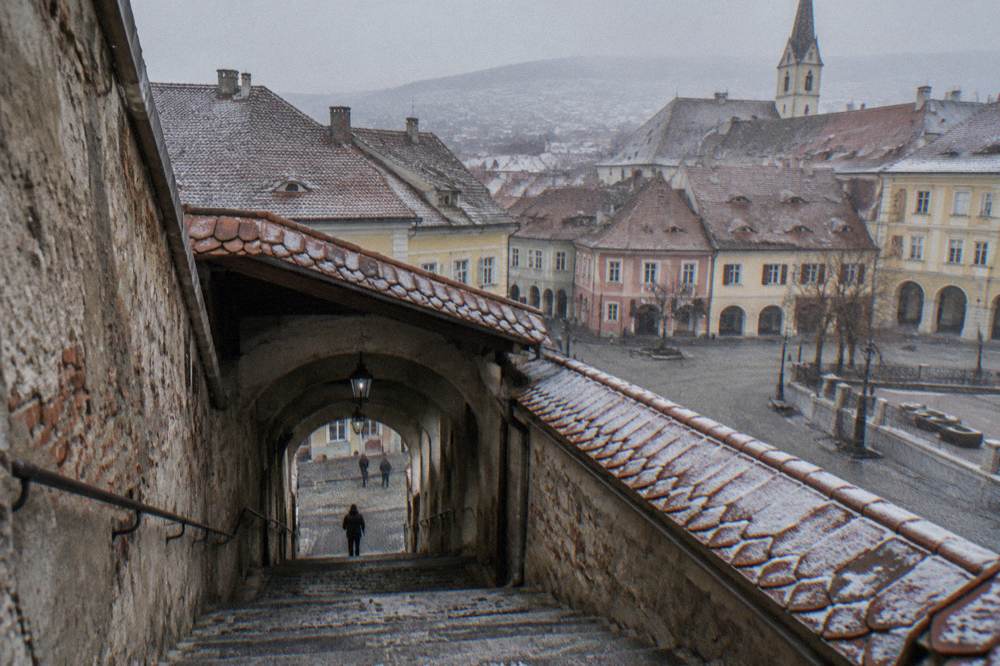
The geography is simple once you see it once. The Upper Town sits at 431 m, the Lower Town at 415 m per the city's official presentation page, and the walls trace the shoulder between them. The most dramatic connection is the Stairs Passage, a covered staircase street that links the two levels and reads as part of the fortifications itself. Along the eastern and southern edges the wall runs with towers at intervals; on the west it drops toward the Lower Town streets where Turnișor begins.
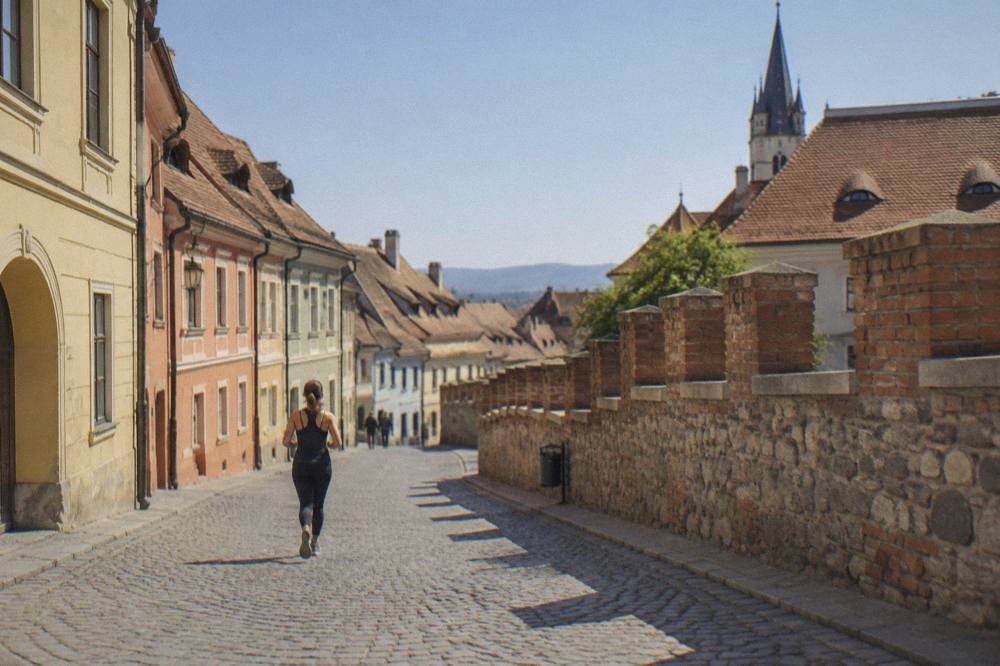
Reading the walls is easier with the guild logic in mind. Each tower belonged to a guild that owed defence duty: potters, carpenters, arquebusiers, and others whose names survive on the structures. The city's tourism site lists the Potters', Arquebusiers' and Stairs towers among the free public sites of the old town. The system was not a single wall but successive lines, and the patchwork you walk today reflects which sections were kept, rebuilt or cleared over the centuries.
Which Towers Can You See On The Sibiu City Walls?
The towers visible today on the Sibiu city walls include the Potters' Tower, the Carpenters' Tower, the Arquebusiers' Tower and the Stairs Tower, all free open-air structures, alongside the Council Tower between Piața Mare and Piața Mică, which is closed to visitors for restoration until about January 2028. The city's tourism site treats the wall towers as public space with no ticket. The Council Tower, by contrast, has been closed since 19 January 2026 for a restoration the city says is planned at about 24 months, with completion expected about January 2028; walls have been cleaned and re-plastered and the copper roof came down in September 2026.
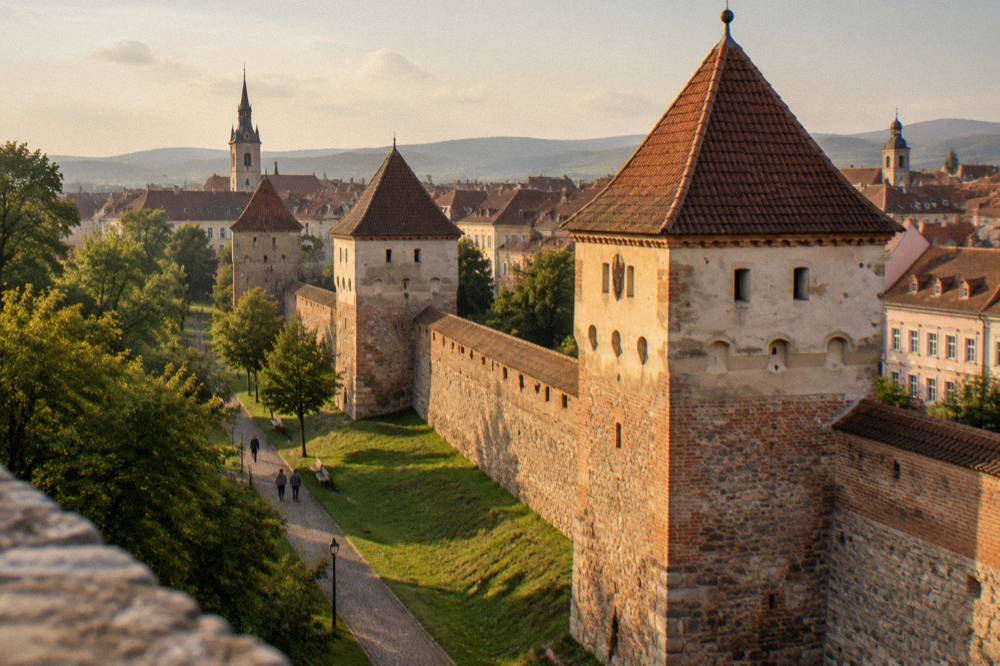
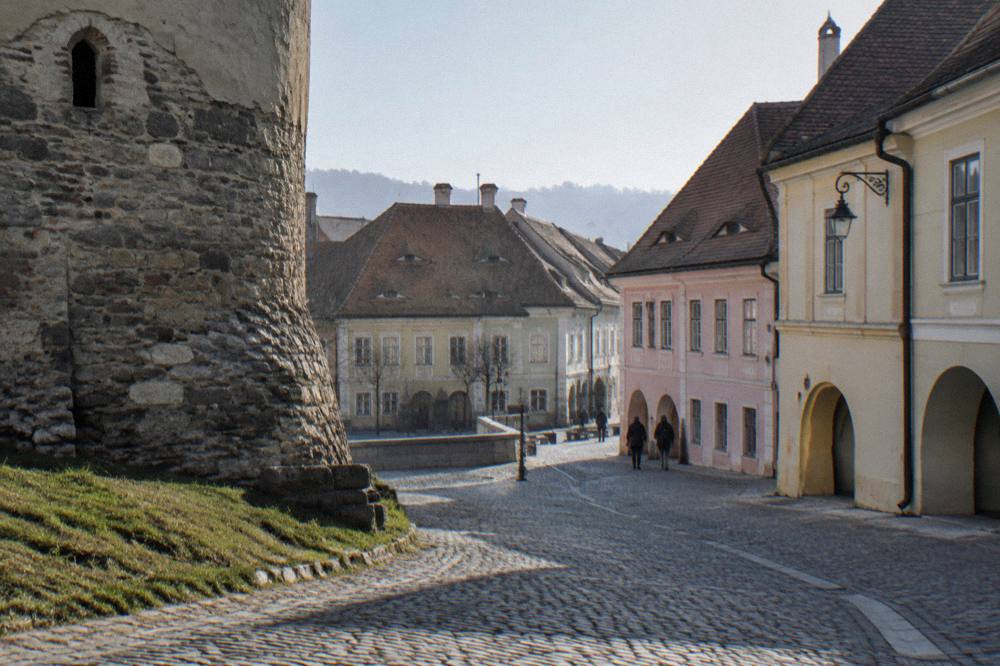
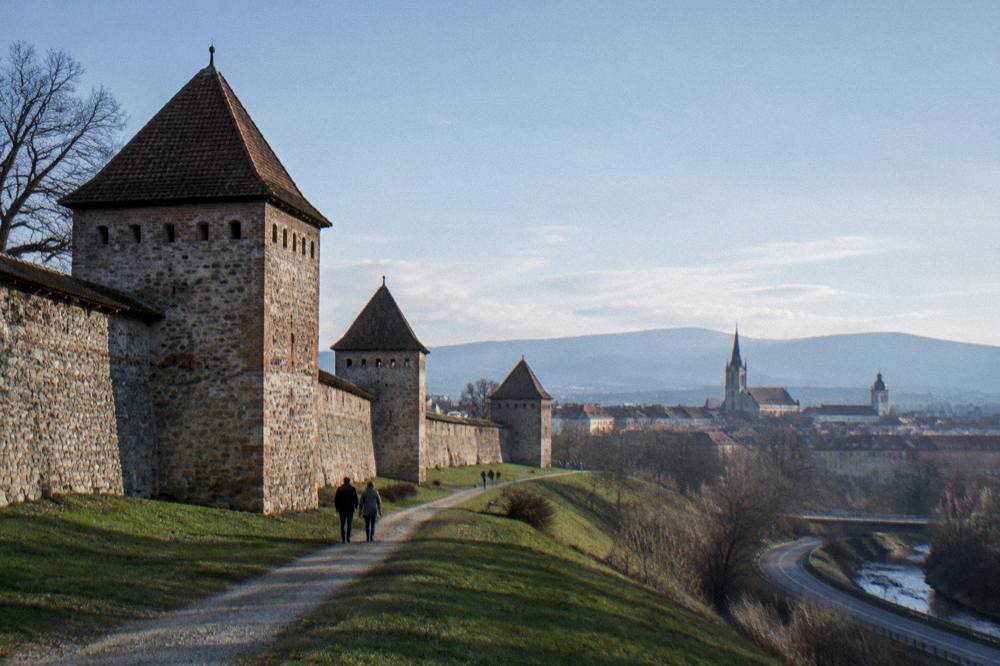
The Potters' Tower and the Carpenters' Tower stand on the south-eastern stretch of the wall, where the defences are at their most photographed. They are solid guild structures, and the lawn below them is one of the quietest green spots inside the ring. The Arquebusiers' Tower anchors another section nearby, and the Stairs Tower guards the passage that drops to the Lower Town. None of these has interior access as a museum; they are landmarks to walk around and photograph, and the city's tourism site attaches no price or hours to them.
The Council Tower deserves its own note because so many older guides get it wrong. It stands between the two main squares as the emblem of the city, but since 19 January 2026 it has been closed to visitors for a restoration project run by the city hall. No ticket, price or hours apply, because there is nothing to enter. The Council Tower remains worth seeing from Piața Mare as a landmark; it is simply not a climbable one for now.
| Tower or structure | Location on the circuit | Access today |
|---|---|---|
| Potters' Tower | South-eastern wall stretch | Free, exterior viewing, no ticket |
| Carpenters' Tower | South-eastern wall stretch near Potters' | Free, exterior viewing, no ticket |
| Arquebusiers' Tower | Eastern wall section | Free, exterior viewing, no ticket |
| Stairs Tower | At the Stairs Passage, Upper to Lower Town | Free, part of the public passage |
| Council Tower | Between Piața Mare and Piața Mică | Closed for restoration until about January 2028 |
| Evangelical Cathedral tower | Piața Huet, inside the ring | Open viewpoint, 10 RON adult, 5 RON reduced |
Can You Walk The Sibiu City Walls For Free?
Yes, the Sibiu city walls and their towers are free open-air public space with no ticket and no opening hours, per the city's tourism site, so a full circuit of the surviving fortifications, from Piața Mare around the guild towers and down the Stairs Passage, costs nothing at all on foot. The free zone is large: Piața Mare, Piața Mică, Piața Huet, the Bridge of Lies, the Stairs Passage and the wall towers all sit in it. The only paid structures inside or beside the ring are the museums and the Evangelical Cathedral tower, and the open viewpoint there costs 10 RON for an adult, per the city's tourism site.
A sensible free walk starts on Piața Mare, crosses to Piața Mică under the closed Council Tower, climbs to Piața Huet past the Bridge of Lies, then follows the wall past the guild towers on the south-east edge before descending through the Stairs Passage to the Lower Town. That loop touches every free fortification landmark in under two hours at walking pace. Add the Pharmacy Museum in Piața Mică at 16 RON, per the Brukenthal National Museum's own price page, if you want one interior stop.
Two 2026 realities shape the paid side of the list. The Brukenthal National Museum sites are closed Monday and Tuesday, and the Hunting Museum is closed indefinitely, per the museum's own visiting page. And since 1 January 2026, hotels in the city collect a 2 percent tax on the accommodation value, so a nightly bill carries a small extra line. Neither touches the walls themselves, which remain exactly as free as the squares.
| Sight on or beside the walls | Cost | Notes |
|---|---|---|
| Wall towers (Potters, Carpenters, Arquebusiers, Stairs) | Free | Public space, no hours |
| Piața Mare, Piața Mică, Piața Huet | Free | Public squares |
| Bridge of Lies | Free | Reportedly built 1859 to 1860 |
| Stairs Passage | Free | Public passage between town levels |
| Evangelical Cathedral tower | 10 RON adult, 5 RON reduced | Open viewpoint; hours on the city's tourism site |
| Pharmacy History Museum | 16 RON | Piața Mică; closed Monday and Tuesday |
For visitors who want the walls explained rather than just walked, a guided option covers the ground efficiently. The Upper Town Landmarks tour works through the squares and defences with a guide, and there is a compact daily sightseeing walk for a first-day orientation. Both are bookable on the operator's live listing. And once the circuit is walked, the same defensive story continues far beyond the ring, at fortress sites reachable on a guided day.
The guided walk below is the one most tightly focused on the walls' own ground.
Where Do The Walls Connect To The Upper Town And Lower Town?
The walls connect the Upper Town and Lower Town mainly through the Stairs Passage, a covered public staircase street that drops from the guild-tower level to the lower streets, with the wall ring tracing the shoulder between the two levels at 431 m and 415 m respectively. The city's official presentation page gives those two elevations. The passage is free, always open, and doubles as the most atmospheric route between the squares above and the quieter streets below.
The Upper Town holds the power buildings: the squares, the main churches, the museum palaces and the strongest wall sections with the guild towers. The Lower Town was the working belt, and its streets still carry a different scale, smaller houses and a more local rhythm. The wall system treated them differently too, with the inner ring around the Upper Town and outer belts added around the Lower Town as the city grew, per the city's UNESCO documentation. Walking the boundary between the two is the quickest way to understand the medieval city's social map.
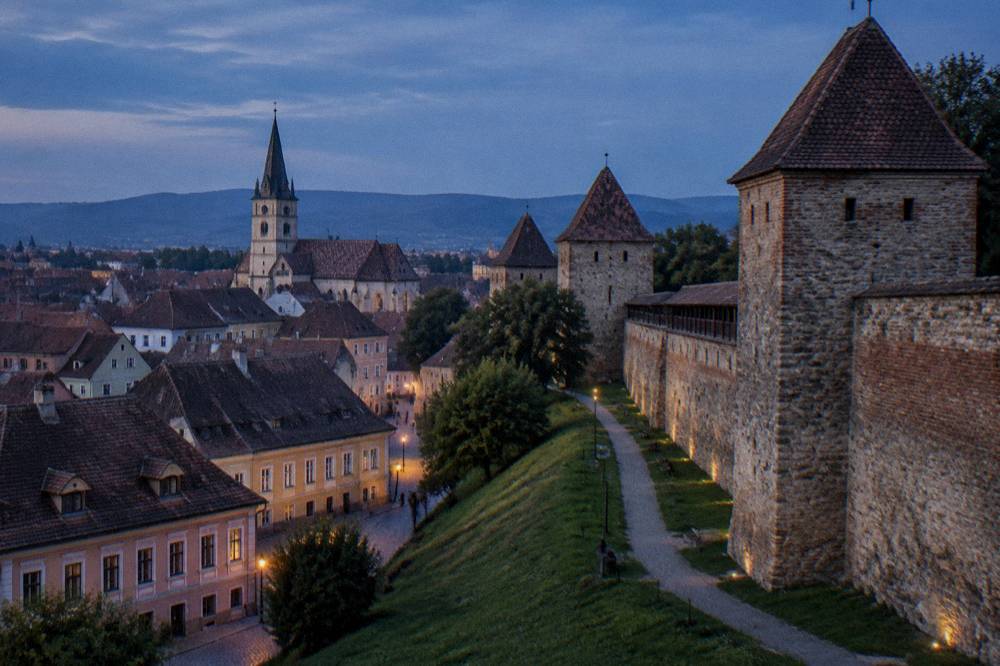
The viewpoints along the top edge are the reward. Because the wall line sits on a shoulder, several terraces beside it look straight down over the Lower Town roofs, and these are free to stand on. The one paid viewpoint in the old town, the Evangelical Cathedral tower, adds height above the whole ring; per the city's tourism site it is open Monday 12:00 to 17:00, Tuesday to Thursday 10:00 to 17:00, Friday and Saturday 10:00 to 20:00, and Sunday 11:00 to 17:00, with guided visits on request in Romanian, German and English. Confirm hours before you go, since services can change access.
How Old Are The Sibiu Fortifications, Really?
Sibiu was first documented in 1191 as Cibinium, and its fortifications were attested early and extended in successive enclosures as the city grew, according to the city's own history page and its UNESCO documentation, though no single construction date exists for any wall section or guild tower. The Saxon settlers who built the city are reported to have come from the Moselle area in the 12th century. The Bridge of Lies nearby is reported by secondary sources to date from 1859 to 1860, described as the first cast-iron bridge in Romania, but the walls themselves are far older than that crossing.
Precision matters here because invented dates circulate freely. The Council Tower's 13th-century origin, its height and its step count are not reliably sourced, so this page prints none of them. What the record does support, from the city's own chronology, is that Sibiu claimed a hospital in 1292, a school in 1380 and a pharmacy in 1494 on current Romanian territory, figures the city itself presents as its own chronology. The fortifications grew alongside that civic wealth, and the guild tower system reflects a city wealthy enough to assign defence to trades. The wider set of guides lives on Sibiu Travel Guide.
For context, the European Capital of Culture year 2007 is reported as a turning point that pushed restoration across the old town, and the walls benefited from that attention. The current Council Tower restoration, running since January 2026, continues the same pattern. A time capsule was found at the tower in September 2026 during the works, per local press reports, which is the kind of detail that keeps the fortifications in the news even while the tower itself is closed.
| Fortification fact | Figure | Where it comes from |
|---|---|---|
| First documentation of the city | 1191, as Cibinium | The city's own history page |
| Saxon settlement reported from the Moselle area | 12th century | Reported, patrimoniu.sibiu.ro |
| Successive enclosure rings added over time | No single dated phase | The city's UNESCO documentation |
| Bridge of Lies construction | Reported 1859 to 1860 | Secondary sources; treat as reported |
| Council Tower closure | Since 19 January 2026 | City hall statement, 30 September 2026 |
| Expected reopening | About January 2028 | Reported; 24-month project |
When Is The Best Time To Walk The Walls?
The best months to walk the Sibiu city walls are May and June and again in September and October, when the ERA5 reanalysis for Sibiu, 1991 to 2020, shows mean daily highs of 19 to 24 C and 8 to 10 hours of sunshine a day, while December and January bring snow and highs of only 2 to 4 C. The walls are open-air and free at any hour, so the season shapes comfort rather than access. Tourism sources for the city also name May, June, September and October as the favoured shoulder months.
Winter has its own case. The Christmas market runs 13 November 2026 to 3 January 2027 in Piața Mare, with free entry and a 600 sqm ice rink, and the wall towers dusted with snow photograph well, with November and December showing 13 and 21 cm of modelled snowfall in the ERA5 reanalysis, 1991 to 2020. Cold snaps bite, though: January's mean daily low in the same reanalysis is -5.7 C. Clocks go back on Sunday 25 October 2026, so late-autumn walks lose light quickly.
| Month | Mean high C (ERA5, 1991-2020) | Mean low C | Sun hours per day |
|---|---|---|---|
| January | 2.2 | -5.7 | 6.2 |
| April | 14.6 | 4.0 | 10.4 |
| June | 22.4 | 12.9 | 12.4 |
| August | 24.5 | 14.8 | 11.8 |
| October | 14.5 | 5.7 | 8.0 |
| December | 3.1 | -3.9 | 5.6 |
Rain is the one planning variable the reanalysis table does not settle, and the city's own official figure is the one to quote: a mean annual 662 mm, with June the wettest month at 113 mm and February the driest at 26.7 mm, per the city's official presentation page. An umbrella in June is not pessimism, it is arithmetic. The Sibiu weather and best time to visit pages carry the month-by-month detail.
How Do The Sibiu Walls Compare With The Fortified Churches Beyond The City?
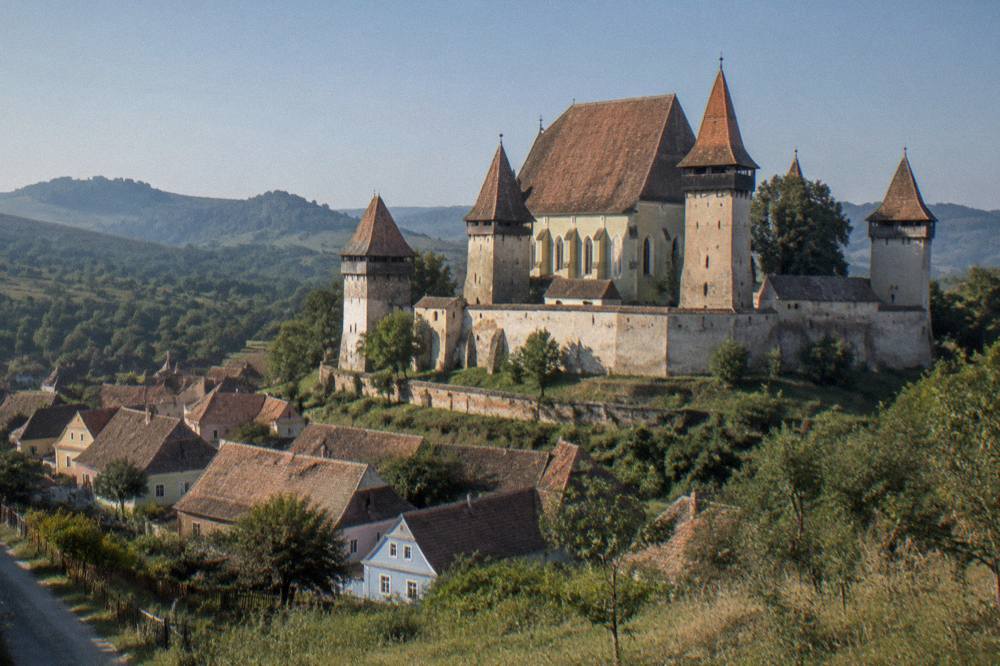
The Sibiu city walls defended a whole town with guild towers, while the fortified churches of the surrounding Saxon villages, a UNESCO serial site inscribed at Biertan in 1993 and extended in 1999 to seven villages, protected single congregations with walls and towers around a church, so the two systems are cousins at different scales. UNESCO's own listing covers Biertan, Prejmer, Viscri, Valea Viilor and others. The city walls are free to walk; the village churches charge entry, with Biertan at 20 RON for an adult, reported by the regional tourism site, hours seasonal, so confirm before you go.
The comparison is worth the drive because it completes the story. Inside Sibiu you see urban defence, financed by guilds and a wealthy city government. An hour away you see the rural answer: a church turned into a refuge, with walls, towers and granary rooms above the nave. Biertan sits about 76 km from Piața Mare, roughly 1 hour 15 to 1 hour 30 by road, reported driving times. Cisnădie and Cisnădioara, with their own fortified churches, are far closer at about 10 and 13 km, computed over OpenStreetMap routing.
Guided trips stitch the two scales together neatly. The Sighișoara day trip reaches another walled citadel, one on the UNESCO list since 1999, and the Râșnov fortress route adds a peasant fortress to the set on the Râșnov fortress page. On the operator listings, a Sighișoara and Biertan tour covers two UNESCO sites in one guided day.
| Fortified destination from Piața Mare | Distance by road | Driving time, free-flow |
|---|---|---|
| Cisnădie fortified church | about 10 km | about 14 minutes |
| Cisnădioara fortified church | about 13 km | about 18 minutes |
| Biertan fortified church (UNESCO) | about 76 km | about 1 hour 15 to 1 hour 30, reported |
| Sighișoara citadel (UNESCO) | about 96 km | about 102 minutes |
| Alba Iulia citadel | about 71 km | about 81 minutes |
| Brașov | about 142 km | about 154 minutes |
Distances are computed over OpenStreetMap routing in free-flow conditions and are not timetables. Confirm opening hours and tickets for the village churches before setting out, since several run short winter schedules.
What Day Trips Pair Well With The Walls?
The strongest day trips from the walls are the Dacian fortress, Hunyadi Castle and Alba Iulia circuit to the west, the Sighișoara and Brașov citadels to the east, and the Transfăgărășan mountain road to the south, with Alba Iulia about 81 minutes and 71 km from Piața Mare and the Corvin Castle route about 123 minutes and 130 km, all computed driving figures. The Alba Carolina citadel grounds are free to walk, reported by regional tourism sources. No 2026 ticket prices or hours were found for Corvin Castle or the Făgăraș fortress, so confirm those at the castle's own site before booking anything.
The Dacian fortress route is the natural extension of a fortifications-themed trip, because it runs from medieval walls back into pre-medieval ones. The Sarmizegetusa-area Dacian ruins, Hunyadi Castle at Hunedoara and the Alba Iulia citadel make a coherent defensive-history day, and the Dacian Fortress and Hunyadi Castle day trip is this site's featured pairing for exactly that reason: Check availability on the operator's live listing. These are long days on the road, which the distances above support.
One 2026 caution belongs on any mountain plan. The Transfăgărășan's 2026 season opened on 12 June with daily hours of 07:00 to 21:00 on the high stretch, and by rule the alpine section can be closed on any day from 20 October, with fines of 10,000 to 30,000 lei for driving the closed section. Never assume the road is open; check the live road status before you plan a Bâlea Lake day. Closer to town, Păltiniș opens its ski season on 28 November 2026, per the resort's announcement, if a winter walls-and-slopes combo appeals.
Common Questions About The Sibiu City Walls
Are the Sibiu city walls free to visit?
Yes. The walls and their towers, including the Potters', Carpenters' and Arquebusiers' towers, are open-air public space with no ticket and no opening hours, per the city's tourism site. Only the museums and the Evangelical Cathedral tower inside the ring charge entry.
Can you climb the Council Tower in Sibiu?
No. The Council Tower has been closed to visitors since 19 January 2026 for a restoration planned at about 24 months, with completion expected about January 2028. The open viewpoint in the old town is the Evangelical Cathedral tower, 10 RON for an adult.
How long does it take to walk the Sibiu city walls?
A loop covering the surviving wall sections, the guild towers, the three main squares and the Stairs Passage takes under two hours at a steady walking pace, plus whatever time you spend in the museums along the way.
What is the Potters' Tower in Sibiu?
The Potters' Tower is one of the surviving guild towers on the south-eastern stretch of the Sibiu city walls, named for the potters' guild that held defence duty there. It is a free exterior landmark with no interior museum access.
Is the Stairs Passage part of the city walls?
Yes, functionally. The Stairs Passage is a covered public staircase street that links the Upper Town and the Lower Town, with the Stairs Tower at its top, and it formed part of the fortified boundary between the two levels. It is free and open at all hours.
The walls give Sibiu its shape, and the tower silhouette from the lawn below the guild towers is the picture that stays with a visitor. Walk them early, walk them free, and let the circuit hand you the rest of the old town, one square at a time.