Sibiu Weather: Month By Month
Sibiu has a temperate continental climate: warm summers, cold snowy winters and a shoulder season in May, June, September and October that tourism sources call the best window for a visit.
Short answer
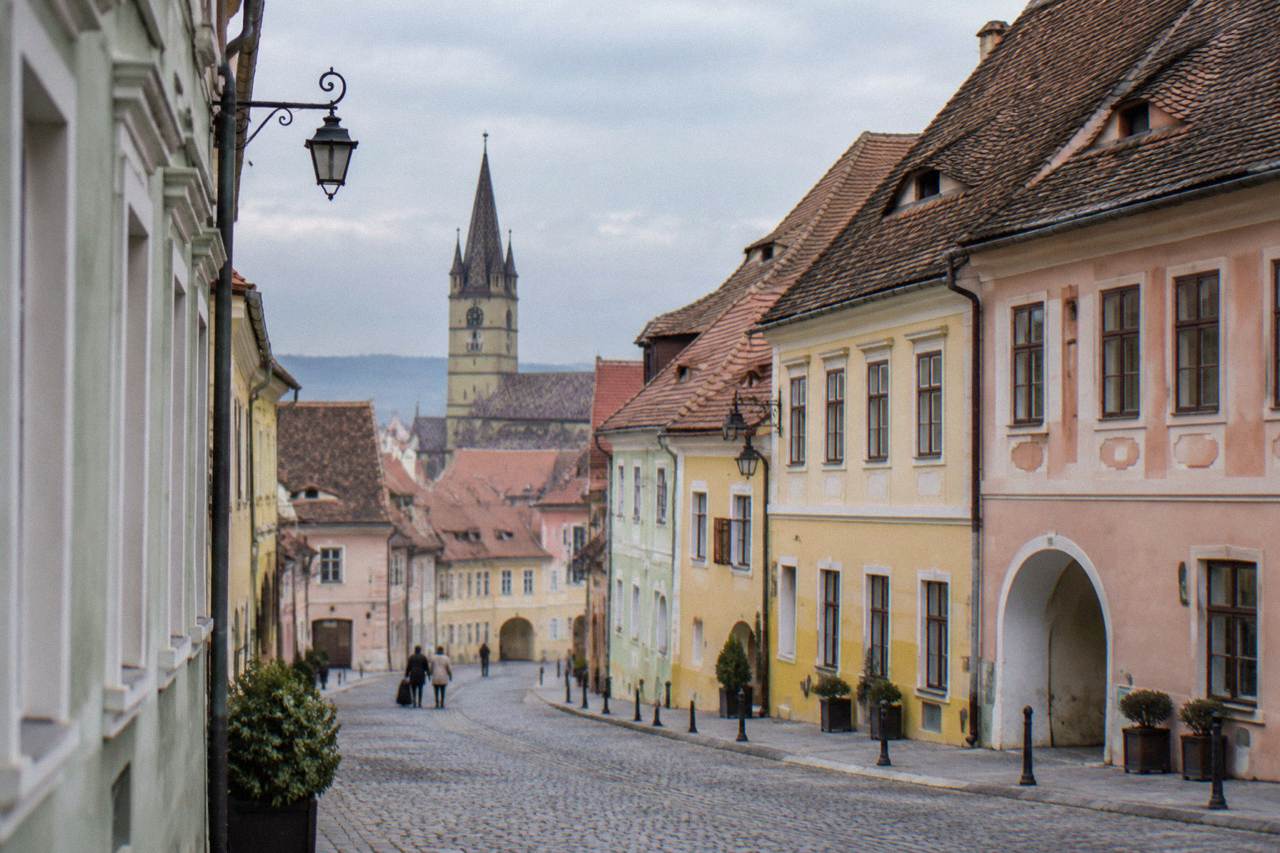
Sibiu, in central Romania at 415 to 431 m, has a temperate continental climate with a mean annual temperature of 8.9 C and 662 mm of annual rainfall per the city's official figures. Summers reach mean highs near 24 C, winters drop to mean lows around -5.7 C, and snow falls from November to March.
Sibiu sits in central Romania, in Transylvania, at 415 m in the Lower Town and 431 m in the Upper Town, and its weather follows the temperate continental pattern of the interior of the country: warm summers, cold winters with reliable snow, and rainfall spread across the year with a June peak. The city's own official page puts the mean annual temperature at 8.9 C and mean annual rainfall at 662 mm, with June the wettest month at 113 mm and February the driest at 26.7 mm. This guide lays out Sibiu weather month by month, using those official city figures for rainfall and the ERA5 reanalysis, 1991-2020, a modelled grid cell rather than a weather station, for monthly temperatures, sunshine and snow, and then turns to what the numbers mean for packing, walking the old town and planning day trips toward the Făgăraș mountains.
What Is The Climate Of Sibiu?
Sibiu has a temperate continental climate, per the city's official presentation page: mean annual temperature 8.9 C and mean annual rainfall of 662 mm, with June the wettest month at 113 mm and February the driest at 26.7 mm. The ERA5 reanalysis, 1991-2020, shows monthly mean highs rising from 2.2 C in January to 24.5 C in August and mean lows falling to -5.7 C in January, with snow on the modelled record from November to March.
Continental means distance from the moderating effect of any large body of water, and Sibiu is far inland: the nearest coast is the Black Sea, hundreds of kilometres away across the Carpathians and the plains. What shapes Sibiu's air instead is the Cibin valley, the Cindrel foothills to the south and the open Transylvanian plateau to the north. Summers build steadily from May, hold through August and ease in September. Winters arrive with the first sustained snow in November and keep a snow cover through the turn of the year. The city's altitude of 415 to 431 m, published on the city's own page, keeps nights cooler than lowland Romanian cities in every season.
The official city figures and the ERA5 reanalysis measure different things, and it helps to keep them apart. The 662 mm rainfall figure comes from the city's official page. The ERA5 reanalysis, 1991-2020, is a modelled grid cell near Sibiu at about 430 m, and it is the source for the temperature, sunshine and snowfall numbers throughout this guide. For anyone comparing destinations, the short version is this: Sibiu is warmer than the mountain resorts of the Făgăraș range and cooler than Bucharest in summer, and its winters are proper winters, not the grey damp of the coast.
What Are Sibiu Temperatures Month By Month?
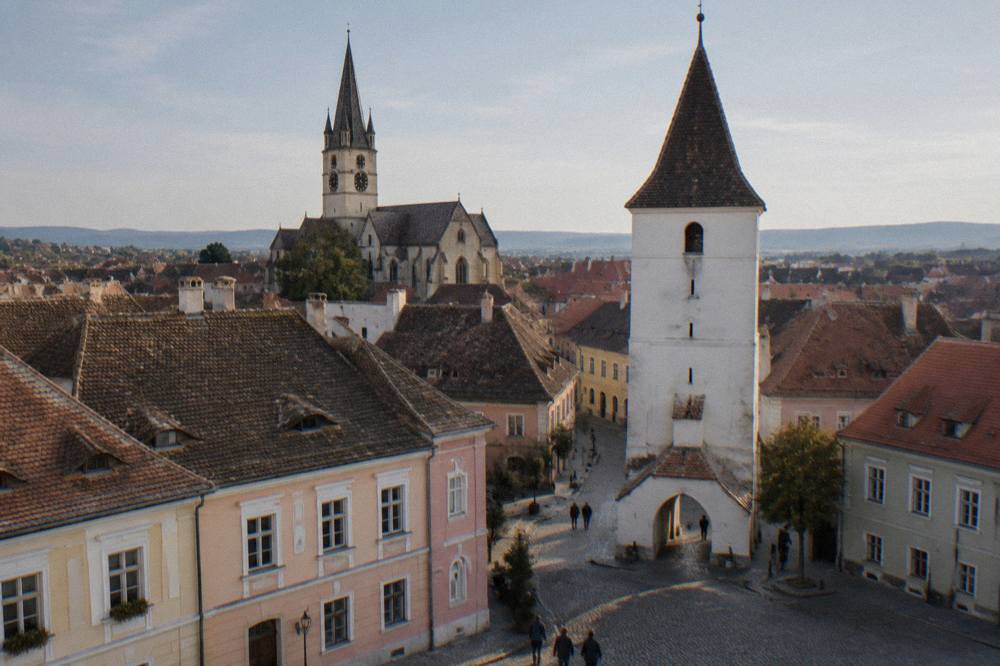
Per the ERA5 reanalysis, 1991-2020, Sibiu's monthly mean highs run from 2.2 C in January to 24.5 C in August, and monthly mean lows from -5.7 C in January to 14.8 C in August. April and October sit mid-table at mean highs of 14.6 C and 14.5 C, and the transition months swing hard: March averages a high of 8.7 C while November averages the same figure on the way down.
The table below carries the full set of monthly means. The pattern to notice is the lag: the modelled peak arrives in August rather than July, and the coolest mean low arrives in January rather than December. Shoulder seasons compress quickly. A May day can feel fully summer-like while an October afternoon can carry the first frost of the season by nightfall.
| Month | Mean High C | Mean Low C | Sunshine H/Day | Snowfall Cm |
|---|---|---|---|---|
| Jan | 2.2 | -5.7 | 6.2 | 23.3 |
| Feb | 4.3 | -4.4 | 7.1 | 22.3 |
| Mar | 8.7 | -0.8 | 8.7 | 18.2 |
| Apr | 14.6 | 4.0 | 10.4 | 7.9 |
| May | 19.1 | 9.0 | 11.3 | 0.3 |
| Jun | 22.4 | 12.9 | 12.4 | 0.0 |
| Jul | 24.2 | 14.6 | 12.8 | 0.0 |
| Aug | 24.5 | 14.8 | 11.8 | 0.0 |
| Sep | 19.6 | 10.5 | 9.7 | 0.1 |
| Oct | 14.5 | 5.7 | 8.0 | 2.7 |
| Nov | 8.7 | 0.9 | 6.4 | 13.0 |
| Dec | 3.1 | -3.9 | 5.6 | 20.8 |
All four columns come from the same ERA5 reanalysis, 1991-2020, so they can be read against each other. The sunshine column runs from 5.6 hours a day in December to 12.8 hours a day in July, modelled figures rather than station records, but the shape is what a visitor plans around: short, dim days in deep winter and long bright evenings in midsummer. Daylight hours span from 8.7 per day in December to 15.7 in June, a spread that matters for photographers working the Sibiu old town in golden light or for anyone planning long mountain day trips, where the driving window in December is short indeed.
Rainfall, by contrast, should be taken from the city's official figures rather than the model, because the ERA5 grid cell for this area runs far wetter in total than the official 662 mm. The official page names June the wettest month at 113 mm and February the driest at 26.7 mm. In practical terms: summer rain arrives as afternoon thunderstorms that pass, winter precipitation mostly falls as snow, and the shoulder months sit between the two.
How Cold And Snowy Is Sibiu In Winter?
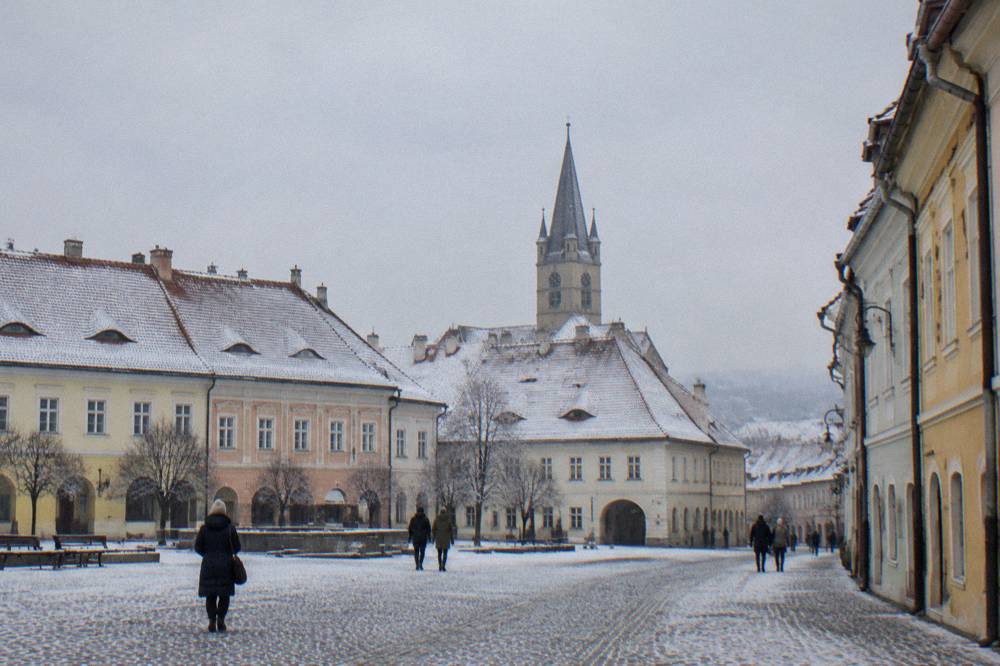
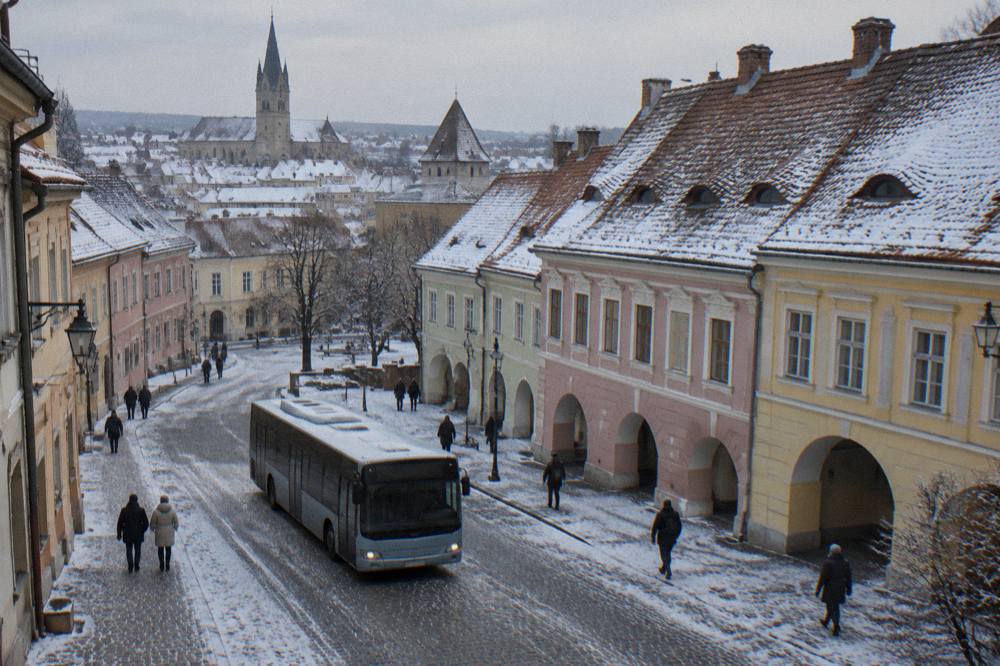
Sibiu winters are cold and snowy: per the ERA5 reanalysis, 1991-2020, snow falls from November to March, with the modelled monthly totals peaking at 23.3 cm in January, and mean lows hold below freezing from December through February at -3.9, -5.7 and -4.4 C. Mean highs stay between 2.2 and 4.3 C across those three months, so thaw days are the exception rather than the rule.
Snow is part of the city's winter identity rather than an inconvenience that arrives once a season. The Christmas market in Piața Mare, covered in detail in the Sibiu Christmas market guide, runs 13 November 2026 to 3 January 2027, and a dusting on the coloured facades around the square is a realistic expectation for December. The modelled snow record gives December 20.8 cm and January 23.3 cm, with November at 13.0 cm and March still at 18.2 cm. Winter does not switch off on a calendar date in this climate.
Cold-weather practicalities are straightforward. Pavements in the old town can stay icy in shaded lanes between the Upper Town and the Lower Town, and the Stairs Passage links the two levels with steps that deserve footwear with grip. The emergency number anywhere in Romania is 112. Layers, a real coat and waterproof shoes cover December through February; the packing section below gives the full breakdown.
One weather consequence worth flagging: the alpine section of the Transfăgărășan road can be closed on any day from 20 October under the standing rule, and the 2026 high season, daily 07:00 to 21:00, began on 12 June. Fines for driving the closed stretch run from 10,000 to 30,000 lei. Winter visitors aiming at Bâlea Lake go by cable car, which runs on its own schedule, or not at all, and the day trips section handles the details.
What Are Sibiu Summers Like?
Sibiu summers are warm rather than hot: the ERA5 reanalysis, 1991-2020, puts July at a mean high of 24.2 C and August at 24.5 C, with mean lows of 14.6 and 14.8 C, so nights cool off meaningfully after sunset. Sunshine runs at 12.8 hours a day in July, and June carries the official wettest-month figure of 113 mm, which lands mostly as passing afternoon storms.
Daytime temperatures make summer walking weather in the old town genuinely pleasant, and the altitude deserves some credit. At 415 to 431 m, with the Cindrel foothills to the south, Sibiu avoids the heat buildup of the lowland cities. Evenings call for a light layer. Rain, when it comes in June, tends to be convective: a heavy hour, then clear skies again, which is why the squares fill again after every storm passes.
Summer is also the festival season, and the weather shapes it. Artmania Festival took Piața Mare as a free-access edition on 24 and 25 July 2026, and the Sibiu International Theatre Festival ran 19 to 28 June 2026, with the 2027 edition announced for 18 to 27 June under the theme "Lumină". Open-air performances depend on the June storm rhythm; the Sibiu festivals guide tracks what runs when. The long midsummer daylight, 15.7 hours a day in June, stretches sightseeing deep into the evening.
For touring, summer is the full-access season: the Transfăgărășan is open daily 07:00 to 21:00 through its summer window, Păltiniș works as a cool-air escape from the city, and the Saxon villages of Mărginimea Sibiului sit in rolling country that handles a passing shower without ruining a day.
When Is The Best Time To Visit Sibiu For Good Weather?
Tourism sources name May and June, and September and October, as the best months to visit Sibiu, and the numbers back the claim: ERA5 reanalysis, 1991-2020, gives May a mean high of 19.1 C and September 19.6 C, both with mean lows near 9 to 10.5 C, while sunshine holds at 11.3 and 9.7 hours a day. These months carry mild temperatures without the July and August peak or the deep-winter cold.
| Season | Months | Mean High C | Character |
|---|---|---|---|
| Spring | Mar to May | 8.7 to 19.1 | Fast warming, March still snowy at 18.2 cm modelled |
| Summer | Jun to Aug | 22.4 to 24.5 | Warm days, cool nights, June storms |
| Autumn | Sep to Nov | 19.6 down to 8.7 | Long mild stretch, first snow in November |
| Winter | Dec to Feb | 2.2 to 4.3 | Sustained snow, mean lows below freezing |
The choice within those windows depends on what the trip is for. May suits photography and walking: everything is green, daylight runs to 14.9 hours, and the modelled snowfall has already dropped to 0.3 cm. September suits the same purposes with warmer nights. Late June overlaps with the theatre festival, at the cost of the wettest official month. October trades warmth, mean high 14.5 C, for the first autumn colour and thinning crowds, and the whole best time to visit guide compares the options month by month.
Winter is its own argument rather than a worse version of summer. December mean highs of 3.1 C with 20.8 cm of modelled snow, the Christmas market from 13 November 2026 and the Păltiniș ski season opening on 28 November 2026 make the cold a feature. Anyone pairing the city with skiing should watch the calendar around the market opening and the 1 December National Day holiday.
How Much Does It Rain In Sibiu?
Sibiu receives a mean of 662 mm of rain per year, per the city's official page, which names June the wettest month at 113 mm and February the driest at 26.7 mm. The annual figure is modest by European standards, and its distribution matters more than the total: a summer maximum arriving as storms, and a winter minimum because cold-month precipitation falls as snow instead.
| Official City Figure | Value | Attribution |
|---|---|---|
| Mean annual temperature | 8.9 C | City of Sibiu, official page |
| Mean annual rainfall | 662 mm | City of Sibiu, official page |
| Wettest month | June, 113 mm | City of Sibiu, official page |
| Driest month | February, 26.7 mm | City of Sibiu, official page |
| Snow season | November to March | ERA5 reanalysis, 1991-2020 |
Rain rarely stops a Sibiu day outright. The old town is compact, Piața Mare to Piața Mică is a two-minute walk, and the covered arcades, café interiors and museums absorb a wet hour well. The Brukenthal Palace is open Wednesday to Sunday, 10:00 to 18:00, closed Monday and Tuesday, with an adult ticket at 50 RON per the Brukenthal National Museum's own price page, and the 48-hour combined ticket at 120 RON covers the museum's other sites. Confirm hours before you go. On genuinely wet days the indoor options run deep, from the History Museum at Casa Altemberger to the Pharmacy Museum on Piața Mică. Everything else covered here is indexed on Sibiu Travel Guide.
For mountain day trips the calculus changes. Rain in Sibiu can be snow on the Transfăgărășan, where Bâlea Lake sits at 2,034 m, and September 2026 already brought winter conditions up top while the road was still open. Checking the live road status before any Făgăraș drive is not optional.
Does Sibiu Weather Change Your Day Trip Plans?
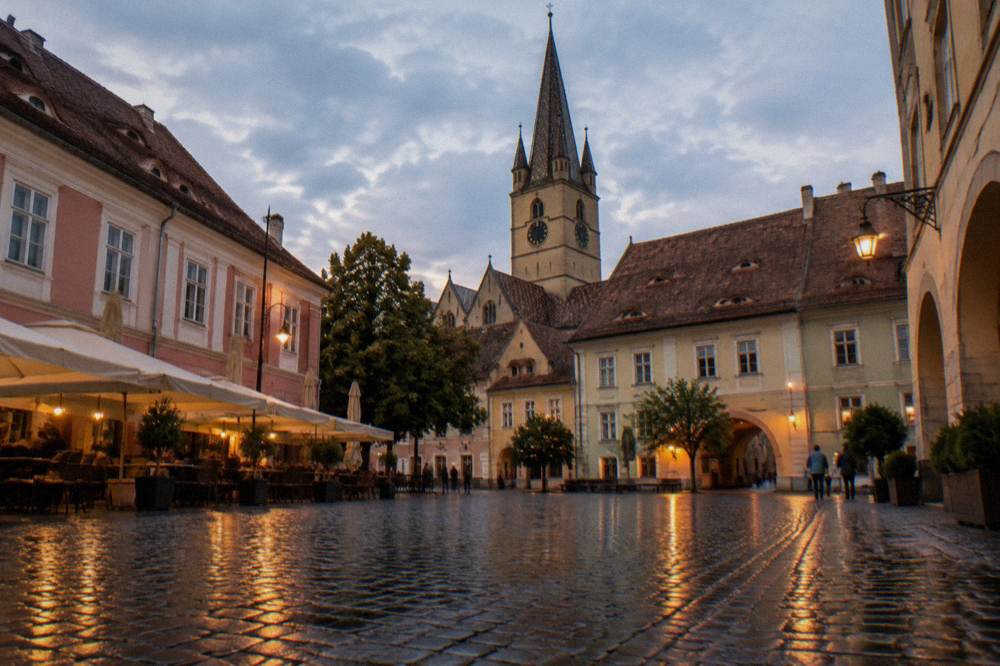
Yes: the high mountain day trips from Sibiu are seasonal by rule, not by preference. The Transfăgărășan's alpine section reopened for 2026 on 12 June, runs daily 07:00 to 21:00, and can be closed on any day from 20 October, with fines of 10,000 to 30,000 lei for driving the closed stretch. Păltiniș, about 40 minutes and 32 km from Piața Mare, opens its ski season on 28 November 2026.
The divide runs between the lowland and the highland trips. Sighișoara, about 102 minutes and 96 km by road, Alba Iulia at about 81 minutes and 71 km, and the Saxon villages of Cisnădie and Cisnădioara at 14 and 18 minutes, work in any weather a Sibiu winter produces, with the ordinary winter-driving caution. The fortified churches of Mărginimea Sibiului, Rășinari at about 18 minutes and Sibiel at about 36 minutes, are year-round country drives. The fortified churches near Sibiu guide covers that network.
| Day Trip | Distance From Piața Mare | Weather Sensitivity |
|---|---|---|
| Păltiniș | 32 km, about 40 min | Ski season opens 28 Nov 2026; lifts weather-dependent |
| Transfăgărășan high section | 63 km to Bâlea Cascadă, about 69 min | Closed any day from 20 Oct by rule; reopened 12 Jun 2026 |
| Bâlea Lake | 76 km, about 88 min | Road or cable car only; winter access by cable car on its own schedule |
| Sighișoara | 96 km, about 102 min | Year-round; allow extra time in snow |
| Alba Iulia | 71 km, about 81 min | Year-round |
| Rășinari | 13 km, about 18 min | Year-round |
| Brașov | 142 km, about 154 min | Year-round main road; allow winter margins |
Two road notes for winter planners. The A1 motorway toward Bucharest is unfinished, and the Sibiu to Boița section is closed from 5 October to 19 December 2026 for overpass works, with traffic diverted onto DN7, so the Bucharest road, about 250 km, deserves extra time rather than a motorway assumption. And clocks go back on Sunday 25 October 2026, Europe/Bucharest moving from UTC+3 to UTC+2, which shortens the usable daylight for any long autumn drive on the very date the high passes gain their closure window.
Spring has its own trap in reverse: the modelled March snowfall of 18.2 cm means the mountain roads can still carry winter well after the city has warmed to a mean high of 8.7 C. The Transfăgărășan opening each June is not a formality; it is the end of a genuine snow-clearing operation at altitude.
What Should You Pack For Sibiu?
Pack for the season you land in, because the spread is wide: from July mean highs of 24.2 C to January mean lows of -5.7 C, per the ERA5 reanalysis, 1991-2020. Summer calls for light layers, a rain shell for June storms and something warm for evenings that cool to about 14.6 C. Winter demands a real insulated coat, hat, gloves and waterproof boots with grip for snowy or icy streets.
| Season | Mean High / Low C | What To Bring |
|---|---|---|
| Dec to Feb | 2.2 to 4.3 / -5.7 to -3.9 | Insulated coat, thermal layers, waterproof boots, hat and gloves |
| Mar to May | 8.7 to 19.1 / -0.8 to 9.0 | Layers, light jacket, waterproof shoes; warm gear if March |
| Jun to Aug | 22.4 to 24.5 / 12.9 to 14.8 | Light clothing, rain shell, sweater for evenings, sun protection |
| Sep to Nov | 8.7 to 19.6 / 0.9 to 10.5 | Layers, jacket, umbrella; winter kit if November |
Footwear deserves the emphasis. Sibiu's old town is cobblestone throughout, the link between the Upper Town and the Lower Town is literally a stair passage, and in winter those surfaces hold ice and packed snow. Comfortable waterproof shoes serve every month of the year here, and traction matters more than style from December through February.
The rest of the kit is ordinary continental-Europe travel gear. An umbrella earns its place from May through September, sun protection from June through August when modelled sunshine peaks at 12.8 hours a day, and a daypack big enough to shed a layer into by mid-morning in April or October, when a day can span both seasons. Families juggling gear for several climates at once will find season-by-season suggestions in the Sibiu with kids guide.
Sibiu Weather Month By Month At A Glance
Each month in Sibiu carries a distinct character: deep winter cold and snow from December through February, a fast spring from March to May, a warm storm-seasoned summer from June to August, and a long mild autumn from September into early November, per the ERA5 reanalysis, 1991-2020, and the city's official rainfall figures. The summary table pairs each month with its mean temperatures, sunshine and the headline planning note.
| Month | Mean High C | Mean Low C | Sunshine H/Day | Planning Note |
|---|---|---|---|---|
| Jan | 2.2 | -5.7 | 6.2 | Peak modelled snow, 23.3 cm; market tail and quiet squares |
| Feb | 4.3 | -4.4 | 7.1 | Driest official month, 26.7 mm; cold but often clear |
| Mar | 8.7 | -0.8 | 8.7 | Warming city, still 18.2 cm modelled snow up high |
| Apr | 14.6 | 4.0 | 10.4 | Spring proper; layers, changeable |
| May | 19.1 | 9.0 | 11.3 | Named among the best months by tourism sources |
| Jun | 22.4 | 12.9 | 12.4 | Wettest official month, 113 mm; theatre festival season |
| Jul | 24.2 | 14.6 | 12.8 | Peak sunshine; Artmania in Piața Mare in 2026 |
| Aug | 24.5 | 14.8 | 11.8 | Highest mean high; warm evenings |
| Sep | 19.6 | 10.5 | 9.7 | Jazz festival month in 2026, 2 to 6 Sept; mild |
| Oct | 14.5 | 5.7 | 8.0 | High passes closable from 20 Oct by rule |
| Nov | 8.7 | 0.9 | 6.4 | First sustained snow, 13.0 cm; market opens 13 Nov 2026 |
| Dec | 3.1 | -3.9 | 5.6 | Shortest days, 8.7 h daylight; market in full swing |
Reading the table as a year, the honest summary is that Sibiu has no bad month, only months that suit different trips. June through August belongs to festivals, terraces and the full menu of mountain drives. December belongs to the market, the snow and the short blue days. May, June, September and October, the months tourism sources name as the best, split the difference: full access to the day-trip map, mild walking weather and daylight long enough for a full itinerary.
How Does Weather Shape A Walking Day In Sibiu?
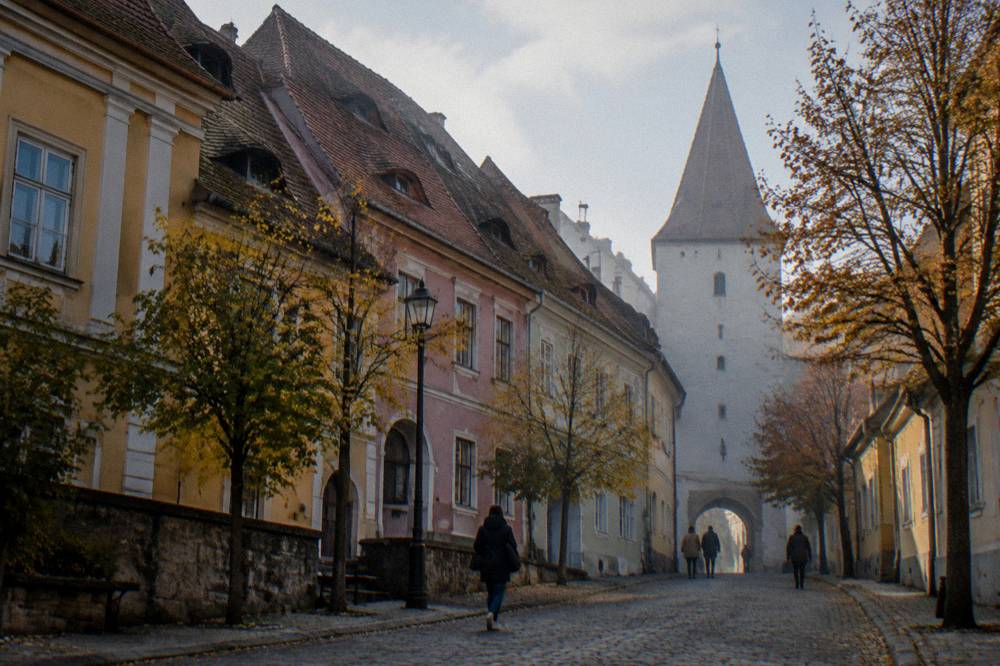
A walking day in Sibiu works in nearly every condition because the core sightseeing circuit, Piața Mare, Piața Mică, Piața Huet, the Bridge of Lies and the Stairs Passage, is compact, pedestrian and free of opening hours, and the indoor anchors cover the wet or cold hours: Brukenthal sites open Wednesday to Sunday and the Evangelical Cathedral tower, the open viewpoint at 10 RON, runs daily hours with late closing on Friday and Saturday.
The one 2026 closure that reshapes the classic circuit is the Council Tower, closed to visitors since 19 January 2026 for a restoration planned at about 24 months, with completion reported at about January 2028. The Evangelical Cathedral tower is the viewpoint that is actually open, 10 RON for an adult per the tourism site listing, open Monday 12:00 to 17:00, Tuesday to Thursday 10:00 to 17:00, Friday and Saturday 10:00 to 20:00 and Sunday 11:00 to 17:00. In winter, that Friday and Saturday evening window lines up with the market lights in Piața Mare below.
Weather-by-hour planning beats weather-by-day planning here. A June morning is reliably dry before the afternoon storm risk; a December midday, with the day's 8.7 hours of daylight centred near noon, is the window for photography; and in any season the walk from the Upper Town down through the Stairs Passage to the Lower Town is best done in dry or daylight conditions, since the steps are unlit historic stone. The Sibiu map guide lays out the circuit.
A guided walk makes the weather matter less, because a guide reroutes around it, and the roster's daily sightseeing tour, the related pick for this page, is bookable with free cancellation:
Between showers, the food side of the city is weather-proof by nature. A gastronomy walk or a long indoor lunch of ciorbă, sarmale or papanași turns a storm into the best hour of the day, and the what to eat in Sibiu guide maps the dishes worth ordering.
Does Sibiu Weather Affect Getting To And Around The City?
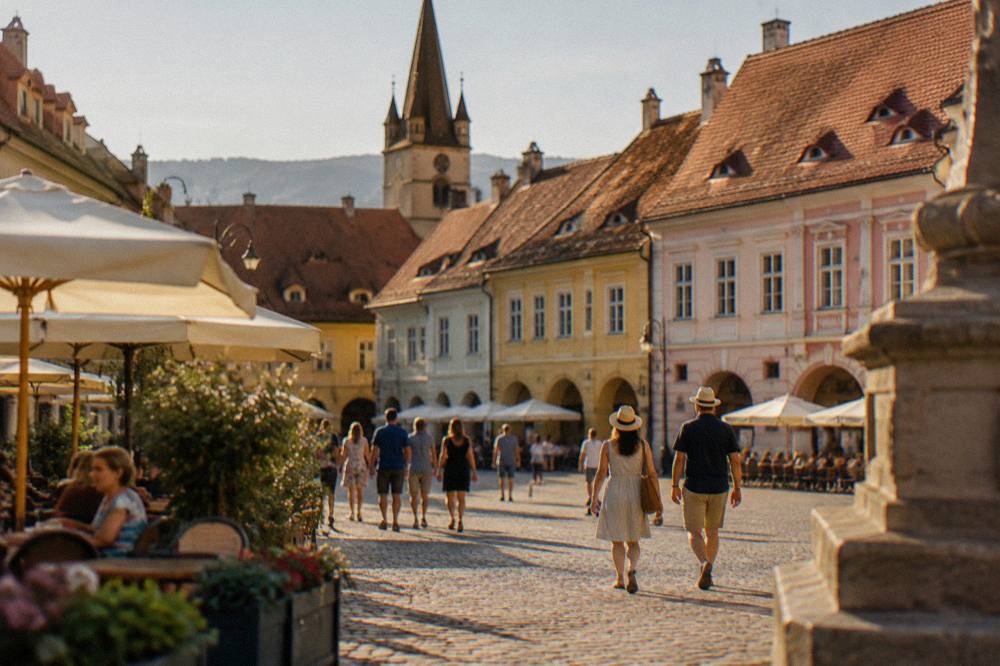
Reaching Sibiu is weather-stable: Sibiu International Airport is about 5 to 6 km from Piața Mare, served by Tursib bus line 11 with a 60-minute ticket at 3.5 lei, and winter fog or snow can delay flights but rarely closes the road network for long. Within the city, buses and the walkable centre make weather a comfort question rather than an access question.
Winter arrivals deserve one caveat: the Wizz Air winter 2026-27 schedule, from 25 October, cuts Sibiu to 17 flights a week, down from 20, so a weather-delayed flight has fewer same-day recovery options than in summer. The Sibiu airport guide and the getting around Sibiu guide cover the transfer details and onward connections, including the rail options toward Brașov, Sighișoara and Bucharest, with journey times best checked on the operator's own timetable before travel.
Getting around the city itself barely registers as a weather problem. The distance from the train station to Piața Mare is about 0.8 km, the bus station sits a similar distance away, and Tursib tickets at 3.5 lei for 60 minutes, 5 lei for 75 or 7 lei for 90 cover the network. In deep winter the calculation is simply whether the 0.8 km walk is pleasant, about 10 minutes at an easy pace, or whether the bus is the warmer call.
Where To Check The Sibiu Forecast Before And During A Trip?
Use a standard forecast service for the city itself and official road-status sources for the mountain roads: the Transfăgărășan's status changes by the day once 20 October approaches, and the road authority's live dispecerat channels, not a weather app, are the deciding voice on whether the high section is passable. For the city, any hourly forecast for Sibiu at about 420 m elevation will track the ERA5 normals described here.
The seasonal rhythm gives a reliable prior. If the calendar says January, pack for the modelled 23.3 cm snowfall and a mean low of -5.7 C, whatever the week's forecast adds. If it says July, plan for a mean high of 24.2 C and a storm slot in the afternoon. The forecast refines the normals; it does not replace them. For the shoulder months, the month-by-month table above is the better guide, because late April and late October can land a full season apart in a given year.
For the mountain day trips, two checks matter more than the weather app. The first is road status: the Transfăgărășan rule allows closure on any day from 20 October, and 2026 saw winter conditions at Bâlea Lake in late September while the road was still open. The second is daylight: with 8.7 hours in December, an 88-minute drive each way to Bâlea Lake compresses badly. The how to get to Sibiu guide adds the route-level detail for arrival planning.
The Bâlea cable car runs on its own schedule as the winter access when the road is closed, per the operator's page, which lists 09:00 to 18:00 with departures about every 30 minutes; confirm the current price and running status directly before counting on it.
Common Questions About Sibiu Weather
Does it snow in Sibiu?
Yes. Per the ERA5 reanalysis, 1991-2020, snow falls in Sibiu from November to March, with modelled monthly totals of 23.3 cm in January, 22.3 cm in February and 20.8 cm in December, and even March still averages 18.2 cm. Snow on the ground through midwinter is the normal state, not an exception.
What is the wettest month in Sibiu?
June, per the city's official page, which records 113 mm that month against an annual 662 mm. February is the driest at 26.7 mm. Summer rain tends to arrive as short afternoon storms rather than all-day rain.
How hot does Sibiu get in summer?
Per the ERA5 reanalysis, 1991-2020, July averages a high of 24.2 C and August 24.5 C, with overnight lows around 14.6 to 14.8 C. Individual days run warmer than the means, but the altitude of 415 to 431 m keeps sustained heat rare.
Is Sibiu cold in winter?
Yes, properly cold: mean lows sit at -5.7 C in January, -4.4 C in February and -3.9 C in December, against mean highs of 2.2 to 4.3 C, all per the ERA5 reanalysis, 1991-2020. Winter visitors need an insulated coat and boots with grip.
When is the best weather in Sibiu?
Tourism sources name May and June, and September and October, as the best months. The numbers support it: mean highs of 19.1 C in May and 19.6 C in September, mild nights and long daylight, without the June peak rainfall or the July and August peak warmth.
Does weather close the roads around Sibiu?
The alpine Transfăgărășan section can be closed on any day from 20 October under the standing rule, with fines of 10,000 to 30,000 lei for driving it closed, and its 2026 season ran daily 07:00 to 21:00 from 12 June. City and lowland routes, including those to Sighișoara and Alba Iulia, stay open year-round with ordinary winter caution. The A1 Sibiu to Boița section is closed 5 October to 19 December 2026 for works, with traffic diverted onto DN7.
Sibiu's weather is a continental four-season cycle with numbers you can plan against: 8.9 C mean annual temperature and 662 mm of rain officially, snow from November to March, and warm bright summers, all detailed month by month in the tables above. Match the season to the trip, spring and autumn for walking and the full day-trip map, winter for the market and Păltiniș snow, summer for festivals and the high passes, and the climate works with you rather than against you.
