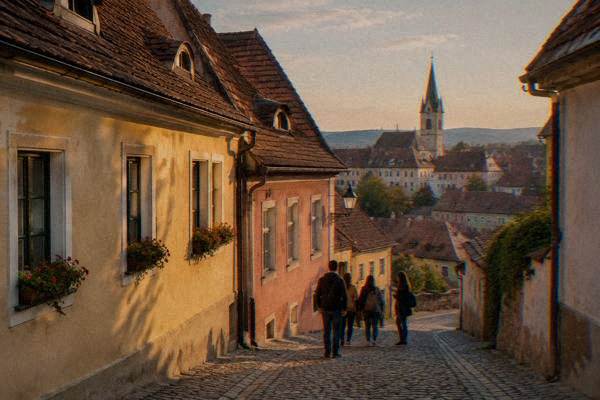
Huet Square: The Quiet Square Around The Cathedral
Piața Huet is the quietest of Sibiu's three old-town squares, wrapped around the Evangelical Cathedral and sitting a few steps above Piața Mare in the Upper Town.
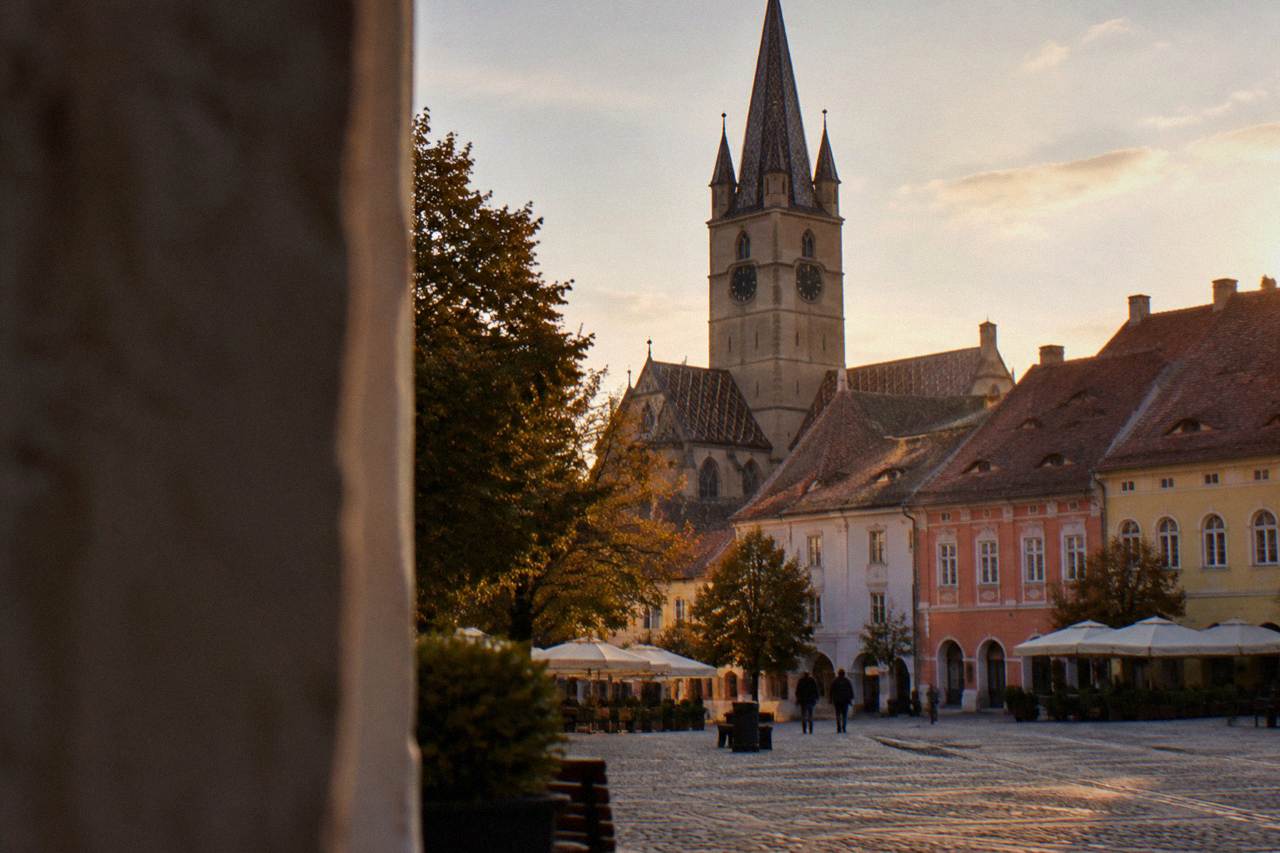
Short answer
Piața Huet is a free, always-open public square in Sibiu's Upper Town, dominated by the Evangelical Cathedral, whose tower charges 10 RON for adults and is the city's open viewpoint while the Council Tower is closed for restoration.
Sibiu, in Transylvania, central Romania, keeps its medieval old town around three connected squares, and Piața Huet is the quiet one at the top of the slope. Where Piața Mare is broad and civic and Piața Mică is lined with cafes under the arches, Huet Square is dominated by a single building: the Evangelical Cathedral, whose Gothic tower stands over the whole Upper Town. The square is a free, open-air public space with no ticket and no opening hours, and it sits about a minute's walk from Piața Mare, reached through the passage beside the Council Tower or down from the higher streets of the Upper Town. This page lays out what the square holds, what it costs, what its history is, and how it fits into a visit to the city.
The Sibiu Travel Guide editorial desk has assembled this page from what the city's own sources and the museum sites state, because Huet Square concentrates several things that changed in 2026: the Council Tower next door is closed for a two-year restoration, the cathedral tower is the viewpoint that replaced it, and the Brukenthal institutions around the corner run on a Monday-and-Tuesday closure pattern that shapes any itinerary. The square itself, though, asks nothing of a visitor except attention, and it rewards plenty.
Where Exactly Is Huet Square In Sibiu?
Piața Huet sits at the top of Sibiu's Upper Town, immediately northwest of Piața Mare and directly beside the Council Tower, roughly one minute's level walk from the Great Square through the archway on the tower's side. The square forms an uneven L around the Evangelical Cathedral, serving as the northern anchor of the old town's square sequence. The square forms an uneven L around the Evangelical Cathedral, with historic houses closing the remaining sides, and it functions as the northern anchor of the old town's square sequence. From here the Stairs Passage drops toward the Lower Town, and the streets behind rise toward the former city walls and their surviving towers. Everything in the square is pedestrian-scale and walkable in a few minutes; the whole old town of Sibiu is compact, and Huet Square is close to its geographic heart.
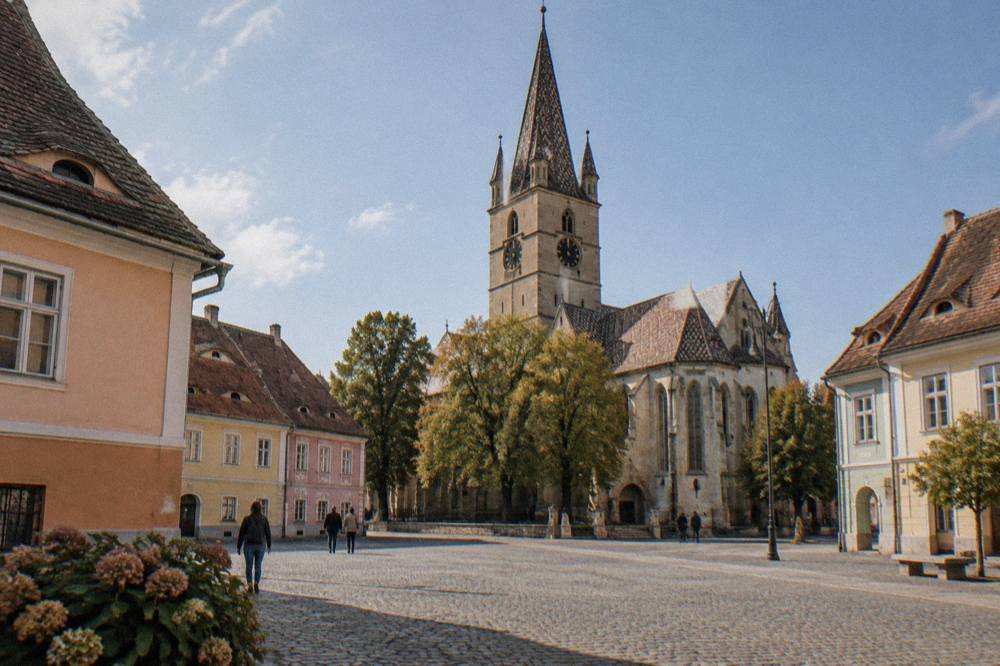
The square belongs firmly to the Upper Town, the higher of Sibiu's two historic halves, which sits at about 431 m above sea level against the Lower Town's 415 m, per the city's own presentation page. The Upper Town was the civic and ecclesiastical quarter, and Huet Square was its church square: the cathedral, the parish architecture around it and the first schools of the Saxon community all gathered here. The Lower Town, by contrast, was the craft and trade quarter, reached down the Stairs Passage a short walk away.
Orientation is simple. Stand in the square facing the cathedral's west tower. Behind you, through the passage under the Council Tower, lies Piața Mare, the Great Square with the Brukenthal Palace on its western side. To the right, the slope runs down to Piața Mică and the Bridge of Lies. To the left and behind, the streets of the Upper Town climb toward the old walls. A visitor who can hold those four directions can navigate the entire old centre from this one square.
| From Piața Huet to | Walking time | Notes |
|---|---|---|
| Piața Mare | about 1 minute | through the passage beside the Council Tower |
| Piața Mică and the Bridge of Lies | about 3 minutes | downhill via the Council Tower steps |
| Stairs Passage to the Lower Town | about 4 minutes | historic covered stairway, free access |
| Brukenthal National Museum (Palace) | about 3 minutes | Piața Mare 4-5, per the museum's own price page |
| Orthodox Cathedral | about 8 minutes | across the Upper Town toward the park |
| Train station (Gara Sibiu) | about 12 minutes on foot | station sits about 0.8 km from Piața Mare |
Walking times between the squares are short and level along the Upper Town ridge; only the descents to the Lower Town involve stairs, and those are part of the city's character rather than an obstacle.
What Can You See On Huet Square In Sibiu?
The square's sights are the Evangelical Cathedral and its climbable tower, the Statue of Samuel von Brukenthal on the southern side, the closed Council Tower framing the passage to Piața Mare, and the rows of historic houses whose roof windows form part of the "eyes of Sibiu" the city is known for. Everything except the cathedral tower is free and open at any hour, because the square is a public space with no gate, no ticket desk and no closing time. The cathedral charges admission, and its tower is a separate climb, and both are the only paid items on the square. The rest is architecture, public art and atmosphere, which is precisely why the square suits a slow loop at the start or end of a day.
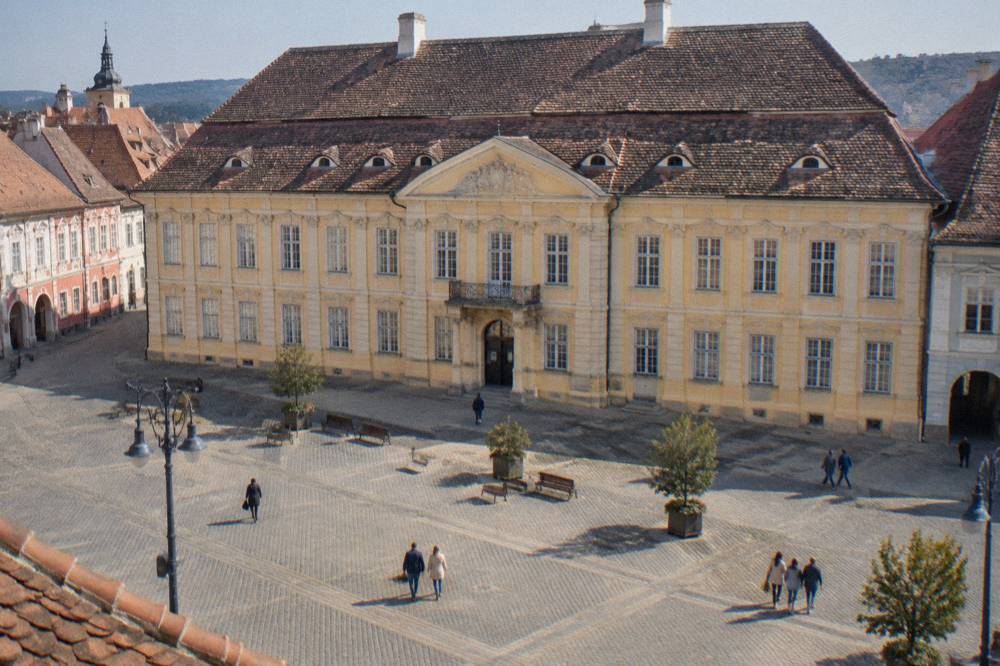
The Evangelical Cathedral is the square's reason for being. It is a Gothic hall church, the principal Lutheran church of the Transylvanian Saxon community, and the tourist infrastructure around it is minimal and honest: a small admission, a separate tower ticket, hours posted by the parish and carried on the city's tourism site. The tower is the current open viewpoint of the old town, and this matters more than usual in 2026 and 2027, because the Council Tower a few steps away has been closed to visitors since 19 January 2026 for a restoration planned at about 24 months, with completion reported at about January 2028. The cathedral tower is where the view went.
The Statue of Samuel von Brukenthal, the Habsburg governor whose collection became the Brukenthal National Museum, stands at the square's southern edge, a quiet reminder that the museum's palace is only two squares away. The museum opened to the public in 1817, per the museum's own historical pages, and its presence still shapes the neighbourhood. Around the square's remaining sides stand gabled houses whose attics carry the small eyebrow dormers locals and guidebooks call the eyes of Sibiu, a free architectural detail visible from the cobbles themselves.
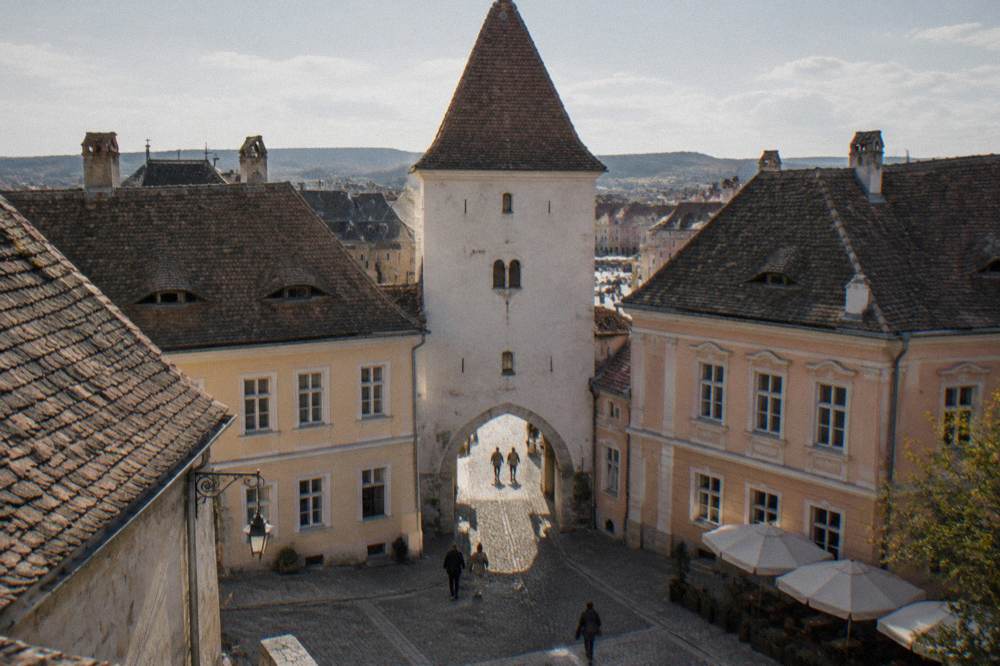
Two practical cautions come from the current facts, not from folklore. First, the Council Tower is not climbable and has no price or hours to check; its walls were cleaned and re-plastered and its copper roof removed as of September 2026, per the City Hall statement carried by local media, and the work continues. Second, the Brukenthal museums around the corner are closed on Mondays and Tuesdays, so a weekend-to-Tuesday visitor who plans museum time around the square needs to shape the itinerary accordingly. The square itself never closes.
A guided walk is one way to absorb the square's layers quickly, and the daily sightseeing tour this site features covers the old town's landmarks, Huet Square among them, starting from the city centre. You can also Check availability directly with the operator's live listing.
How Much Does It Cost To Visit Huet Square In Sibiu?
The square itself is free, the Evangelical Cathedral charges 10 RON for an adult and 5 RON for pupils, students and pensioners, and the tower climb is priced the same way, 10 RON adult and 5 RON reduced, per the city's tourism site. Those are the whole costs of the square for a visitor. There is no city card or tourist pass in Sibiu, and none was found on any official source, so nobody should plan around one. The prices below are the official figures on the parish listing; as with any church admission, confirm the current price on site before climbing, because parishes adjust small fees without much notice.
| Item | Adult | Reduced (pupils, students, pensioners) |
|---|---|---|
| Piața Huet itself | free, no hours | free, no hours |
| Evangelical Cathedral admission | 10 RON | 5 RON |
| Evangelical Cathedral tower | 10 RON | 5 RON |
| Council Tower | closed for restoration since 19 January 2026 | closed, no tickets apply |
| Brukenthal Palace, two squares away | 50 RON | 25 RON pensioners, 12.50 RON pupils and students |
The Brukenthal rows in that table come from the museum's own price page, which also lists a 48-hour combined ticket at 120 RON covering its sites, and the museum asks visitors to confirm before they go, since a price adjustment was discussed in the press in 2026 without any confirmed change on the official page. The pattern to remember when budgeting a day around Huet Square is Monday and Tuesday: the main Brukenthal museums are closed those two days, while the cathedral runs its own weekly rhythm, listed below.
| Day | Evangelical Cathedral hours (per the city's tourism site) |
|---|---|
| Monday | 12:00 to 17:00 |
| Tuesday to Thursday | 10:00 to 17:00 |
| Friday and Saturday | 10:00 to 20:00 |
| Sunday | 11:00 to 17:00 |
Guided visits of the cathedral are available on request in Romanian, German and English, per the same listing, and the church asks visitors to respect service times. That is the sum of what is officially published: no combined church-and-tower ticket was found on the parish listing, so treat the two as separate 10 RON admissions even though some secondary sources describe a bundled price.
When Is The Best Time To Visit Huet Square In Sibiu?
Morning light and late afternoon suit Huet Square best photographically, because the cathedral tower faces the rising sun and the houses glow in the early evening, while the practical answer is that any hour works, since the square is public and free, and the only clock that matters is the cathedral's opening schedule. Visitors who want the tower climb should aim for a weekday morning outside service times, when the stairwell is quietest and the parish desk is staffed. The tourist-friendliest months per tourism climate sources are May, June, September and October, with mild air and thinner crowds than midsummer.
Sibiu's climate is temperate continental, and the square is an outdoor space, so the seasons shape the visit. The city's official figures give a mean annual temperature of 8.9 C and mean annual rainfall of 662 mm, with June the city's stated wettest month at 113 mm and February its driest at 26.7 mm. The table below, from the ERA5 reanalysis, 1991-2020, a modelled grid cell rather than a weather-station record, gives the shape of a year in temperature, sunshine and snow.
| Month | Mean high C | Mean low C | Sunshine h/day | Snowfall cm |
|---|---|---|---|---|
| January | 2.2 | -5.7 | 6.2 | 23.3 |
| February | 4.3 | -4.4 | 7.1 | 22.3 |
| March | 8.7 | -0.8 | 8.7 | 18.2 |
| April | 14.6 | 4.0 | 10.4 | 7.8 |
| May | 19.1 | 9.0 | 11.3 | 0.3 |
| June | 22.4 | 12.9 | 12.4 | 0.0 |
| July | 24.2 | 14.6 | 12.8 | 0.0 |
| August | 24.5 | 14.8 | 11.8 | 0.0 |
| September | 19.6 | 10.5 | 9.7 | 0.1 |
| October | 14.5 | 5.7 | 8.0 | 2.7 |
| November | 8.7 | 0.9 | 6.4 | 13.0 |
| December | 3.1 | -3.9 | 5.6 | 20.8 |
Winter gives the square a particular stillness. Snow falls somewhere in the Sibiu grid cell in every month from November to March in the ERA5 reanalysis, 1991-2020, and December through February are the snowy heart of the season, which suits the square's Gothic silhouette well. From 13 November 2026 to 3 January 2027 the Christmas market fills nearby Piața Mare, free to enter, per the market's own site, and a walk up to Huet Square between market visits is a natural loop for a cold evening, when the tower is floodlit and the square is nearly empty. Summer evenings work the same way in reverse: the long daylight of June and July, modelled at more than 12 hours a day, lets a visitor finish dinner on Piața Mică and still catch the square in full light.
What Is The History Of Huet Square In Sibiu?
Huet Square grew as the church square of Sibiu's Saxon Upper Town around the Evangelical Cathedral, in a city first documented in 1191 as Cibinium, and its name honours the Saxon pastor and historian Christian Friedrich HTC von Huet, with the surrounding quarter holding the institutions of the Transylvanian Saxon community. The documented date comes from the city's own history page, which records the 1191 confirmation of the German prepositure, and the Saxon settlement itself is reported by the heritage authority as arriving from the Moselle area in the 12th century. The square's built form is medieval in footprint, with house fronts from later periods layered over it, and the city's sources give no architect or construction date for the cathedral's present fabric.
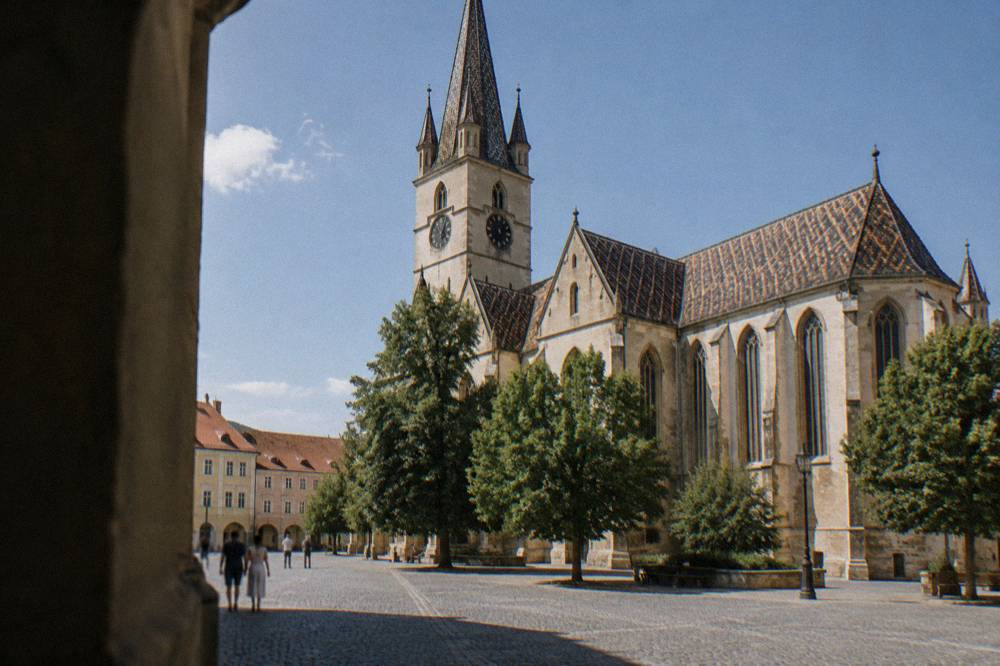
What the sources do support is the institutional story. The city's own chronology credits Sibiu with the first hospital on current Romanian territory in 1292, the first school in 1380 and the first pharmacy in 1494, and those institutions belonged to exactly the church-and-school quarter that Huet Square anchors. Samuel von Brukenthal, governor of Transylvania from 1777 to 1787, left the collection that opened to the public as a museum in 1817, per the museum's own historical pages, and his statue now watches the square from its southern edge. The Bridge of Lies nearby, reportedly the first cast-iron bridge in Romania, was built in 1859 to 1860 per secondary sources, part of the same era of modernisation that reshaped the old town's crossings.
The square's present moment is defined by the restoration beside it. The Council Tower has stood over the passage between Piața Mare and Piața Huet since the medieval period, but its documented present is a construction site: closed since 19 January 2026, its walls cleaned and re-plastered and its copper roof dismantled as of late September 2026, per the City Hall statement in local media, with completion reported at about January 2028. A time capsule was found on the site in September 2026, local media reported. Until the tower reopens, the cathedral tower above the square carries the viewing role, and the square's history is best read from the ground, house by house, plaque by plaque.
How Does Huet Square Compare With Piața Mare And Piața Mică In Sibiu?
Huet Square is the smallest and quietest of Sibiu's three old-town squares, and the only one organised around a church rather than commerce: Piața Mare is the grand civic space, Piața Mică is the cafe-and-craft square under the Council Tower, and Piața Huet is the ecclesiastical one, with the cathedral, the Brukenthal statue and a calmer rhythm. All three are free public spaces with no tickets or hours, and all three sit within a three-minute walk of one another, which is why the triangle they form is the standard spine of every Sibiu walk, including the guided city walking routes the old town is built around.
| Square | Character | Ticketed items | Best for |
|---|---|---|---|
| Piața Mare | grand civic square, Brukenthal Palace, City Hall | Brukenthal Palace 50 RON, closed Mon-Tue | scale, museums, Christmas market |
| Piața Mică | cafes, arcades, the Bridge of Lies at its end | Pharmacy History Museum 16 RON | eating, evening light, the bridge |
| Piața Huet | church square around the cathedral | Cathedral and tower, 10 RON each, adult | quiet, the view from the tower, architecture |
The differences are practical as much as atmospheric. Piața Mare carries the events: the Christmas market from 13 November 2026, and the open-air festival editions the square hosts in summer. Piața Mică carries the evenings, with the Bridge of Lies and its legend of collapsing under liars at its western end. Piața Huet carries the mornings, the tower climb and the photography, and it is the square where a visitor is most likely to have the cobbles to themselves before ten o'clock. A sensible loop runs all three in order, Mare to Mică to Huet, and takes fifteen minutes at a stroll, or a full morning with the cathedral and the tower included.
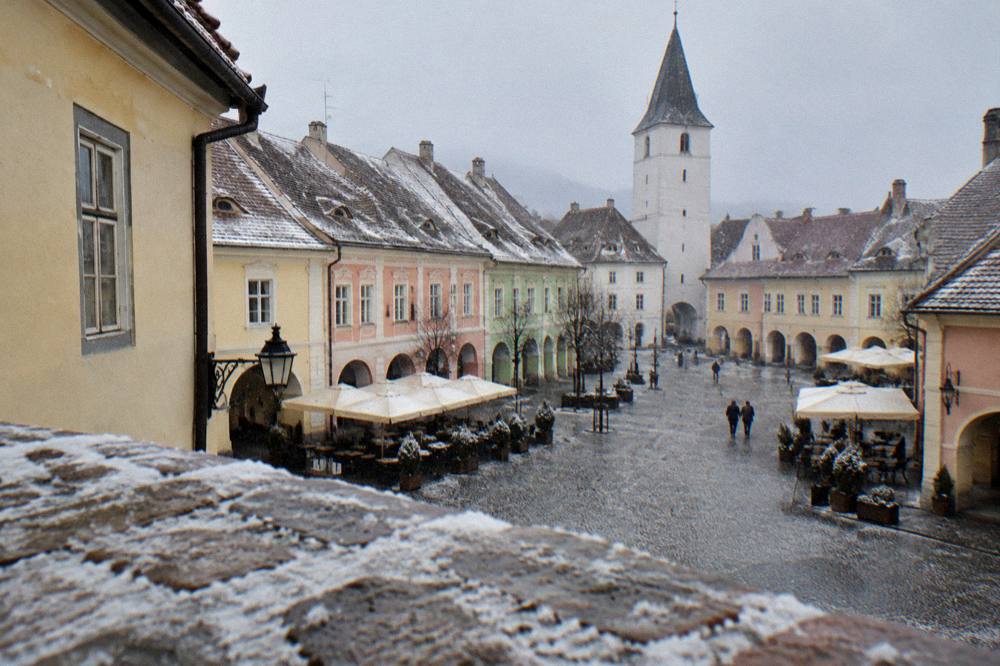
What Sibiu Tours Include Huet Square?
Huet Square appears on essentially every guided old-town walk in Sibiu, because no route through the Upper Town can skip the cathedral, and this site's featured option, the daily sightseeing guided tour, covers the old-town landmarks in a short loop from the centre, with private walking tours and themed walks as alternatives. Product details, prices, ratings and durations for those tours render from the listings themselves rather than from this page, and availability changes with the season, so the listing is always the place to confirm. What can be said in prose is coverage: the sightseeing walk takes in the squares and their principal buildings, while deeper options add the Brukenthal collections, the gastronomy of the old town, or the countryside beyond the walls.
For visitors who want the square explained rather than just seen, a guide solves two problems at once: the architecture rewards context that signage does not fully provide, and the 2026 closures, the Council Tower and the museum days, are easier to plan around with someone who works around them daily. The alternative is the self-guided route this site describes in its things to do in Sibiu overview, which reaches the square as its second or third stop after Piața Mare.
Beyond the city walls, the same operators run the day trips that give the square its context. The Transylvanian Saxon community that built this church also built the fortified churches of the villages, and a day trip into that countryside explains why a parish church needed a tower this defensible in the first place.
Food-minded visitors can pair the square with a cooking workshop in the city, which turns the Transylvanian dishes named on Sibiu menus, sarmale, ciorbă, mici and papanași, into something a visitor can recognize and order with intent for the rest of the trip.
How Do You Photograph Huet Square In Sibiu?
The two classic frames of Huet Square are the cathedral tower seen full-height from the square's north-eastern corner in morning light, and the Statue of Brukenthal silhouetted against the cathedral's south side in late afternoon, with the "eyes of Sibiu" dormers on the surrounding roofs as the detail shot. The square is small enough that a 20-minute visit at either end of the day covers the main angles, and the cobble surface and pedestrian scale mean no road traffic interrupts a long exposure in the early morning. The passage toward the Council Tower adds a third composition: the tower, scaffolded through its restoration, framed in the archway, which documents the square's 2026 state as honestly as any postcard ever will.
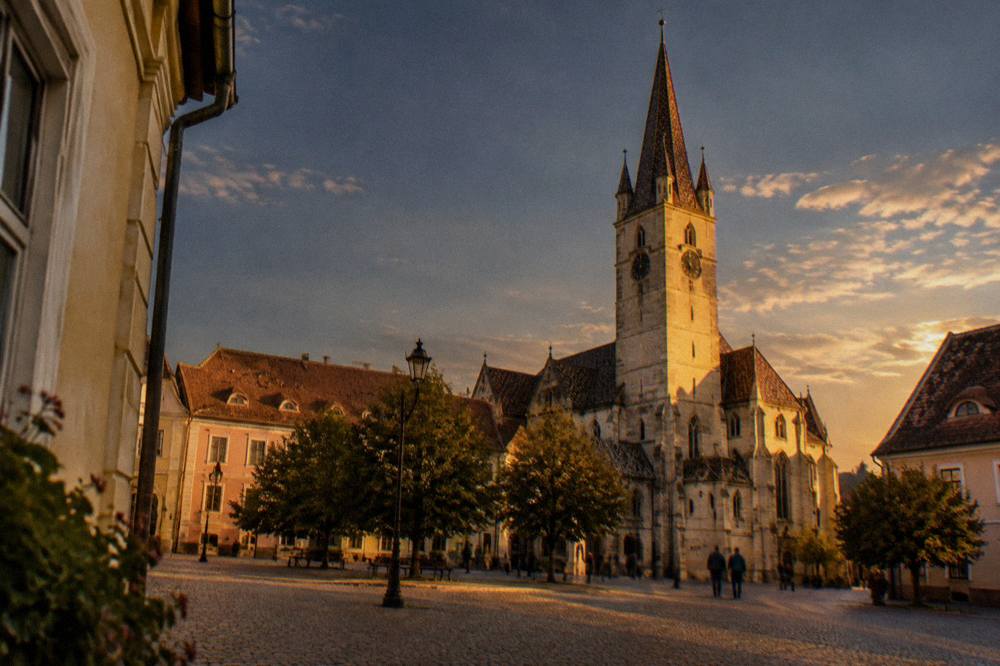
Light works differently by season, per the ERA5 reanalysis, 1991-2020: December offers only about 5.6 modelled sunshine hours a day and a low sun that rakes across the roofs, while July gives about 12.8 and lifts the tower cleanly out of the skyline. Snow changes the square completely, with November through March the months when modelled snowfall appears in the grid cell, and January the heaviest at 23.3 cm. Photographers wanting the tower without crowds should note the cathedral's Monday opening at 12:00 rather than 10:00, which makes Monday morning the quietest slot on the square's weekly clock.
Common Questions About Huet Square In Sibiu
Is Huet Square in Sibiu free to visit?
Yes. Piața Huet is a public open-air square with no ticket, no gate and no opening hours. The only paid items on the square are the Evangelical Cathedral admission, 10 RON for adults and 5 RON reduced, and the tower climb at the same prices, per the city's tourism site.
Can you climb the Council Tower from Huet Square?
No. The Council Tower has been closed to visitors since 19 January 2026 for a restoration planned at about 24 months, with completion reported at about January 2028. The Evangelical Cathedral tower on the square, at 10 RON for adults, is the open viewpoint in the meantime.
What is Huet Square known for?
The square is known for the Evangelical Cathedral that dominates it, the Statue of Samuel von Brukenthal, and its role as the church square of Sibiu's Saxon Upper Town, in a city first documented in 1191. The surrounding houses also carry the roof "eyes" that Sibiu is famous for.
How far is Huet Square from Piața Mare in Sibiu?
About one minute on foot, through the arched passage beside the Council Tower. Piața Mică is about three minutes away, and the Stairs Passage down to the Lower Town begins about four minutes from the square.
When is the Evangelical Cathedral on Huet Square open?
Per the city's tourism site: Monday 12:00 to 17:00, Tuesday to Thursday 10:00 to 17:00, Friday and Saturday 10:00 to 20:00, and Sunday 11:00 to 17:00, with guided visits on request and service times to be respected. Confirm on site before a visit timed to the hour.
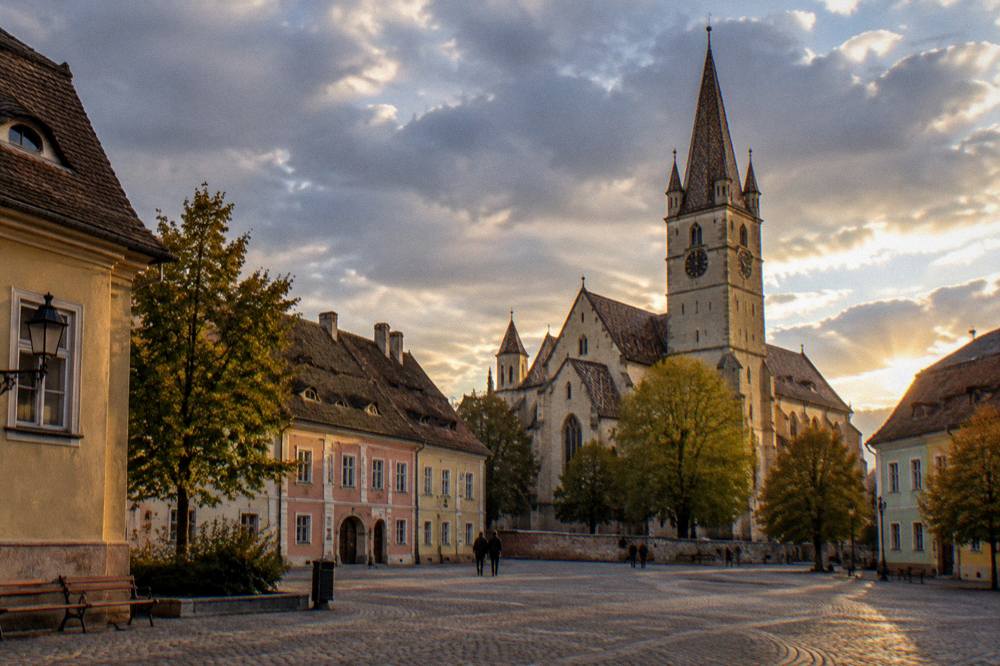
Huet Square asks for less planning than anywhere else in Sibiu's old town and gives back the city's clearest single image: a Gothic tower over Saxon rooftops, free to stand beneath, a few steps from everything else. Walk up from Piața Mare in the morning, climb the cathedral tower while the Council Tower sleeps under its scaffolding, and let the rest of the day organise itself around the two livelier squares below.