Lower Town: Along The Cibin Below The Walls
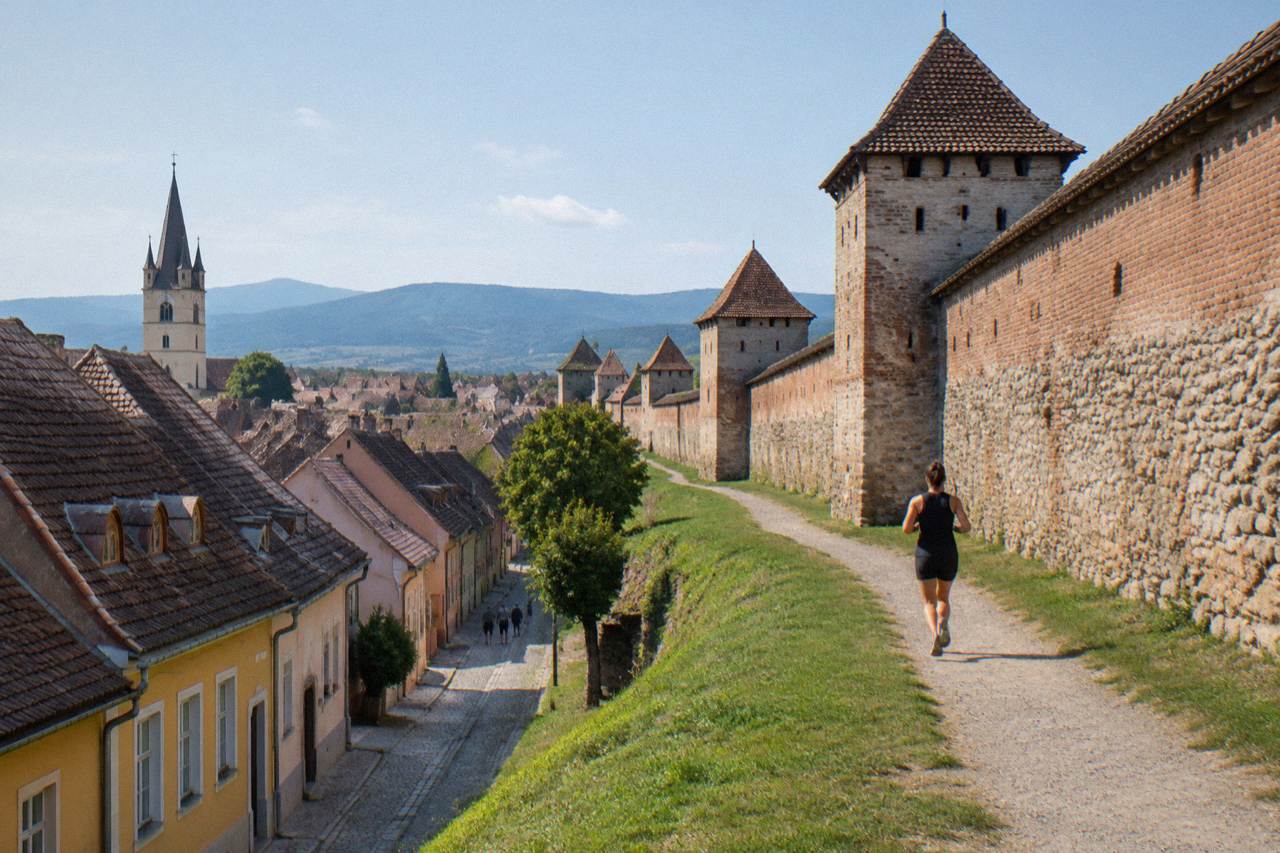
Sibiu's Lower Town is the bowl of streets that spreads from the foot of the Upper Town plateau down toward the Cibin river, a patchwork of pastel houses, quiet lanes and the surviving wall and towers that once guarded the Saxon city.
Short answer
The Lower Town (Orașul de Jos) sits about 0.4 km straight-line from Piața Mare, below the Upper Town plateau, linked by the free, always-open Stairs Passage. Its squares, walls and towers need no ticket; the Council Tower above it is closed for restoration until about January 2028.
Sibiu's Lower Town, the Orașul de Jos, is the half of the city that spreads downhill from the plateau of the Upper Town toward the Cibin river, the water that gave the medieval settlement its Latin name, Cibinium, first documented in 1191. The city sits at about 415 m in its lower part and 431 m on the plateau, and that sixteen-metre step in the ground is the whole reason the two halves exist: the Saxons built their main squares and churches on the high ground and let the trades, the gardens and the smaller houses fill the slope and the flood plain below. What the visitor gets today is a ring of surviving walls and towers, steep-roofed streets in muted colours, and a slower, more residential rhythm than the piazzas above. The whole area sits about 0.4 km straight-line from Piața Mare, so nothing here is more than a short walk from the centre, and every one of its open-air sights, the walls, the towers, the passage and the lanes, costs nothing to enter.
What Is The Siu Lower Town And Where Does It Begin?
The Sibiu Lower Town, Orașul de Jos, is the low-lying half of the medieval city, running from the foot of the Upper Town plateau down to the Cibin river, about 0.4 km straight-line from Piața Mare. It grew as the trades and artisans' quarter beneath the walled citadel, and its streets still follow that older, denser grain of small houses, narrow lanes and garden plots, rather than the grand squares above.
The split between the two towns is not symbolic, it is topographical. Sibiu's official presentation puts the city between 415 m and 431 m of altitude, and the Upper Town, described in the site's area guide to the plateau, occupies the rise while the Lower Town fills the shelf and slope below it. Historically the division was also legal and economic: the Saxon burghers held the high ground with the main squares and the parish church, while tanners, potters, coopers and other trades worked along the water. The name of the Potters' Tower among the surviving wall towers is a direct record of that arrangement.
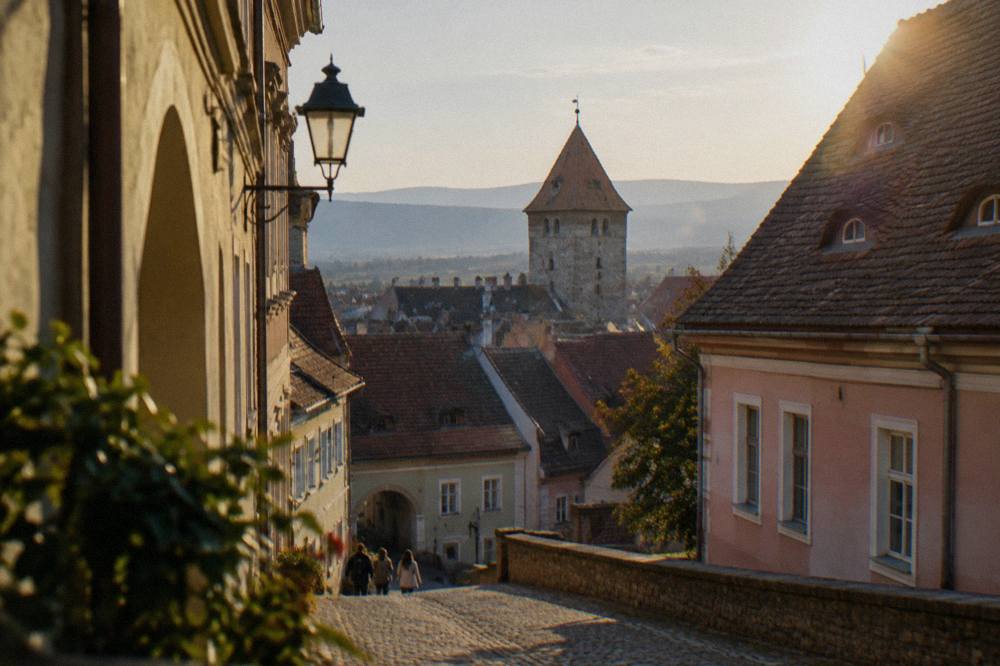
The practical boundary a visitor cares about is the line of the city wall itself. Below the wall you are in the Lower Town's oldest streets, threaded between the towers; above it you climb into the network around Piața Mare, Piața Mică and Piața Huet. Because the whole city is compact, the crossing takes minutes. The one-day Sibiu itinerary treats the Lower Town as a half-day loop at most, and the two- and three-day plans give it a fuller sweep.
The character below the wall rewards slow walking. Houses stand shoulder to shoulder in ochres, blues and faded pinks, with the steep roofs and small dormer windows that make Sibiu's streetscape recognisable from any angle. The 'eyes of Sibiu', the roof windows that look down like eyelids over the street, are everywhere here, and they are free to look back at from any pavement.
How Do You Walk Between The Sibiu Lower Town And The Upper Town?
The main pedestrian link is the Stairs Passage, Pasajul Scărilor, a covered stone stairway that climbs the face of the plateau between the Lower Town and the Upper Town, and it is a free public space with no ticket and no opening hours. It is the most direct and the most atmospheric route on foot, and the wall towers at its top frame the arrival into Piața Huet.
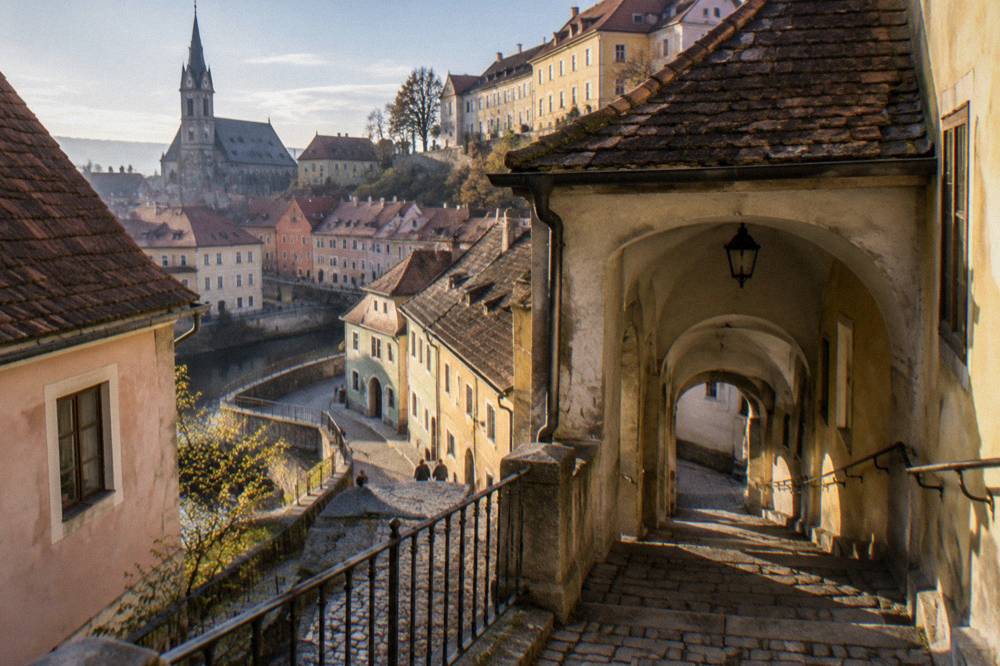
The passage is described in detail on the site's Stairs Passage page, including its role as the historic gated connection between the two levels of the city. Alternatives exist on the sloping streets either side, which wind more gently and suit anyone who prefers a gradual climb, but the stairway is the route that carries the history: the city's defences were built to control exactly this kind of pinch point, and walking up it you understand why the Upper Town was the safe half.
The passage also connects the Lower Town to the cluster of towers at the wall's edge, covered in the next section. For orientation before you go, the site's Sibiu map guide lays out the two levels and the walking lines between them, and for a guided version of the same terrain, the evening panorama walk described below covers the ground with a guide and then climbs out of the valley for the view back.
For anyone weighing guided options against walking it alone, these are the current bookable picks that fit the Lower Town and its surroundings:
The panorama tour is the one that belongs most naturally to this page: it crosses the Cibin valley in the evening and looks back at the Lower Town from Gușterița Hill, so the bowl of roofs and towers appears whole, with the wall line showing clearly against the plateau.
What Walls And Towers Survive Around The Sibiu Lower Town?
The Lower Town keeps a genuine ring of medieval fortification on its upper edge, including the Potters' Tower, the Arquebusiers' Tower and the Stairs Tower, all of them open-air public structures with no ticket and no opening hours, per the city's tourism listings. Together with the surviving wall sections they form a free walking circuit that frames the whole Lower Town from above.
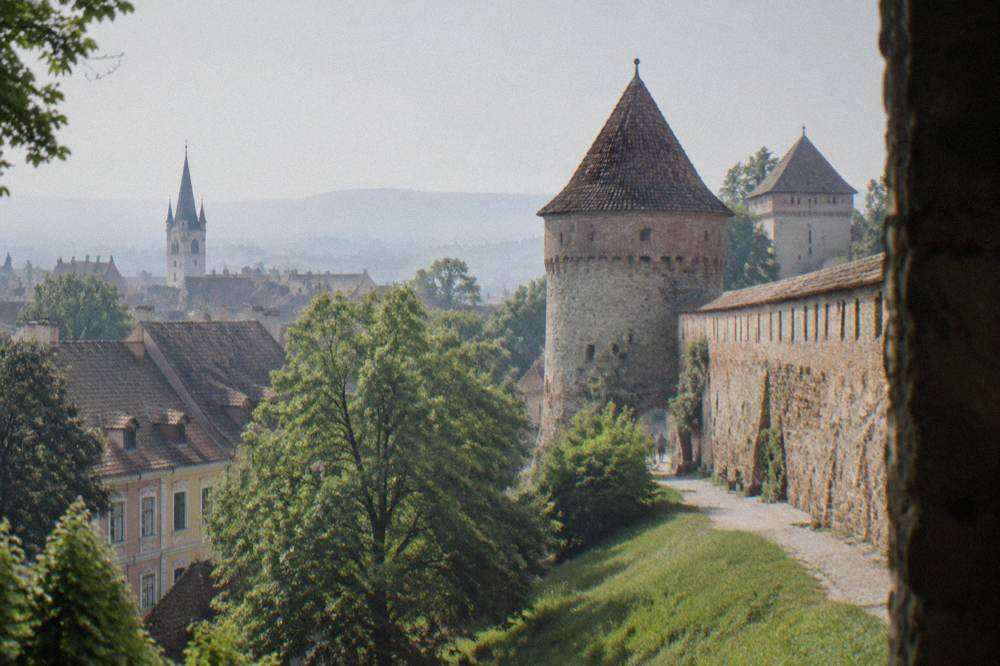
The walls and towers page covers the individual structures and their history. What matters down here is the ensemble: the towers are spaced along the contour so that each covers a stretch of the wall and the slope below it, and the street grid inside the ring still bends around them. Sibiu was a fortified city with successive rings of defence, attested in the city's UNESCO documentation, and the Lower Town's edge is where the most legible pieces survive.
Two 2026 corrections matter for anyone planning the walk. First, the Council Tower, the symbol of the city standing between Piața Mare and Piața Mică above the wall, is closed to visitors: it has been in restoration since 19 January 2026, with completion reported at around January 2028. Print no climb, no ticket and no hours for it; the open viewpoint in the centre is the Evangelical Cathedral tower, listed at 10 RON for an adult on the city's tourism site. Second, the Brukenthal museums above are closed Monday and Tuesday, and the Hunting Museum branch is closed for an indefinite period, so a Lower Town walk combined with a museum morning needs to land on Wednesday to Sunday.
| Free sight in or beside the Lower Town | Access | Ticket |
|---|---|---|
| Stairs Passage (Pasajul Scărilor) | Open-air public passage, always walkable | None |
| Potters' Tower | Exterior view from public streets | None |
| Arquebusiers' Tower | Exterior view from public streets | None |
| Stairs Tower | Exterior view beside the passage | None |
| Lower Town lanes and house fronts | Public streets | None |
| Cibin riverbanks | Public ground | None |
One paid sight sits right on the boundary: the Pharmacy History Museum in Piața Mică 26, under the sign of the Black Bear, part of the Brukenthal National Museum, listed at 16 RON for an adult on the museum's own price page. It closes Monday and Tuesday like the other main Brukenthal sites. The climb to it from the Lower Town is the Stairs Passage itself, so the pairing is natural.
How Far Is The Sibiu Lower Town From Everything Else?
The Lower Town's core sits about 0.4 km straight-line from Piața Mare, closer than any other named area of the city except the Upper Town itself, which measures 0.1 km from the square. The train station and the intercity bus station are each about 0.8 km away, and the outlying areas, Terezian at 1.2 km, Turnișor at 2.7 km and Dumbrava at 4.6 km, ring it at increasing distance.
These figures are computed straight-line distances from Piața Mare, published on this site's map guide, and they explain the Lower Town's convenience: every transport arrival point in the city is within roughly a kilometre of its streets. On foot, nothing in the central pair of towns takes more than about fifteen minutes to reach.
| Place | Straight-line distance from Piața Mare |
|---|---|
| Upper Town (Orașul de Sus) | 0.1 km |
| Lower Town (Orașul de Jos) | 0.4 km |
| Gara Sibiu, the train station | 0.8 km |
| Intercity bus station | 0.8 km |
| Terezian | 1.2 km |
| Turnișor | 2.7 km |
| Dumbrava Sibiului | 4.6 km |
The neighbouring areas each get their own page on this site: Dumbrava, the forest and museum quarter to the south, Turnișor to the west, and Terezian between the centre and the station zone. All of them are residential in character, and none has a sourced safety score, price level or noise rating, so this site prints none.
For arrivals, the practical details are fixed and cheap. Tursib city-bus tickets cost 3.5 lei for 60 minutes, 5 lei for 75 minutes with one transition and 7 lei for 90 minutes with two, per the operator's tariff page, and the airport lies about 5 to 6 km out. A full plan of arrival options sits on the main things to do page.
What Is The Weather Like Down In The Sibiu Lower Town?
Sibiu has a temperate continental climate with a mean annual temperature of 8.9 C and mean annual rainfall of 662 mm, per the city's official presentation, and the Lower Town shares it exactly, sitting only metres below the plateau. The ERA5 reanalysis, 1991-2020, puts January highs at 2.2 C with lows of -5.7 C and snow in every winter month, and July and August highs at their warmest of the year, with sunshine peaking near 12.8 hours a day in July.
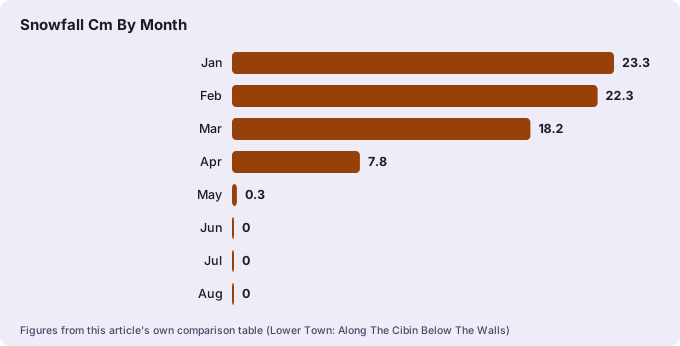
There is no microclimate to speak of between the two towns. The sixteen metres of altitude between bowl and plateau change the view, not the weather. What the lower ground does change underfoot: winter snow, from 23.3 cm in a modelled January and 20.8 cm in December, lingers on streets that get less direct sun than the open squares above, so the cobbles and the stairway deserve steady footwear from November to March. The full index of guides sits on Sibiu Travel Guide.
| Month | Mean high C | Mean low C | Sunshine h/day | Snowfall cm |
|---|---|---|---|---|
| Jan | 2.2 | -5.7 | 6.2 | 23.3 |
| Feb | 4.3 | -4.4 | 7.1 | 22.3 |
| Mar | 8.7 | -0.8 | 8.7 | 18.2 |
| Apr | 14.6 | 4.0 | 10.4 | 7.8 |
| May | 19.1 | 9.0 | 11.3 | 0.3 |
| Jun | 22.4 | 12.9 | 12.4 | 0.0 |
| Jul | 24.2 | 14.6 | 12.8 | 0.0 |
| Aug | 24.5 | 14.8 | 11.8 | 0.0 |
| Sep | 19.6 | 10.5 | 9.7 | 0.1 |
| Oct | 14.5 | 5.7 | 8.0 | 2.7 |
| Nov | 8.7 | 0.9 | 6.4 | 13.0 |
| Dec | 3.1 | -3.9 | 5.6 | 20.8 |
The table is ERA5 reanalysis, 1991-2020, a modelled grid cell near the city, not a weather-station record. The official city figures, the 8.9 C mean and the 662 mm of rain, with June the wettest month at 113 mm and February the driest at 26.7 mm, come from the city's own presentation page and are the ones to quote for rainfall. Seasonal planning advice across the whole city is on the best-time and weather guides.
In the cold half of the year the Lower Town gains a specific asset: the Sibiu Christmas Market fills Piața Mare from 13 November 2026 to 3 January 2027, with free entry, and the walk down through the Lower Town's lanes toward the lights above is part of the draw. The ski season at Păltiniș, in the hills about 32 km and 40 minutes away, is announced to open on 28 November 2026.
Where Should You Stay Near The Sibiu Lower Town?
No hotel on this page is named, because no hotel listing belongs to this area page, and the site prints hotel details only from hotel cards, never from prose. What can be said with figures is positional: the Lower Town's core is 0.4 km from Piața Mare, the station area about 0.8 km, and every central area of Sibiu sits within roughly 1.2 km of the square, so the choice of base inside the centre is a matter of street character, not of distance.
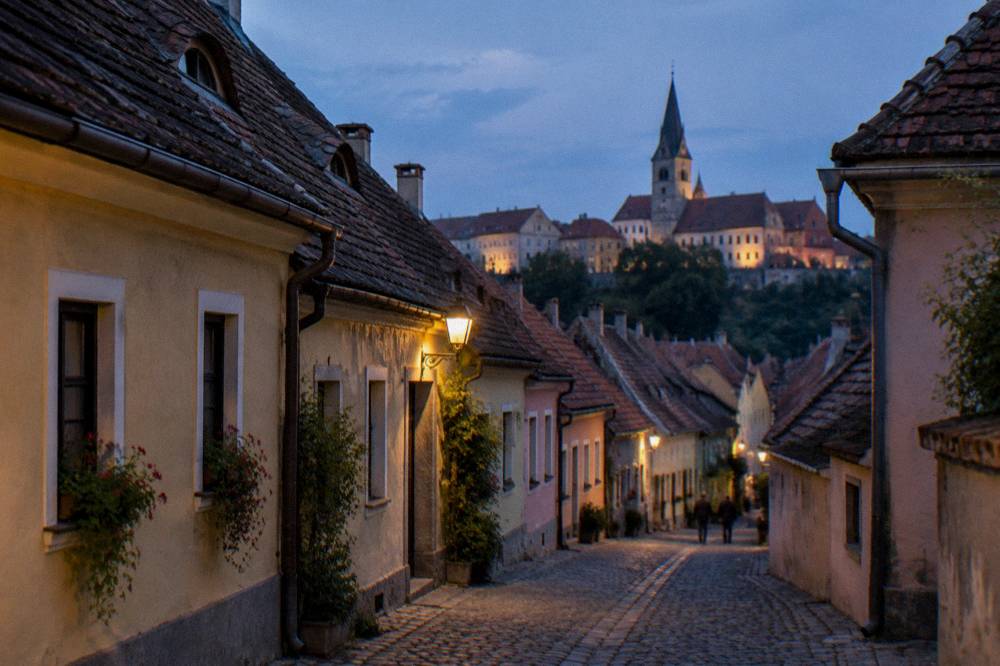
The trade-offs are straightforward. Streets inside the wall ring put you in the oldest fabric, minutes from everything, on lanes that can be dim and cobbled. The areas just outside, Terezian toward the station and Turnișor to the west, offer quieter residential streets a short walk out. The site's where to stay guide compares the districts properly, with the hotel cards carrying the rates.
One figure applies to every bed in the city: since 1 January 2026, Sibiu hotels collect a 2 percent tax on the accommodation value, a city promotion levy approved at the end of December 2025. No per-night amount exists to quote, because the levy is a percentage, not a flat fee, and the bill's accommodation line is what it is calculated on.
For stays of two or three days, the Lower Town works as a base for loops rather than day-long expeditions. The two-day and three-day itineraries show how the walls-and-towers circuit combines with the museums above and a day trip out.
What Food And Drink Traditions Come From The Sibiu Lower Town?
The dishes to look for around Sibiu are the Transylvanian standards, Sibiu salad, ciorbă soups, mici grilled rolls, sarmale cabbage rolls, zacuscă spread, balmoș and papanași doughnuts, named in the city's food traditions without any single venue, because no restaurant in Sibiu has a listing on this site. The Lower Town's contribution to the food story is structural: the trades that filled these streets, the butchers, bakers and gardeners below the wall, are the reason a Saxon market town ate so well.
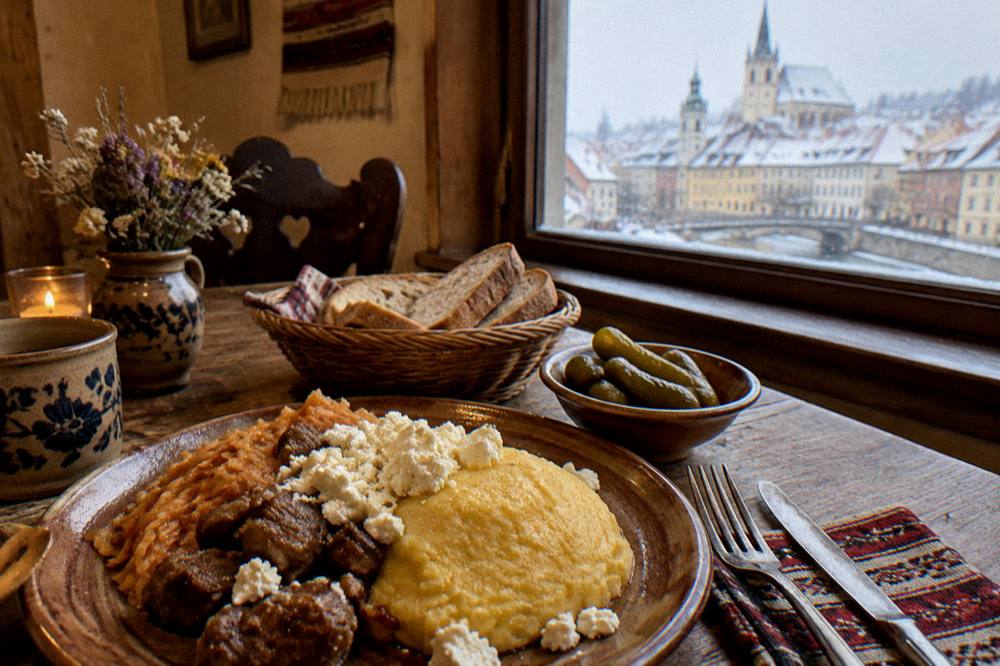
Sibiu's food reputation has a documented strand: the city's own chronology records a pharmacy from 1494, a school from 1380 and a hospital from 1292, all among the first on current Romanian territory, which speaks to the town's early wealth and organisation.
The practical way to taste the traditions without gambling on a restaurant choice is a guided food walk, where the operator holds the venue list. The gastronomy walk below is the current pick that fits:
It covers the city's food history with tastings as it goes, and the operator's live listing carries the current price and availability. Check availability there rather than relying on any figure quoted elsewhere, since tasting inclusions change with the season.
What Day Trips Pair Well With The Sibiu Lower Town?
The Lower Town is a city base, and its natural pairings are the Saxon villages of Mărginimea Sibiului and the fortified-church country, with Rășinari about 13 km and 18 minutes away, Sibiel about 25 km and 36 minutes, Cisnădie about 10 km and 14 minutes, and Păltiniș in the Cindrel hills about 32 km and 40 minutes, all computed free-flow drive times from the centre. Farther out, Sighișoara is about 96 km and 102 minutes, Brașov about 142 km and 154 minutes.
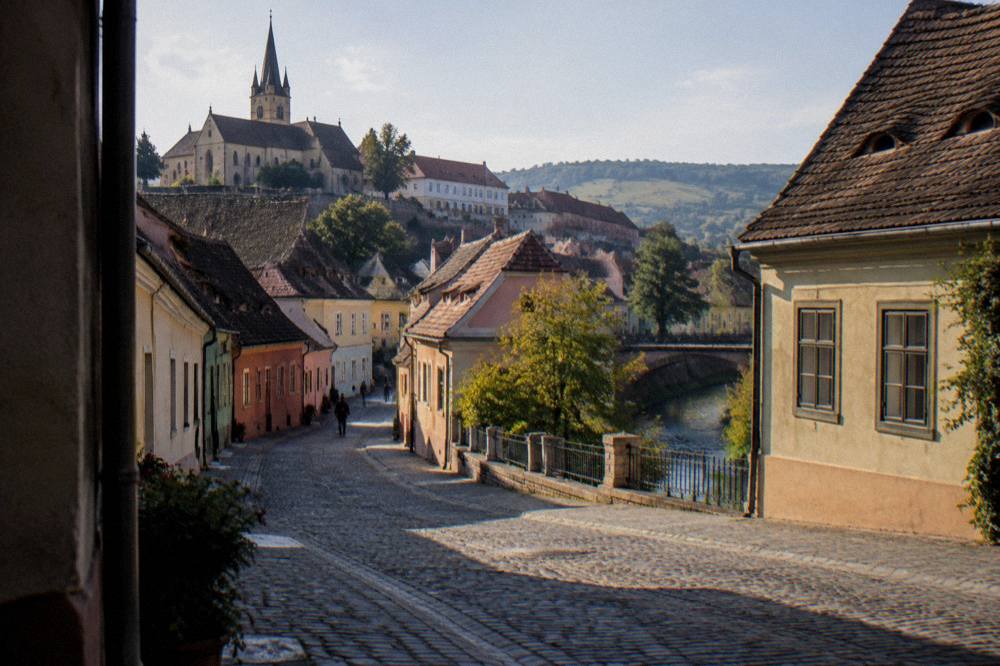
The nearest of these, Rășinari and Sibiel, are the villages of the Mărginimea Sibiului, the shepherding margin of the city on the south side of the Cibin valley, and the evening panorama tour described earlier climbs the same valley side to Gușterița Hill. A guided villages day is the simplest way to reach several of them in one loop, and the current pick is:
The tour visits Saxon villages and fortified churches in a single day from Sibiu, with the operator's listing carrying price and availability. For independent travel, the same roads are public and signposted, and the mountain option, Păltiniș, doubles as the ski resort opening its season on 28 November 2026.
Two mountain warnings apply to any trip that points south. The Transfăgărășan reopened for its 2026 season on 12 June with daily hours of 07:00 to 21:00 on the high stretch, but by rule it can close on any day from 20 October, and driving the closed section carries fines of 10,000 to 30,000 lei, so check the live road status before setting out. The A1 motorway toward Bucharest is unfinished, and the Sibiu to Boița section is closed from 5 October to 19 December 2026 with traffic diverted onto DN7.
| Day-trip destination from Sibiu | Drive distance | Free-flow drive time |
|---|---|---|
| Cisnădie | 10 km | about 14 min |
| Rășinari | 13 km | about 18 min |
| Sibiel | 25 km | about 36 min |
| Păltiniș | 32 km | about 40 min |
| Sighișoara | 96 km | about 102 min |
| Brașov | 142 km | about 154 min |
For a wider sweep of the region from this base, the second set of bookable picks, the panorama walk, the villages day and the gastronomy walk, covers city, countryside and table:
Common Questions About The Sibiu Lower Town
Is the Sibiu Lower Town free to visit?
Yes. The Lower Town's streets, the Stairs Passage, the surviving wall and its towers are all open-air public space with no ticket and no opening hours. The only paid sight on its boundary is the Pharmacy History Museum in Piața Mică, listed at 16 RON for an adult.
How far is the Sibiu Lower Town from Piața Mare?
About 0.4 km straight-line from Piața Mare, the closest of the city's outlying areas after the Upper Town itself. On foot the crossing via the Stairs Passage takes only a few minutes.
Can you climb the Council Tower from the Lower Town?
No. The Council Tower has been closed to visitors since 19 January 2026 for a restoration reported to run about 24 months. The open tower viewpoint in the centre is the Evangelical Cathedral tower, listed at 10 RON for an adult.
Which towers can you see along the Sibiu Lower Town walls?
The Potters' Tower, the Arquebusiers' Tower and the Stairs Tower stand along the surviving wall on the Lower Town's upper edge, all viewable freely from public streets, with no tickets or hours.
Is the Lower Town a separate neighbourhood to stay in?
It is the oldest residential quarter inside the wall ring, about 0.4 km from the main square. Hotel details appear only in the hotel cards on the where-to-stay guide, and since 1 January 2026 a 2 percent tax on the accommodation value applies citywide.
What is the best way to see the Lower Town as a whole?
From across the Cibin valley. The evening panorama tour of Gușterița Hill looks down on the entire bowl of roofs and the wall line against the plateau, and the walk back through the streets afterwards costs nothing.
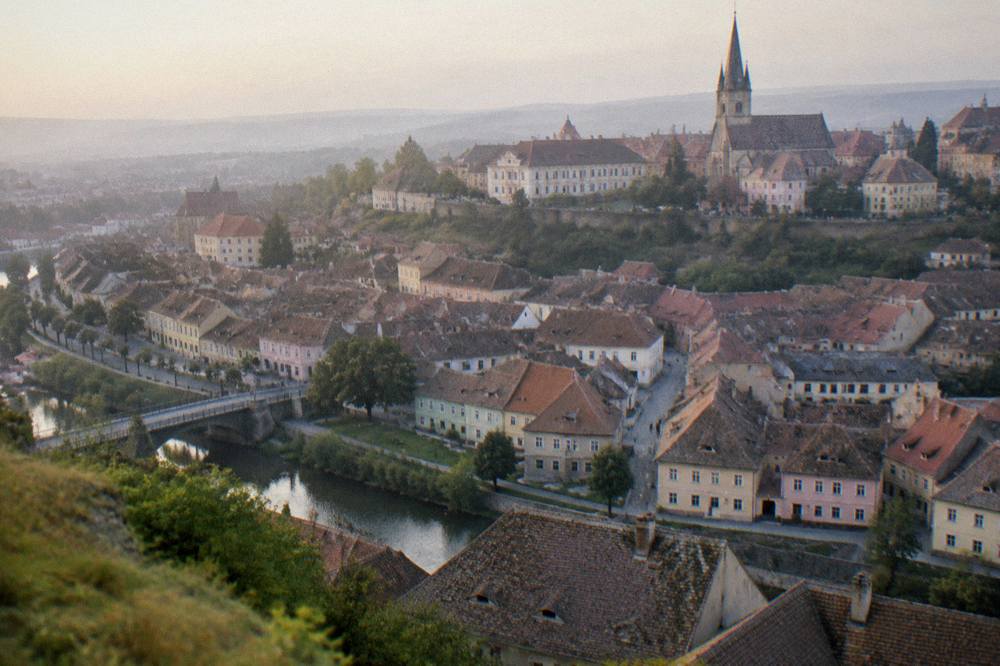
The Lower Town asks little and gives much: no tickets, no hours, one stairway, a ring of towers and the oldest street grain in the city, all within four hundred metres of the main square. Walk it slowly, cross by the passage, and finish with the view back from the far side of the valley, where the whole bowl of Sibiu below the walls shows itself at once.
