Piața Mica: The Small Square And The Lower Old Town
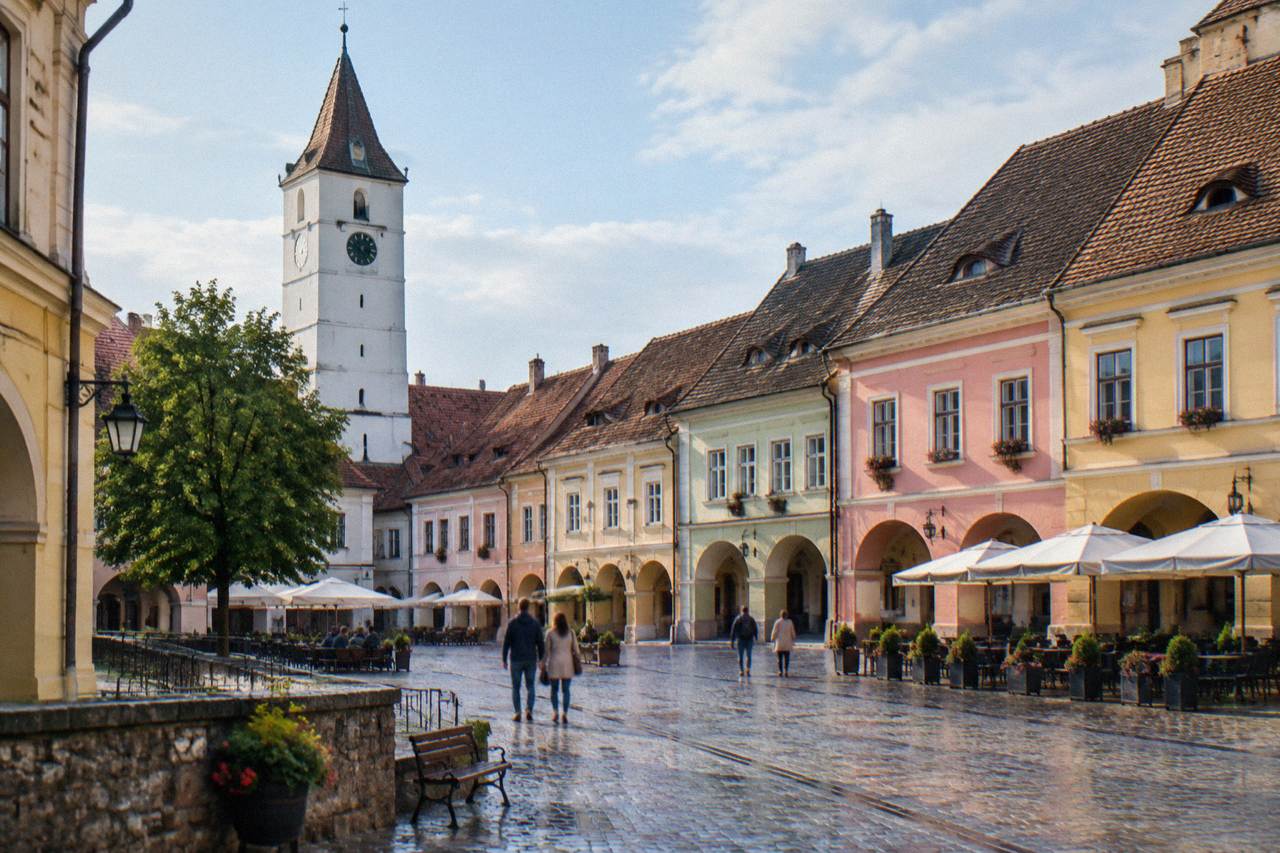
Piața Mică, the Small Square of Sibiu in Transylvania, is the arcaded stretch of the Saxon old town that links the Great Square to the Lower Town, the Council Tower and the Bridge of Lies.
Short answer
Piața Mică is Sibiu's Small Square, an open, free public space of colourful arcaded houses below the Council Tower, connecting Piața Mare with the Lower Town via the Bridge of Lies and the Stairs Passage.
Piața Mică, the Small Square of Sibiu in Transylvania, is the second great public space of this Saxon-founded city on the Cibin river, sitting one level below Piața Mare and packed tighter, louder and more colourfully than its grand neighbour. The square is a free, open public space with no ticket and no opening hours, a string of painted burgher houses in ochre, rust and blue, and it acts as the hinge of the medieval town: the Council Tower closes its western end, the Bridge of Lies carries you onward toward the Lower Town, and the lanes dropping south lead to the oldest commercial streets of the city. This guide walks the square house by house, explains what is open and what is closed in 2026, and sets out how Piața Mică fits into a visit to Sibiu, from the Pharmacy History Museum at number 26 to the Christmas market season that lights the neighbouring squares each winter.
What Is Piața Mică In Sibiu?
Piața Mică is Sibiu's Small Square, a free open public space of arcaded, colourfully painted burgher houses that forms the second square of the medieval Saxon old town, running directly below and east of Piața Mare with the closed Council Tower at its western end. It has no ticket, no gate and no opening hours. The square was the commercial heart of the lower merchant town while the Great Square handled civic and trade life above it, and that division still reads clearly in the architecture: narrower plots, deeper arcades, and ground floors built for workshops and trade rather than ceremony. The square belongs to everyone at every hour, and its benches, café terraces and arcades cost nothing to occupy.
The square's shape is long and narrow, running roughly west to east between the base of the Council Tower and the continuation toward the Orthodox Cathedral quarter. On its northern side, staircases and archways rise directly into Piața Mare, so the two squares work as one continuous public space divided by a row of houses. On the southern side, lanes fall away toward the Lower Town, the oldest part of the city, where the Lower Town spreads its rows of small houses toward the Cibin river. The Upper Town and the Lower Town meet exactly here, which is why the Small Square always feels like a threshold rather than a destination in itself.
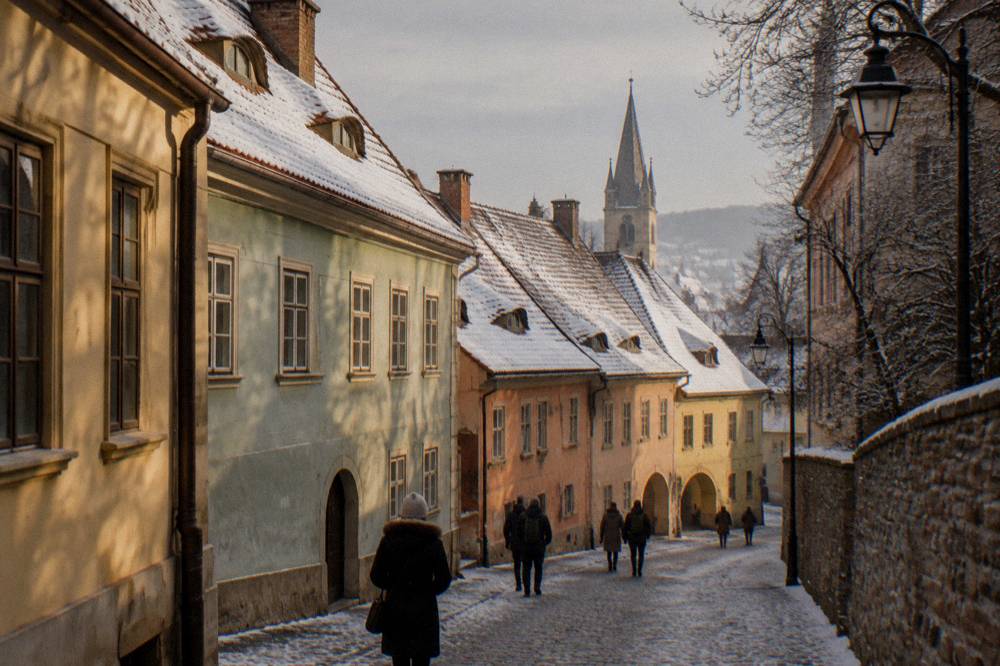
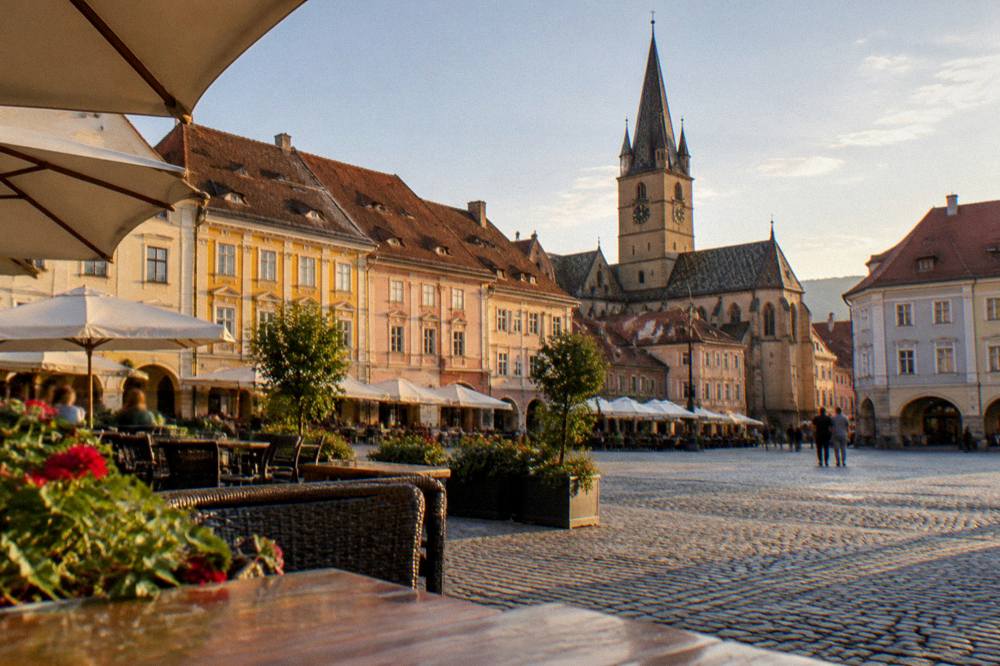
What gives the square its character is the row of arcades. Deep rounded arches run along the ground floors of the southern side, built so that merchants could trade under cover, and today they shelter terraces and shopfronts. Above them the facades rise in a mix of Renaissance, Baroque and later revival work, painted in the strong colour palette that Sibiu's old town is known for. Look for the dormers and the roof windows: the famous "eyes of Sibiu", the small hooded openings in the tiled roofs, are densest in this part of town and give the houses their watchful look. No count of the eyes is needed: they are simply everywhere you look up.
The square's open-air character makes it one of the most reliable sights in the city. Rain or shine, winter or summer, the arcades, the Council Tower mass at the end of the view, and the Bridge of Lies a lane further on are all there, free, at any hour. The full run of Sibiu's public squares and the walking routes between them are covered in things to do in Sibiu, which places the Small Square in the wider context of a city visit.
Where Does Piața Mică Sit And How Do You Reach It?
Piața Mică sits about 200 metres east of the centre of Piața Mare in central Sibiu, reached in a two-minute walk through archways between the two squares, with the Council Tower at its western end, the Bridge of Lies immediately to its north-east, and the Stairs Passage dropping south toward the Lower Town. No transport is needed: the square is a pedestrian zone in the heart of the old town, and everything around it is on foot. From the train station, the walk to the old town squares is roughly 15 minutes at a steady pace, following the main road south-west into the historic centre.
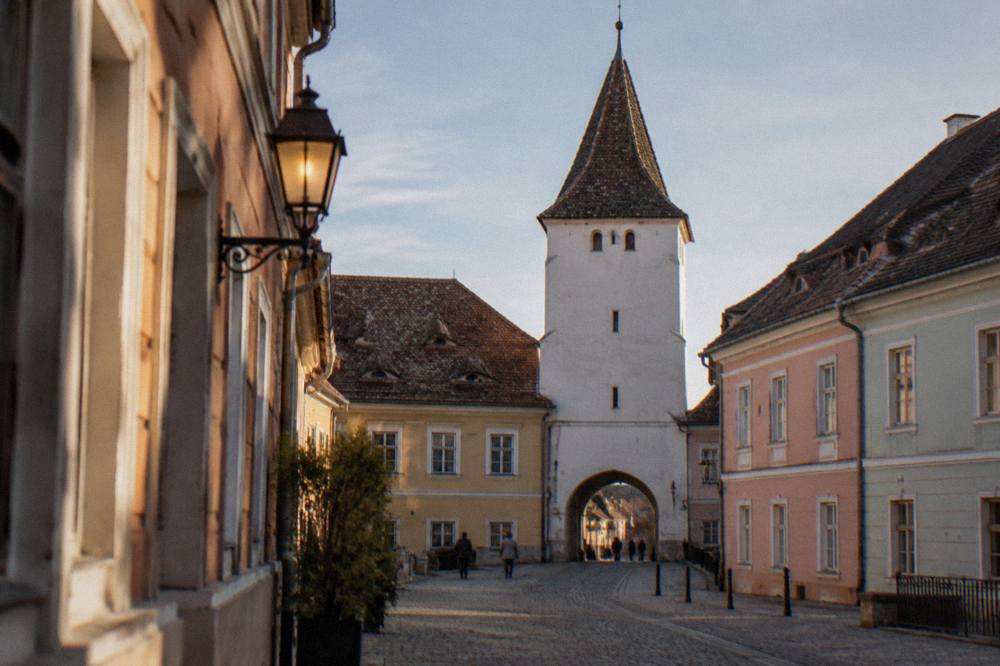
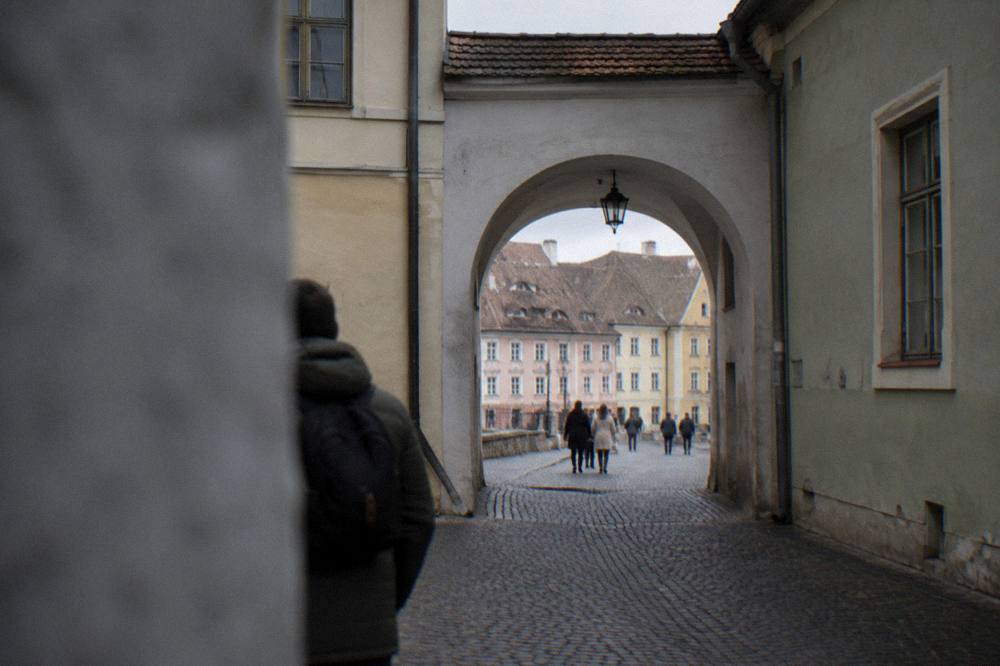
The square's connections are what make it so useful on a first visit. To the north and west, two or three archways and staircases climb directly into Piața Mare, so you can move between the two squares in seconds. To the north-east, the lane passing under the Council Tower leads to the Bridge of Lies, Sibiu's famous iron footbridge, which carries pedestrians over the lane toward Piața Huet and the Evangelical Cathedral quarter. To the south, Ocnei Street descends toward the Lower Town, and the Stairs Passage, a covered stone stairway, links the two levels of the town a little further along. Every one of these connections is free, open and unguarded.
Orientation around the square is simple because the landmarks do the work. The Council Tower, closed for restoration since 19 January 2026 and expected to stay closed until about January 2028, still anchors the view at the western end even though you cannot climb it; the open viewpoint in the old town is now the tower of the Evangelical Cathedral, which charges 10 RON for an adult ticket. The Bridge of Lies, reported as the first cast-iron bridge in Romania and dated 1859 to 1860 in secondary sources, is a two-minute walk away. The Orthodox Cathedral lies a short stroll east along the lower streets.
A good way to fix the layout of the whole old town, squares, walls and gates included, is the Sibiu map guide, and if you want a route that strings the squares together with the walls and towers, the Sibiu walking tour page describes a guided option. The Small Square rewards a slow pass more than a quick photo: the arcades change character block by block, and the side lanes hide courtyards that no first glance from Piața Mare would suggest.
What Can You See On And Around The Small Square?
The Small Square itself offers the Council Tower's silhouette at its western end, the arcaded burgher houses, the Council Tower gate passage, the Bridge of Lies a lane to the north-east, the Pharmacy History Museum at Piața Mică 26, and the lane down Ocnei Street toward the Lower Town, all of it free to walk except the museum. The square is compact, and everything listed here stands within a three-minute walk of its centre. The tower cannot be entered, the bridge cannot be avoided, and the museum is the only door on the square that charges admission.
The sights sit close enough together that a table is the clearest way to lay them out. Access status is noted where it is settled; where no 2026 details were found, the entry says so plainly.
| Sight | What it is | Access in 2026 |
|---|---|---|
| Piața Mică itself | Arcaded public square of the lower merchant town | Free, open at all hours |
| Council Tower | Medieval gate tower closing the square's western end | Closed for restoration since 19 Jan 2026, expected to reopen about January 2028 |
| Bridge of Lies | Iron footbridge toward Piața Huet, reportedly the first cast-iron bridge in Romania, built 1859 to 1860 | Free, open at all hours |
| Pharmacy History Museum | Brukenthal branch at Piața Mică 26, in the house known as Sub Ursul Negru | Adult ticket 16 RON, per the Brukenthal National Museum's price page |
| Ocnei Street | Historic lane descending from the square to the Lower Town | Free public street |
| Stairs Passage | Covered stone stairway linking Upper and Lower Town | Free public passage |
The houses deserve a slower look than the checklist suggests. The southern row is the one with the deep arcades, and the northern row carries the connecting archways up into Piața Mare, so the two sides behave differently: one shelters, one connects. The "eyes of Sibiu" are the detail everyone photographs, but the painted facades themselves, in ochres, reds and blues, are the square's real texture. The terraces under the arcades are easy to assess on the spot: look at the menu before you sit, and check prices at the table before ordering.
The Council Tower's closure is the one fact that changes a 2026 visit. For years the tower was the standard viewpoint over the squares; since 19 January 2026 it has been closed to visitors for a restoration planned at about 24 months, with completion reported around January 2028, and the walls have been cleaned and re-plastered and the copper roof removed during the works. The Council Tower page tracks the restoration in detail. For an open view over the town, the Evangelical Cathedral tower is the alternative: the Evangelical Cathedral charges 10 RON for an adult tower ticket, with hours published by the city's tourism site.
What Does The Pharmacy History Museum On Piața Mică Cost?
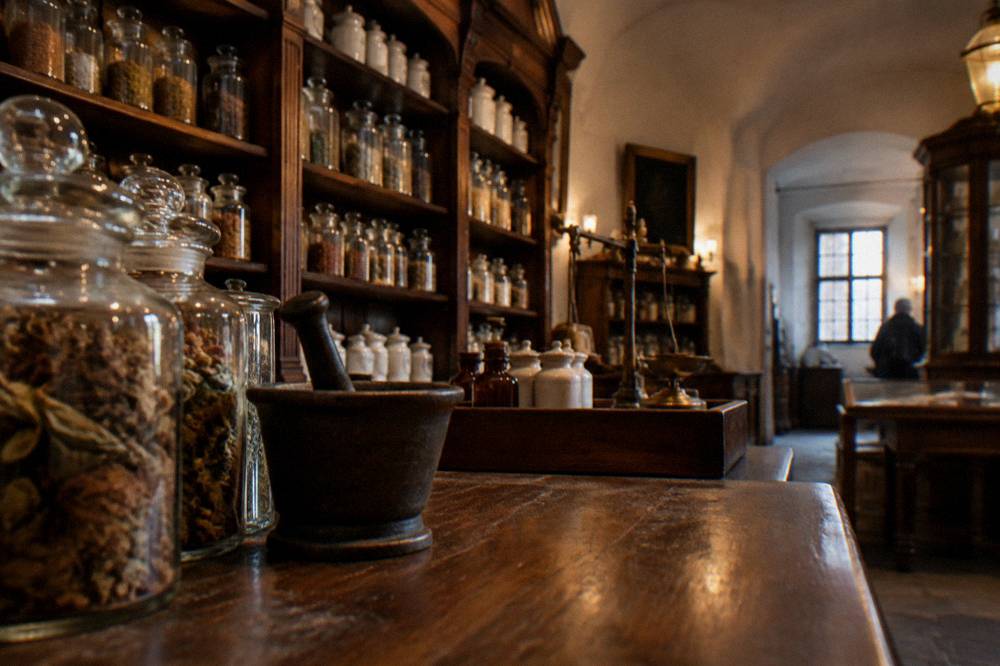
The Pharmacy History Museum at Piața Mică 26 charges 16 RON for an adult ticket, per the Brukenthal National Museum's own price page, with reduced tickets for pensioners at half price and for pupils and students at a quarter price, and the museum is closed on Mondays and Tuesdays like the other main Brukenthal sites. Opening hours on the Brukenthal schedule run Wednesday to Sunday, 09:00 to 17:00, with the cashier closing earlier, and groups may need to book ahead, so confirm the current schedule on the museum's own site before you go. The house itself, known as Sub Ursul Negru, the Black Bear house, is part of the visit as much as the collection.
The museum occupies a historic pharmacy interior with original fixtures, jars and instruments, and it is the easiest paid sight in the old town to combine with a pass through the Small Square, because it stands directly on it. It is one of several separately ticketed Brukenthal sites, not part of a single museum, and the table below sets out the full official price list. Prices are the official figures from the Brukenthal National Museum's price page; confirm before you go, as the museum has spoken in the press about possible adjustments.
| Brukenthal site | Adult ticket | Notes |
|---|---|---|
| Palace, European and Romanian art | 50 RON | Piața Mare, closed Mon and Tue |
| History Museum, Casa Altemberger | 36 RON | Closed Mon and Tue |
| Pharmacy History Museum | 16 RON | On Piața Mică, closed Mon and Tue |
| Natural History Museum | 20 RON | Closed Mon and Tue |
| Contemporary Art Museum | 15 RON | Open Monday to Friday, closed at weekends |
| Combined 48-hour ticket | 120 RON | Covers all open Brukenthal sites |
The combined 48-hour ticket at 120 RON is the value calculation worth making if museums are a big part of your trip: it costs less than the Palace, History and Natural History museums bought separately, and the Pharmacy Museum is included. Reduced tickets run at half price for pensioners and a quarter price for pupils and students across the list. The Hunting Museum, a separate Brukenthal branch elsewhere in the city, is closed indefinitely and appears on no itinerary this site recommends. The wider collections are covered on the Brukenthal National Museum page, and the pharmacy's own story on the Pharmacy Museum page.
How Does The Small Square Lead Down To The Lower Old Town?
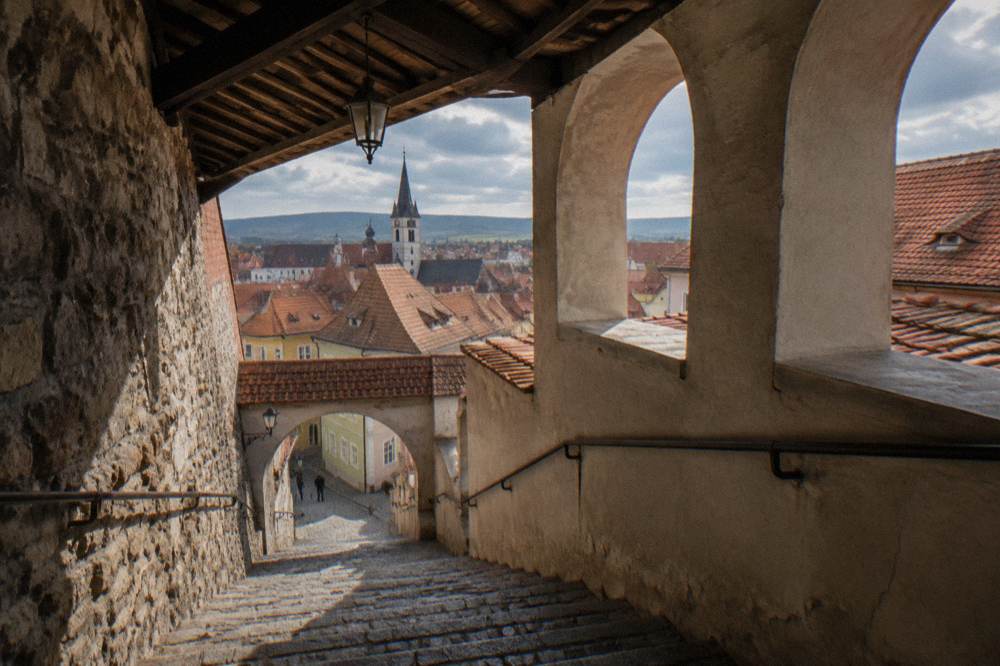
Ocnei Street drops south from the Small Square through a gate beneath the houses into the Lower Town of Sibiu, and the Stairs Passage, a covered stone stairway a short walk east, links the two levels on foot, both free public ways that carry you from the arcaded merchant square into the oldest part of the city within about five minutes' walking. The descent is steep in places and stepped in others, and the contrast is the point: the Upper Town's painted Baroque gives way within a few dozen metres to the small-scale lanes and yards of the lower burg. Nothing on this route charges admission or keeps hours.
The Lower Town is where Sibiu's documented past is thickest. The city was founded by Transylvanian Saxons, settlers reported to have come from the Moselle area in the 12th century, and first documented in 1191 as Cibinium. The lower streets between the square and the Cibin river hold the densest surviving fabric of that early town, and the view back up toward the Council Tower and the towers of the city wall from below is one of the classic photographs of Sibiu. The city walls and towers page covers the Potters, Arquebusiers and Stairs towers and the surviving fortification line, all free public monuments.
The Bridge of Lies deserves its own ten minutes, legend and all. The structure is reported as the first cast-iron bridge in Romania, built 1859 to 1860, with the date carried by secondary sources rather than an inscription this site could confirm, so treat the year as reported. The legend attached to it, that the bridge would collapse if someone told a lie while standing on it, or that dishonest merchants met their end over the drop, is a legend, and no source treats it as history. The bridge itself is small, iron, and best photographed from the lane below. The full story sits on the Bridge of Lies page.
If you are building a full day or two around this descent, the Sibiu in 2 days and Sibiu in 3 days itineraries place the Small Square, the Lower Town and the walls into a workable order, with time for the Brukenthal sites and the ASTRA Museum. For where to sleep within easy reach of both levels of the old town, start with where to stay in Sibiu and the best hotels in Sibiu. The wider set of guides lives on Sibiu Travel Guide.
When Is The Best Time To See Piața Mică?
Late spring and early autumn suit Piața Mică best: May, June, September and October bring the mild temperatures and longer daylight that make an open-air square comfortable, while July and August are the busiest summer weeks and December belongs to the Christmas market, which lights Piața Mare from 13 November 2026 to 3 January 2027. The square itself never closes, so the choice is about weather and crowds rather than access. The tourism sources this site cites name May and June and September and October as the best months for the city overall.
The climate data explains the rhythm. According to the ERA5 reanalysis for Sibiu, 1991-2020, modelled on a grid cell near the city at about 430 m elevation, January averages a high of 2.2 C and a low of -5.7 C with about 23 cm of snow, while July and August average highs of 24.2 and 24.5 C, and sunshine runs from 12.8 hours a day in July down to 5.6 in December. The city's own official page gives a mean annual temperature of 8.9 C and mean annual rainfall of 662 mm. Snow falls from November to March, and the December light is short but atmospheric, which suits the market season.
| Month | Mean high C | Mean low C | Sun h/day | Snow cm |
|---|---|---|---|---|
| Jan | 2.2 | -5.7 | 6.2 | 23.3 |
| Feb | 4.3 | -4.4 | 7.1 | 22.3 |
| Mar | 8.7 | -0.8 | 8.7 | 18.2 |
| Apr | 14.6 | 4.0 | 10.4 | 7.8 |
| May | 19.1 | 9.0 | 11.3 | 0.3 |
| Jun | 22.4 | 12.9 | 12.4 | 0.0 |
| Jul | 24.2 | 14.6 | 12.8 | 0.0 |
| Aug | 24.5 | 14.8 | 11.8 | 0.0 |
| Sep | 19.6 | 10.5 | 9.7 | 0.1 |
| Oct | 14.5 | 5.7 | 8.0 | 2.7 |
| Nov | 8.7 | 0.9 | 6.4 | 13.0 |
| Dec | 3.1 | -3.9 | 5.6 | 20.8 |
Winter has its own case. The Christmas market fills Piața Mare, not Piața Mică, but the Small Square sits one archway away and carries the spillover glow, with the 600 sqm ice rink and the market's wheel and carousel a minute's walk up the steps. The market runs 13 November 2026 to 3 January 2027, entry is free, and the market's Golden Ticket, reported at 100 lei, covers unlimited rides on the wheel, carousel and mini-train. Christmas-week visitors should book rooms early; the Sibiu in winter and Sibiu in December guides cover the season in detail, and hotels add a 2 percent tourism tax on the accommodation value since 1 January 2026, a cost built into the bill rather than collected at the desk.
How Much Time Should You Give The Small Square?
A first pass through Piața Mică takes about 20 to 30 minutes at walking pace, a fuller visit with the Pharmacy History Museum runs to about an hour, and the square's surroundings, the Bridge of Lies, the descent to the Lower Town and the Stairs Passage, justify another hour on top, making roughly half a day for the whole quarter. These are planning figures for a stroll-and-look visit, not fixed timetables. The square rewards early morning and late afternoon light in particular, when the arcades throw long shadows and the painted facades change tone.
The half-day frame works well because the Small Square sits at the centre of a dense cluster of sights. A route that starts at Piața Mare, drops through the archways into Piața Mică, visits the Pharmacy History Museum, passes under the Council Tower to the Bridge of Lies, climbs to Piața Huet and the Evangelical Cathedral, then descends the Stairs Passage into the Lower Town, covers the essential old town in a loop that keeps returning to the Small Square as its hub. Add the History Museum or the Natural History Museum and the loop fills a full day at museum pace.
Timing has one hard constraint in 2026: the Brukenthal sites, including the Pharmacy History Museum on the square, are closed Monday and Tuesday, so a Monday or Tuesday visit to Piața Mică is an outdoor-only affair. The Evangelical Cathedral tower keeps different hours, open Monday 12:00 to 17:00, Tuesday to Thursday 10:00 to 17:00, Friday and Saturday 10:00 to 20:00 and Sunday 11:00 to 17:00, per the city's tourism site. Nothing else around the square keeps hours at all, which is the Small Square's quiet advantage: whatever day you land in Sibiu, the square itself is there.
What Food And Drink Should You Try Around Piața Mică?
Around Piața Mică the dishes to look for are the classic Transylvanian table: Sibiu salad, ciorbă soups, mici grilled rolls, sarmale cabbage rolls, zacuscă spread, balmoș polenta and papanași fried doughnuts for dessert, all traditional in this region and found across the old town's kitchens. The terraces under the square's arcades make the setting; the menu does the rest, and prices for meals and drinks are best checked at the table before you order. Kitchen quality varies from terrace to terrace, so read the menu and the room before you sit down.
The Saxon layer of the city's food culture is the part specific to Sibiu. Transylvanian Saxon cooking, the historic German community's cuisine, sits alongside Romanian dishes in the old town, a legacy of the settlers reported to have arrived from the Moselle area in the 12th century. Dishes travel better than addresses in any case: ciorbă comes in dozens of regional variants, mici are a national staple rather than a local one, and papanași, the fried doughnut with sour cream and jam, is the dessert that ends most Transylvanian meals. The wider food picture, including what to look for and how meals are typically structured, is covered in what to eat in Sibiu, and Romanian wine has its own story on the Romanian wine near Sibiu page.
A guided food walk is one way to cover the table without research of your own, and the gastronomy walk in the picks below strings the old town's food history into a single route. For a self-planned version, the market at Piața Cibin is the city's everyday food shopping ground, a short trip out of the old town, where the raw materials of the table, from zacuscă jars to fresh cheese, are sold without a menu in sight.
What Day Trips Start Easily From The Small Square?
The Small Square's central position puts the whole Sibiu day-trip belt within reach: the fortified churches of Cisnădie at about 14 minutes and Cisnădioara at about 18 minutes by road, the villages of Mărginimea Sibiului such as Rășinari at about 18 minutes and Sibiel at about 36 minutes, and the bigger runs to Sighișoara at about 102 minutes and Brașov at about 154 minutes. These drive times are computed over open-street routing from Piața Mare in free-flow conditions, not timetables, and winter weather or roadworks change them. All are day trips: Sibiu is inland, and the mountains are reached by road, not from the city itself.
The table below gathers the standard set, with the drive times this site has computed from the old town. Distances are approximate road distances, not straight lines.
| Destination | Approx. drive from the old town | Approx. time |
|---|---|---|
| Cisnădie fortified church | 10 km | about 14 min |
| Rășinari, Mărginimea Sibiului | 13 km | about 18 min |
| Sibiel | 25 km | about 36 min |
| Păltiniș mountain resort | 32 km | about 40 min |
| Mediaș | 56 km | about 68 min |
| Sighișoara historic centre | 96 km | about 102 min |
| Alba Iulia citadel | 71 km | about 81 min |
| Brașov | 142 km | about 154 min |
Two 2026 road facts matter for planning the bigger runs. The Transfăgărășan high section reopened on 12 June 2026 with daily hours 07:00 to 21:00, but by rule it can be closed on any day from 20 October, and driving the closed section carries fines of 10,000 to 30,000 lei, so check the live road status before setting out toward Bâlea Lake. And the A1 motorway toward Bucharest is unfinished: the Sibiu to Boița section is closed from 5 October to 19 December 2026 with traffic diverted onto DN7, so allow extra time on any southbound drive. Bucharest is about 250 km away and is not a day trip.
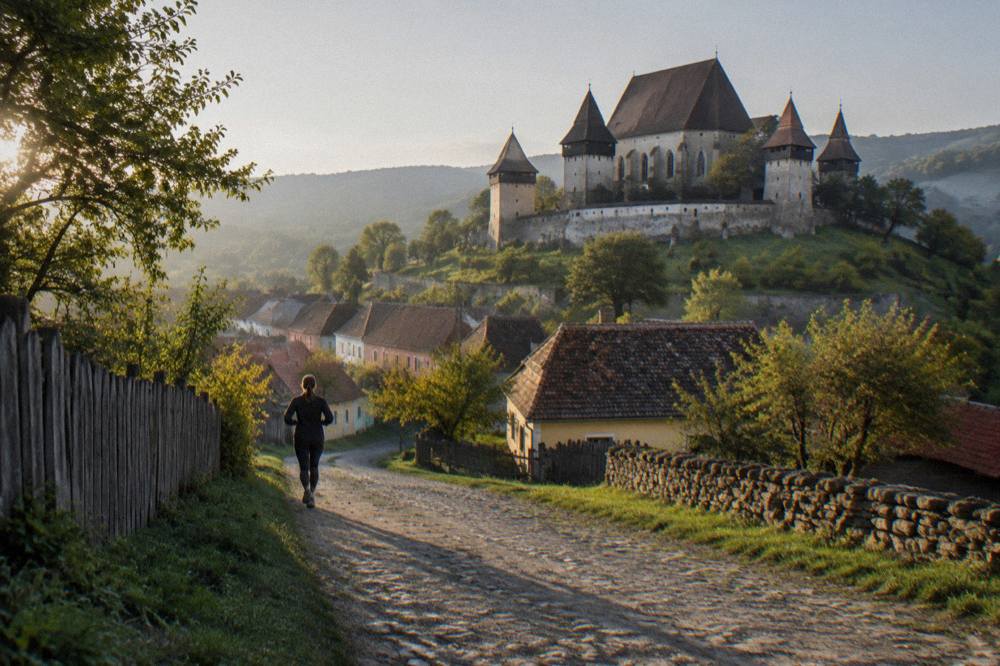
The village belt is the natural first trip from here. The fortified-church circuit, taking in farm life and a carriage ride in the villages, is the pick below, and the Saxon village story, from Cisnădie to Biertan and Viscri, is laid out on the fortified churches near Sibiu page. The UNESCO-listed Biertan church charges an adult ticket of 20 RON, per the local tourism listing, with shorter winter hours from November to March.
What Should You Not Miss And What Should You Skip?
Do not miss the arcades on the southern side of Piața Mică, the view up at the Council Tower's closed mass from the square's centre, the Bridge of Lies from the lane below, the Pharmacy History Museum if it is open on your days, and the descent by the Stairs Passage into the Lower Town; skip any plan that counts on climbing the Council Tower, on the Brukenthal museums on a Monday or Tuesday, or on a tour of the Hunting Museum, all closed in 2026. The square's essentials cost nothing but time: two squares, a bridge, a passage and a museum, in that order of reliability.
The closure list deserves its own short table, because the 2026 traps are the difference between a plan that works and one that loses a morning.
| Closed or restricted in 2026 | Source | Alternative |
|---|---|---|
| Council Tower | Closed since 19 Jan 2026, restoration to about Jan 2028 | Evangelical Cathedral tower, 10 RON adult |
| Brukenthal Hunting Museum | Closed indefinitely | Pharmacy History Museum on the square, 16 RON |
| Brukenthal main museums, Mon and Tue | Closed Mon and Tue | Plan museum days Wednesday to Sunday |
| Contemporary Art Museum weekends | Open Mon to Fri only | Visit on a weekday |
| Transfăgărășan high section | Closable any day from 20 Oct | Check live road status; Bâlea cable car runs its own schedule |
Photographers should work the square twice: once in the morning, when the light comes down the northern arcades and the lane to the Bridge of Lies is quiet, and once in the evening, when the terraces fill and the house colours deepen. The classic angles are from under the archways linking to Piața Mare, looking east down the arcades, and from Ocnei Street below, looking back up at the tower. The full list of vantage points across the city is on the Sibiu photography spots page.
Common Questions About Piața Mică In Sibiu
Is Piața Mică free to visit?
Yes. Piața Mică is an open public square with no ticket, no gate and no opening hours. The only paid sight on the square is the Pharmacy History Museum, which charges 16 RON for an adult ticket per the Brukenthal National Museum's price page.
Can you climb the Council Tower from the Small Square?
No. The Council Tower has been closed to visitors since 19 January 2026 for a restoration planned at about 24 months, with completion reported around January 2028. The open viewpoint in the old town is the tower of the Evangelical Cathedral, which charges 10 RON for an adult ticket.
How far is Piața Mică from Piața Mare?
The two squares are directly connected: archways and short staircases between the houses carry you from Piața Mare into Piața Mică in about two minutes on foot. The Small Square sits one level below and east of the Great Square.
What is the house with the bear on Piața Mică?
The house at Piața Mică 26 is known as Sub Ursul Negru, the Black Bear house, and it holds the Pharmacy History Museum, a branch of the Brukenthal National Museum with a historic pharmacy interior. An adult ticket costs 16 RON, and the museum is closed on Mondays and Tuesdays.
When is the Small Square at its quietest?
Early morning, before the terraces fill, is the quiet time in the square, and the arcades give cover whatever the hour. July and August are the busiest weeks of the city's year, and the Christmas market period from 13 November 2026 brings crowds to the neighbouring Great Square through to 3 January 2027.
Can you walk from Piața Mică to the Lower Town?
Yes, and it takes about five minutes. Ocnei Street descends south from the square through a gate beneath the houses, and the Stairs Passage, a covered stone stairway a short walk east, links the Upper and Lower Town on foot. Both are free public ways with no hours.
Piața Mică holds its place in Sibiu because it does several jobs at once: merchant square, hinge between the town's two levels, and the best stretch of arcades in the old town. Walk it slowly, look up at the eyes in the roofs, pass under the closed tower to the Bridge of Lies, and give the Lower Town the hour it earns below.
