How Do You Pronounce Sibiu?
The city of Sibiu in Transylvania, Romania, is easier to say than it looks: an approximate English respelling, where the stress falls, and how the name differs in German and Hungarian.
Sibiu, in Transylvania, Romania, is one of those place names that looks intimidating on a departures board and turns out to be friendly once you hear it broken into syllables. The spelling runs the letters s, i, b, i, u together in a way English almost never does, so the instinct to read it as "SIB-yoo" or "si-BYOO" is understandable and, in Sibiu itself, very common among first-time visitors. Romanian is a phonetic language: once you know that each vowel keeps its own sound, the name stops being a puzzle. No official pronunciation guide for the city exists in the sources this site reports from, so everything below is an approximate English respelling, labelled as approximate, and it will get you understood in Piața Mare without trouble.
How Do You Pronounce Sibiu?
An approximate English respelling of Sibiu is "see-BEE-oo", with the stress on the middle syllable: three sounds, see, then BEE, then oo, said smoothly together. The final vowel is a distinct "oo" of its own, not a silent tail and not a "yoo". The first vowel is a short, clear "see". Keep all three vowels separate and the name lands correctly.
Break it into three beats and say them in one breath: see, BEE, oo. The middle syllable carries the weight, so the "BEE" is longer and stronger than the sounds either side of it. English speakers tend to merge the last two vowels into a diphthong, the way "beauty" merges e and a u, and that is the single habit to unlearn. Romanian keeps every vowel audible.
There is no official audio guide or phonetic transcription published by the city that this site could report from, so treat the respelling above as an approximation rather than a dictionary entry. What can be stated plainly is the structure: three syllables, stress in the middle, no silent letters. Romanian orthography is close to phonemic, which is why the spelling is honest once you know the system. Read the name letter by letter, give each vowel its full value, and the pronunciation follows from the spelling without any hidden rules.
The name travels well. Once you can say it, a whole family of Transylvanian place names opens up, because the same vowel pattern recurs across the region. The table below collects the names you are likeliest to meet on a Sibiu trip, each with an approximate English respelling in the same labelled-as-approximate spirit.
| Name | Approximate English respelling | Notes |
|---|---|---|
| Sibiu | see-BEE-oo | Stress the middle syllable |
| Piața Mare | PYAH-tsa MAH-reh | Main square of the old town |
| Piața Mică | PYAH-tsa MEE-kuh | The small square |
| Cibin | CHEE-been | The river through Sibiu |
| Hermannstadt | HAIR-mahn-shtahrt | The German name of Sibiu |
| Transfăgărășan | trans-fuh-guh-RUHSH-ahn | The mountain road south of the city |
| Sighișoara | sig-ee-SHWAH-rah | The UNESCO town, a day trip away |
Why The Romanian Spelling Confuses English Speakers
The confusion comes from English habits, not from the Romanian word: English readers see "biu" and reach for the "beauty" pattern, merging vowels that Romanian pronounces separately. Romanian writes each vowel with one sound and keeps them all audible, so Sibiu has three full syllables rather than the two English speakers expect. The letter i is never the "eye" of "hi" here; it is the "ee" of "see".
English has absorbed a lot of Latin and French words where vowel clusters collapse, and "Sibiu" triggers every one of those reflexes at once. The reader sees the familiar "bi" and wants "by", then the trailing "u" looks decorative. In Romanian neither assumption holds. The i sounds like the "ee" in "seen", the u sounds like the "oo" in "boot", and the b between them is a plain b.
The stress is the other tripwire. English words of this shape usually stress the first syllable, so "SIB-ee-oo" is the next-commonest attempt after "SIB-yoo". Romanian places the stress on the middle syllable of this name, and hearing that beat is what makes the difference between a guess and the word itself. Locals will understand you either way, but landing the middle stress signals you have done a little homework.
A related habit helps with Romanian generally: the letters ș and ț, which appear in Piața, Mărginimea Sibiului and Transfăgărășan, are "sh" and "ts" respectively. You do not need them to say Sibiu, which uses none of them, but they explain why so many nearby names look harder than they sound. The diacritics carry sound, not decoration, and once you know the two letters, half the map of Transylvania becomes readable. If you want the wider picture of what this city is known for, the companion page on what Sibiu is known for collects the answer.
What Does The Name Sibiu Mean, And Where Does It Come From?
The city was first documented in 1191 as Cibinium, the seat of the free prepositure of the Germans in Transylvania, per the city's own history page, and the modern name is connected to the Cibin river that runs through it. Transylvanian Saxon settlers came from the Moselle valley area in the 12th century, it is reported, and gave the city its German name, Hermannstadt. No official etymology of "Sibiu" itself was found in the sources this site reports from.
So the name you are pronouncing is the Romanian form of a city with at least two other historical names: Hermannstadt in German and Nagyszeben in Hungarian. The river name, Cibin, is easier to say than the city name and shares the same clean vowels: CHEE-been, stress on the first syllable this time. The 1191 documentation is stated on the city's own history page, and the Saxon settlement story is reported by the heritage authority patrimoniu.sibiu.ro, so both carry their attribution here. Everything else covered here is indexed on Sibiu Travel Guide.
This triple naming is normal for Transylvania, where Romanian, German and Hungarian communities each named the places they lived in. It also means you may hear all three names in the same conversation if you spend time with older residents or in the villages of Mărginimea Sibiului to the south. For the German connection in full, the companion answer on the German name for Sibiu goes deeper than this page needs to.
How Do You Say Sibiu In German Or Hungarian?
In German the city is called Hermannstadt, approximately "HAIR-mahn-shtahrt", and in Hungarian it is Nagyszeben, approximately "NODJ-scheh-ben", though no official phonetic guide was found in the sources this site reports from and both respellings are approximations. The Romanian name Sibiu works everywhere in the city today, and Romanian is the official language.
Hermannstadt is the name you will meet in the museum labels, the Saxon church histories and the older guidebooks, and it is still pronounced roughly as written, with the stress near the front. The Hungarian Nagyszeben belongs to the city's Hungarian minority, about 1.4 percent of residents in the 2011 census, a figure stated on the city's own presentation page. Neither name is a translation of the other; all three grew separately from the same medieval settlement.
For a visitor, the practical takeaway is simple: say Sibiu, in the Romanian form, and you will be understood by everyone. The German name survives in institutions rather than daily speech. The Brukenthal National Museum, for instance, takes its name from Samuel von Brukenthal, a Habsburg governor whose collection opened to the public in 1817, it is reported, and the museum's own price page lists its tickets today in Romanian lei.
| Language | Name for the city | Approximate respelling | Where you will meet it |
|---|---|---|---|
| Romanian | Sibiu | see-BEE-oo | Everywhere: signs, tickets, speech |
| German | Hermannstadt | HAIR-mahn-shtahrt | Museum labels, Saxon history texts |
| Hungarian | Nagyszeben | NODJ-scheh-ben | Hungarian-language contexts |
| Latin (historic) | Cibinium | chee-BEE-nee-um | The 1191 documentation |
Tips For Using The Name While You Travel Around Sibiu
Say "see-BEE-oo" with the stress on the middle syllable and you will be understood at the airport, the train station and every hotel desk in the city; the name needs no local variant once you have the three vowels separate. At Sibiu International Airport the public bus line 11 stop is labelled AEROPORT TERMINAL, and a 60-minute Tursib ticket costs 3.5 lei, so the name you practice is also the name on the timetable. Mispronunciations still work: residents hear them constantly.
The situations where the name actually matters are practical ones: booking a taxi or ride, buying a train ticket, telling a day-trip operator where you are starting from. Gara Sibiu, the train station, sits about 0.8 km from Piața Mare, and the bus station is a similar walk, so the word "Sibiu" comes up early in any conversation about directions. Trains to Brașov run about 3 to 4 hours and to Sighișoara about 2 to 2.5 hours, it is reported, and you should check cfrcalatori.ro for live times.
One habit worth borrowing: Romanians pronounce the city name quickly, with the three syllables almost gliding into two, "see-BYOO-oh" compressed. Do not chase that compression at first. Say the three beats clearly, and speed will come on its own. The same advice holds for the squares: PYAH-tsa MAH-reh for Piața Mare, said as two words, is enough to be directed to the main square from anywhere in the old town.
Written Romanian will give you the name in other forms too. On official documents you may see the adjective "sibian", roughly "see-BEE-ahn", meaning of or from Sibiu, and the surrounding county is named judetul Sibiu after the city. Even the local news sources this site reports from are named for the city's landmarks rather than the city itself, a reminder of how much identity here is anchored in the towers and squares of the old town. None of these forms changes the basic rule: three vowels, middle stress.
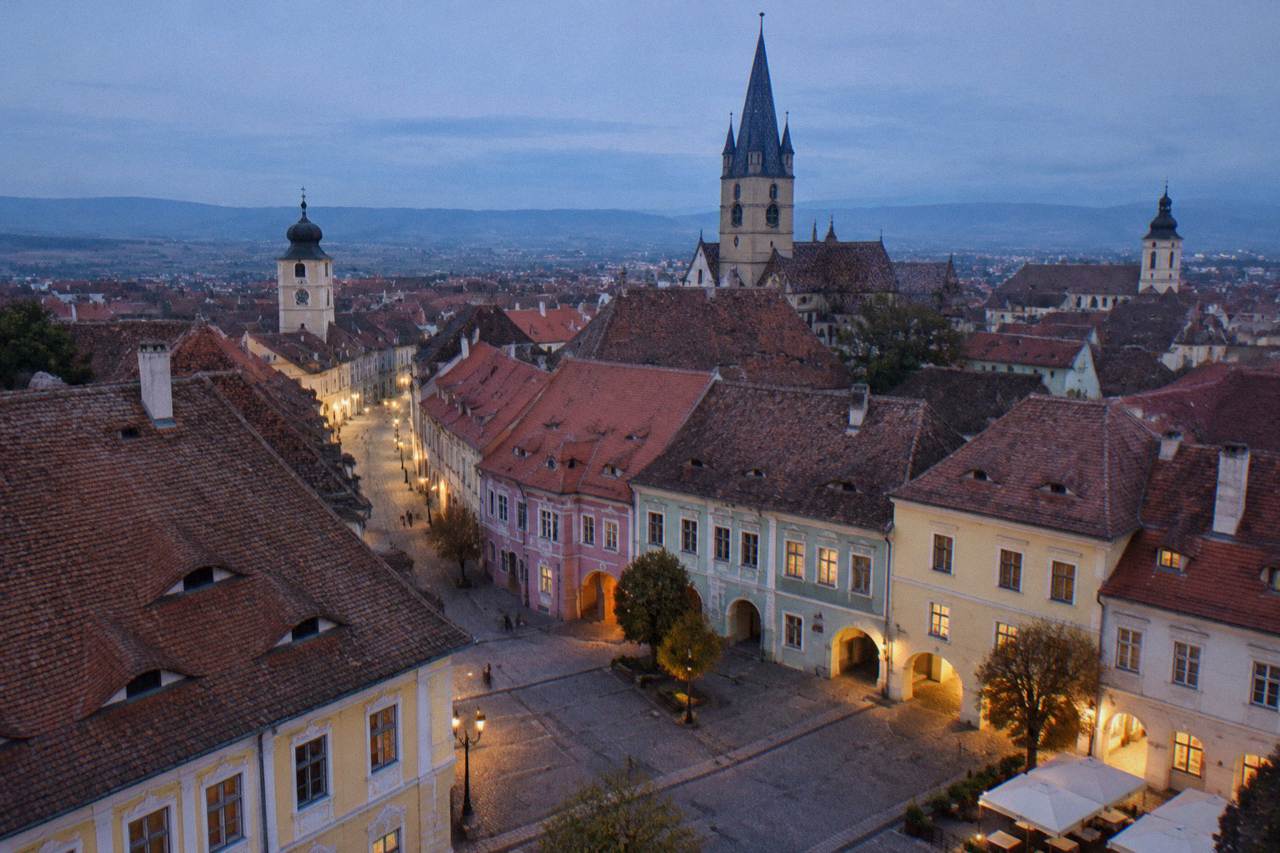
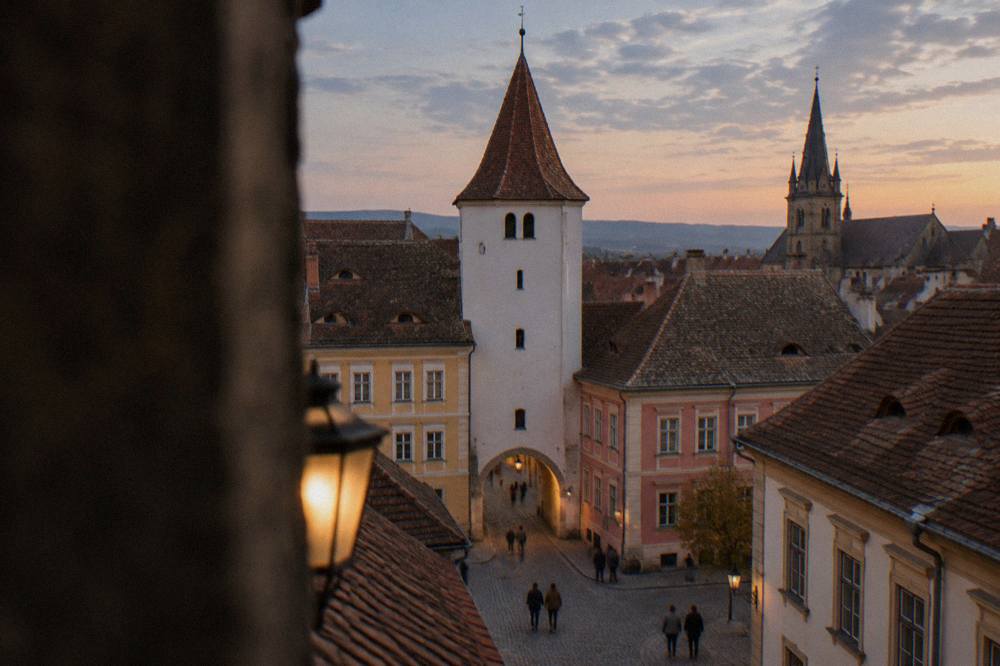
If pronunciation is your entry point to the city, two further pages round it out. The question of whether Sibiu is worth visiting answers the obvious follow-up, and how many days you need in Sibiu helps you size the trip once you have decided. The evening panorama tour of Gușterița Hill, which this site features above, is one of the pleasantest ways to see the skyline you have just learned to name properly.
Common Questions About Pronouncing Sibiu
Is the pronunciation "SIB-yoo" acceptable?
Residents will understand it, but it merges two vowels that Romanian pronounces separately. The closer approximation is "see-BEE-oo", stress on the middle syllable. No official guide exists in the sources this site reports from, so both are approximations.
Where does the stress fall in Sibiu?
On the middle syllable: see-BEE-oo. The final "oo" is its own syllable, short and unstressed.
Why does Sibiu look like it has only two syllables?
English vowel-cluster habits make "iu" look like one sound. Romanian pronounces each vowel, so the name has three syllables: si, bi, u.
Is Sibiu the same city as Hermannstadt?
Yes. Hermannstadt is the German name of Sibiu, and Nagyszeben is the Hungarian name. The city was first documented in 1191 as Cibinium, per the city's own history page.
How do you pronounce the river through Sibiu?
The Cibin river is approximately "CHEE-been", with the stress on the first syllable. The respelling is approximate, in the absence of any official phonetic guide.
