What Is The German Name For Sibiu?
The German name for Sibiu, the Transylvanian city in Romania, is Hermannstadt. Here is where the Saxon name comes from and how it still shows up around the city.
Sibiu, the inland city on the Cibin river in Transylvania, central Romania, answers to three names in three languages, and the German one is the key to its whole founding story. The Romanian name is Sibiu, the Latin documentary name from 1191 was Cibinium, and the German name is Hermannstadt. That last name is not a translation curiosity: it is the mark of the Transylvanian Saxon community that built the Upper Town, the Lower Town, the walls and the squares, and it still appears on buildings, institutions and street corners across the old centre. This page sets out what the sources actually say about the name, where it came from, and where a visitor meets it today.
What Is The German Name For Sibiu?
The German name for Sibiu is Hermannstadt. The city in Transylvania, central Romania, was founded by Transylvanian Saxon settlers reported to have arrived from the Moselle valley area in the 12th century, and their name for their principal city has stayed in use alongside the Romanian Sibiu ever since. Sibiu's own history page records the city's first documentary mention in 1191 as Cibinium, the seat of the free prepositure of the Germans in Transylvania.
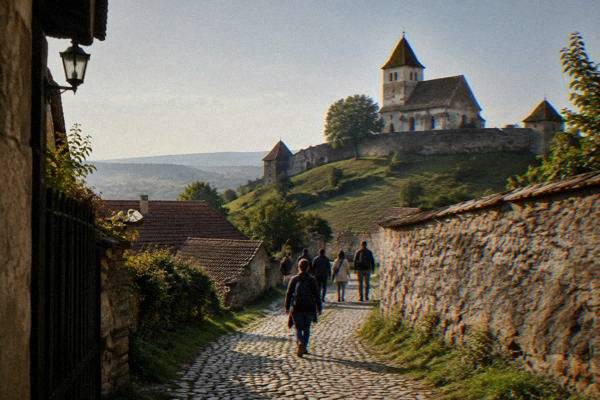
Hermannstadt, then, is not a modern branding exercise. It is the living remainder of a medieval colonisation project in which settlers from the German-speaking Moselle region were invited into southern Transylvania and built a chain of towns and fortified churches, of which Sibiu became the administrative centre. The same community gave the region names that a traveller still crosses today: the villages of the Mărginimea Sibiului ring the city to the south and west, and the fortified church landscape stretches out toward Biertan and beyond, part of the UNESCO serial site of the Villages with Fortified Churches in Transylvania.
For a visitor, the practical payoff of knowing the German name is simple. Older maps, Austrian-era documents, German-language guidebooks and plenty of museum labels inside the city all say Hermannstadt where a Romanian map says Sibiu. If a source speaks of Hermannstadt, it is speaking of this city, on the Cibin river, at an altitude the city's own presentation page gives as 415 m in the Lower Town rising to 431 m in the Upper Town. If you are still placing the city on the map, the companion page Where Sibiu Sits On The Romania Map covers the geography in detail.
Why Does A Romanian City Have A German Name?
Sibiu has a German name because it was founded as a Saxon town. Settlers from the Moselle valley area are reported to have arrived in southern Transylvania in the 12th century, and their community made Sibiu its leading city, documented in 1191 as Cibinium, the seat of the free prepositure of the Germans in Transylvania. The Romanian state absorbed the region later, and the two names have coexisted since.
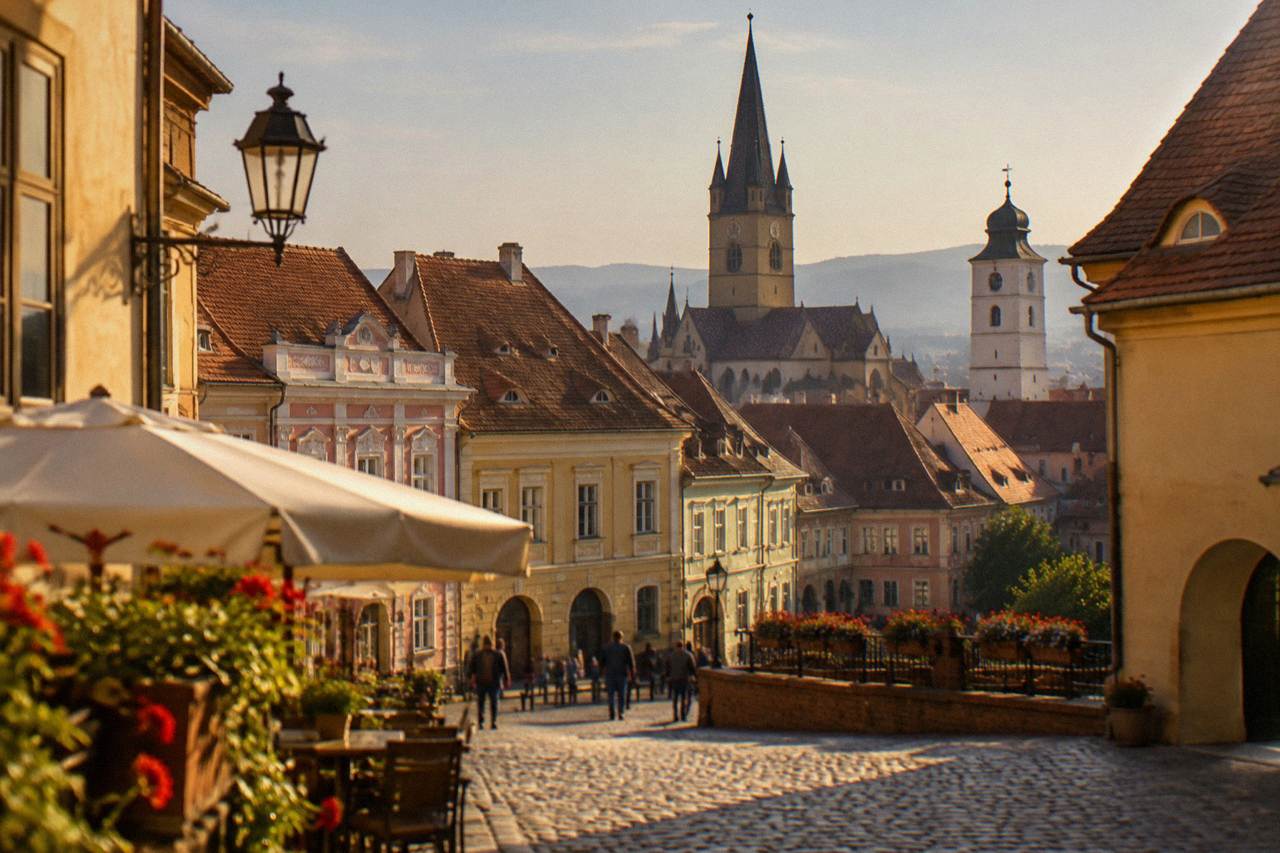
The settlement story matters because it explains the city's physical character, not just its name. The Saxons built in stone and in a planned way: an Upper Town for the administration and the merchants around Piața Mare and Piața Mică, a Lower Town for the crafts, and a defensive belt of walls and towers of which the Potters', Carpenters' and Arquebusiers' towers still stand. The Evangelical Cathedral at Piața Huet is the community's principal church, and its tower, at 10 RON for an adult ticket per the city's tourism site, is currently the open viewpoint in the centre, since the Council Tower next to it has been closed to visitors since 19 January 2026 for a restoration planned at about 24 months.
The German heritage also left an institutional layer. The Brukenthal National Museum, whose palace fronts Piața Mare, opened its collections to the public in 1817 per the museum's own history pages, founded on the bequest of Samuel von Brukenthal, a Habsburg-era governor of Transylvania. The city's own chronology, as published on sibiu.ro, credits the town with the first hospital in 1292, the first school in 1380 and the first pharmacy in 1494 on current Romanian territory, claims worth repeating only as the city's own account of itself. In the 2011 census structure published by the city, Romanians made up 88.9 percent of the population, Hungarians 1.4 percent and Germans 1 percent, a reminder that the German name now describes a heritage rather than a demographic majority.
A note on the city's modern profile: Sibiu is reported to have held the European Capital of Culture title in 2007, and Klaus Iohannis, a member of the German minority's civic tradition, served as mayor from 2000 to 2014 before becoming Romania's president. Both facts are part of why the German dimension of the city stayed visible long after the Saxon community itself dwindled.
Where Do The Names Sibiu, Hermannstadt And Cibinium Come From?
Sibiu's three names come from three layers of its history. The 1191 Latin document calls it Cibinium, tied to the Cibin river it stands on. The Saxon settlers called their town Hermannstadt. The Romanian name Sibiu, like the river name, is the one the modern city carries, and all three are documented or reported in the city's own published history.
| Name | Language | Status and source |
|---|---|---|
| Cibinium | Latin | First documentary mention, 1191, seat of the free prepositure of the Germans in Transylvania, per sibiu.ro's history page |
| Hermannstadt | German | Name of the Transylvanian Saxon town, reported from the Saxon settlement of the 12th century from the Moselle valley area |
| Sibiu | Romanian | The current official name, used on all modern maps, signs and administration |
The river is the quiet thread through all of this. The Cibin, which the city straddles, gave the Latin Cibinium, and the city's presentation page still opens with the river when it describes the place. The Saxon name, by contrast, is a founder's name, of the kind German medieval towns carried across Central Europe. Neither name erased the other: Austrian administration used the German form, Romanian administration uses the Romanian one, and both survive on inscriptions around the old centre. Everything else covered here is indexed on Sibiu Travel Guide.
If you want to hear how the modern name sounds, the companion answer on How To Pronounce Sibiu gives an approximate English respelling, roughly see-BEE-oo with the stress on the middle syllable, labelled as approximate because no official pronunciation guide exists in the sources. There is equally no sourced Hungarian or Roma-name history to add here, so the table above is the complete documented picture.
Is German Heritage Still Visible In Sibiu Today?
Yes, and not only on plaques. The Evangelical Cathedral, the Brukenthal palace on Piața Mare, the municipal chronology, and the surviving Saxon fortified churches in the surrounding villages all carry the Hermannstadt story, and German-language inscriptions sit on buildings across the old centre. The main Saxon-era museums keep short hours on Mondays and Tuesdays, so plan around the closures.
The practical 2026 picture matters for anyone building a day around this heritage. The Brukenthal National Museum is a group of separate sites with separate tickets: the Palace art gallery on Piața Mare at 50 RON for an adult, the History Museum at Casa Altemberger at 36 RON, the Natural History Museum at 20 RON, the Pharmacy History Museum in Piața Mică at 16 RON and the Contemporary Art Museum at 15 RON, with a 48-hour combined ticket at 120 RON, per the museum's own price page. The Palace keeps a Wednesday to Sunday schedule and is closed Monday and Tuesday, and the Contemporary Art Museum is now open Monday to Friday only, closed at weekends, so a weekend visitor sees a different slice than a midweek one. The Hunting Museum, part of the same network, is closed for an indefinite period. Confirm current prices on the museum's own site before you go.
The Saxon footprint extends outward as well. Day trips from Sibiu reach the fortified churches of Cisnădie about 14 minutes and 10 km away and Cisnădioara about 18 minutes and 13 km away, the Mărginimea Sibiului villages such as Rășinari about 18 minutes and 13 km, and Biertan about 76 km to the north, whose UNESCO-listed fortified church charges 20 RON for an adult ticket per the local tourism listing, hours varying by season. The ASTRA Museum of Traditional Folk Civilization on the city's southern edge, in the Dumbrava forest, has functioned since 1963 and carries the folk-civilisation side of the regional story; its autumn 2026 schedule ran to 26 October with last entry about 16:00, and its winter schedule had not been announced, so check before a cold-season visit.
For the city itself, the essentials are free and open at all hours: Piața Mare, Piața Mică, Piața Huet, the Bridge of Lies, the Stairs Passage linking Upper and Lower Town, and the surviving wall towers all stand in public space with no ticket. The Bridge of Lies, a cast-iron structure reported to date from 1859 to 1860, carries its own legend about liars, which is exactly the kind of story a Saxon town accumulated around its landmarks.
How To Explore The Hermannstadt Side Of Sibiu
Walk the old centre with the three names in mind and the city reads like a document. Start at Piața Mare, take in the Brukenthal palace and the Evangelical Cathedral at Piața Huet, cross the Bridge of Lies, descend the Stairs Passage to the Lower Town, and read the bilingual inscriptions along the way. A guided or self-guided walk covers the ground comfortably in a morning, and the visitor centres print maps that carry the German street names alongside the Romanian ones.
The choice of walk comes down to depth. A structured option is the self-guided walking tour of the essential landmarks with audio commentary and a quiz, which the listing describes as covering the core old-town route at your own pace, and it suits visitors who want the Saxon story narrated as they go. If you would rather compare the Saxon town with its equally Saxon-founded rival down the road, the guide to What Sibiu Is Known For and the assessment of Whether Sighișoara Is Worth Visiting both help, and Sighișoara sits about 96 km and 102 driving minutes from Piața Mare.
Either way, the walking geography is compact. The train station lies about 0.8 km north-east of Piața Mare, the bus station a similar distance, and the airport about 5 to 6 km out on the western side, served by the Tursib line 11 bus with a 60-minute ticket at 3.5 lei per the airport's own transport page. That density is the Saxon planners' gift to the modern visitor: everything named on this page sits within a walkable belt of stone.
Common Questions About Sibiu's German Name
What Is The German Name For Sibiu?
Hermannstadt. It is the name given by the Transylvanian Saxon settlers reported to have come from the Moselle valley area in the 12th century, and it appears on buildings, older maps and German-language literature about the city.
Why Is Sibiu Called Hermannstadt In German?
Because Sibiu was founded as the leading town of the Transylvanian Saxons, a German-speaking community invited into southern Transylvania in the Middle Ages. Their name for their capital town has remained the German name of the city.
What Was Sibiu Called In 1191?
The first documentary mention, in 1191, calls it Cibinium, the seat of the free prepositure of the Germans in Transylvania, a Latin name tied to the Cibin river. The city's own history page at sibiu.ro records this.
Do People Still Speak German In Sibiu?
Romanian is the official language, and English is widely used in the tourist areas. The German community is small today, about 1 percent of the population in the 2011 structure published by the city, but the German name and heritage remain part of official city life.
Is Hermannstadt Worth Visiting For Its Saxon Heritage?
The old centre, the Evangelical Cathedral, the Brukenthal museum network and the fortified churches in the surrounding villages all reward a visit focused on the Saxon story. Check museum days before planning, since the main Brukenthal sites are closed on Mondays and Tuesdays.
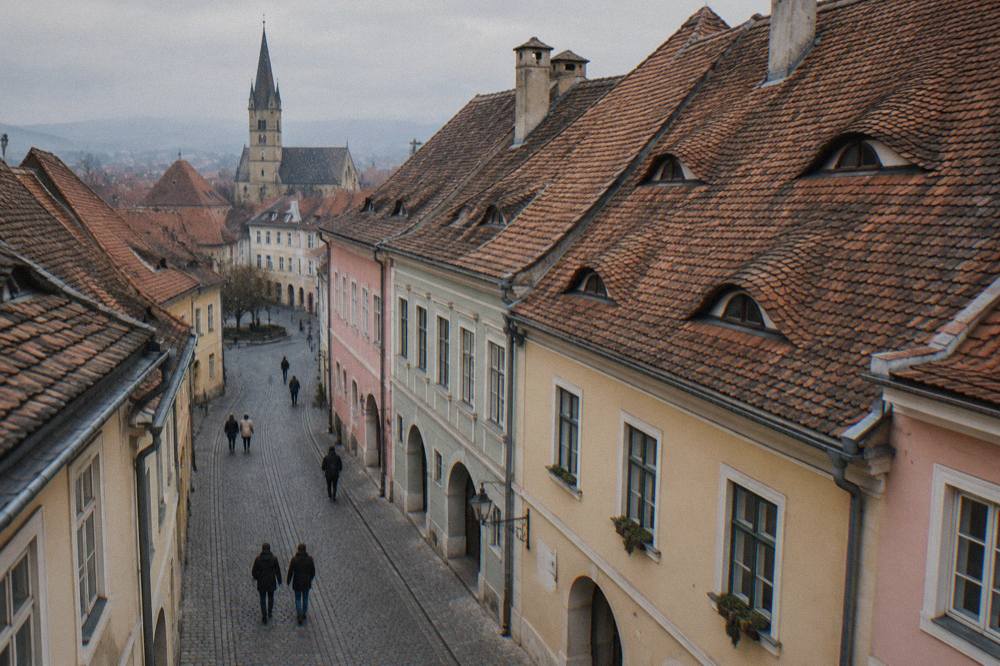
The short version: ask a German speaker about Hermannstadt and a Romanian speaker about Sibiu, and both will describe the same squares, the same cathedral tower and the same eyebrow-windowed rooftops above the Cibin river. The city answers to both names, and the Sibiu Travel Guide covers the rest of what waits in between them.