Where Is Sibiu In Romania?
Sibiu sits in central Romania, in Transylvania, on the Cibin river at the foot of the Carpathians. Where exactly it is, how to reach it and what surrounds it.
Sibiu is a city in central Romania, in the historical region of Transylvania, standing on the Cibin river at an altitude of 415 to 431 metres, with the Carpathian mountains beginning a short drive to the south. It is an inland city with no sea and no coast: the Făgăraș range, the Transfăgărășan road and the Păltiniș resort are day trips from it, not districts of it. First documented in 1191 as Cibinium, the seat of the free prepositure of the Germans in Transylvania, it grew into one of the main towns of the Transylvanian Saxons, whose German name for it, Hermannstadt, is still in use. Today the municipality counts 134,308 residents according to the 2021 census, and the city's own presentation speaks of about 155,000 permanent plus 25,000 temporary residents such as students.
Where Is Sibiu In Romania?
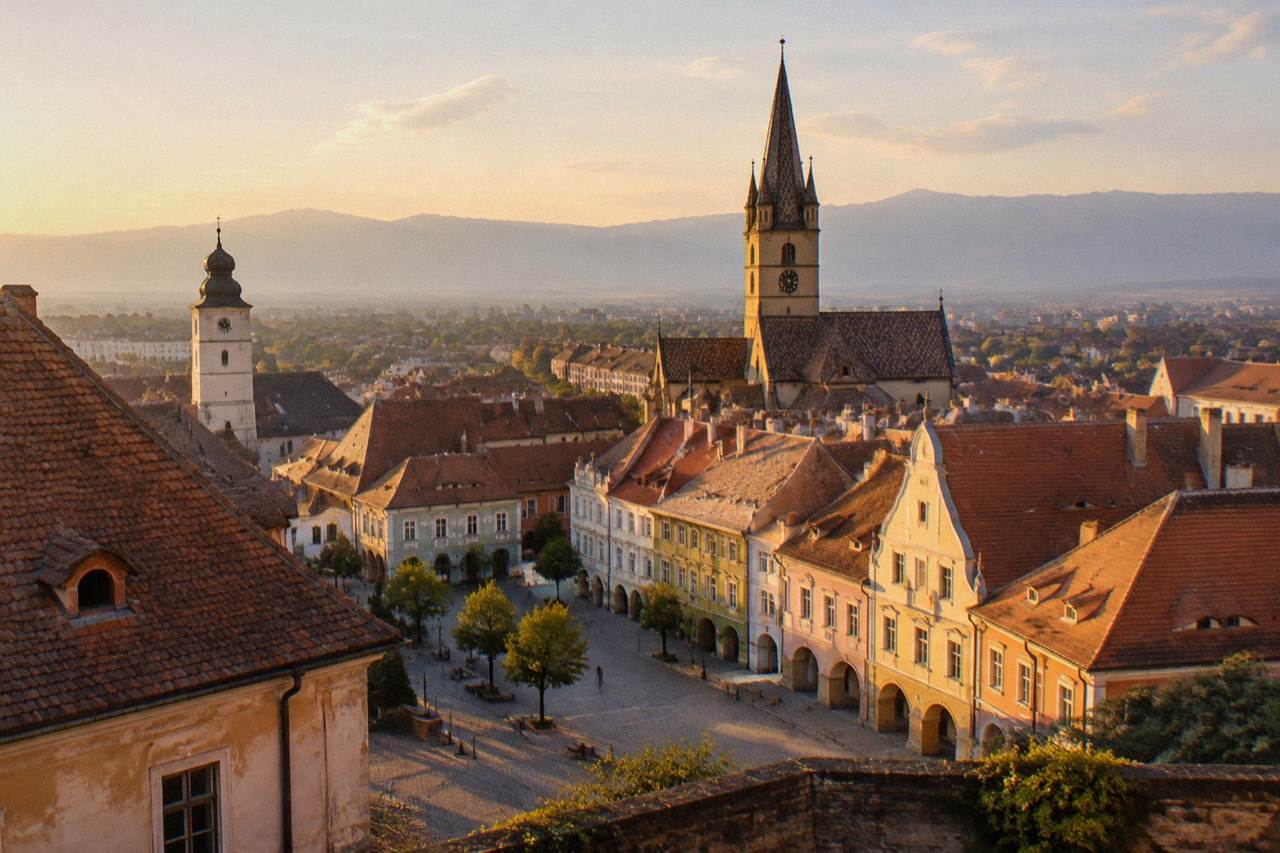
Sibiu is in the central part of Romania, in Transylvania, on the Cibin river, at an altitude between 415 metres in the Lower Town and 431 metres in the Upper Town. It is the seat of Sibiu County, roughly 250 km from Bucharest by road and about 142 km from Brașov, and its medieval core spreads across an Upper Town and a Lower Town around the main square, Piața Mare. The city is inland: the nearest mountains, not the sea, define its horizon.
That single sentence answers the geography question, but the placement matters for planning. Transylvania is the large historical region in the centre of Romania, enclosed by the curve of the Carpathian mountains, and Sibiu sits near its southern edge. The Cibin river runs through the city on its way to the Olt, one of Romania's main rivers, which flows south through the mountains toward the Danube. To the south of the city the land climbs quickly into the Cindrel and Făgăraș ranges; the Făgăraș range is visible from viewpoints in and around town on clear days.
The county frame helps too. Sibiu County borders Mureș, Brașov, Vâlcea, Alba and Hunedoara counties, which places the city within easy reach of the fortified-church villages of southern Transylvania. The practical upshot for a traveller is that Sibiu works well as a base: the city itself is compact and walkable, while day trips reach the mountains, the Saxon villages and UNESCO-listed towns. The Sibiu Travel Guide covers each of those directions in depth.
One confusion worth clearing up early: Sibiu is not in the far north or the west of the country, and it has no coastline. Guides that mention beaches or seaside resorts in the same breath as Sibiu are describing other parts of Romania. If a question like is Transylvania worth visiting for tourists is on your list, Sibiu is one of the region's most convenient entry points.
What Region Of Romania Is Sibiu In?
Sibiu is in Transylvania, the historical region that occupies central Romania inside the Carpathian arc, and it is the county seat of Sibiu County. Transylvania was where Transylvanian Saxon settlers from the Moselle valley area built towns and fortified churches from the 12th century, and Sibiu, their Hermannstadt, became one of the principal centres of that community. The region's borders have shifted across centuries, but Sibiu has stood in its southern part the whole time.
The Saxon layer is the reason the old town looks the way it does. Reported by the county heritage pages, settlers arrived from the Moselle area in the 12th century, and their fortified churches still dot the villages south and east of the city, part of a UNESCO serial listing centred on Biertan. Within the city, the medieval walls, the squares and the "eyes of Sibiu", the roof windows that seem to watch the street, all belong to that German-speaking urban tradition. The city's own chronology lists a hospital in 1292, a school in 1380 and a pharmacy in 1494, presented as firsts on current Romanian territory.
Administratively, modern Romania divides into counties, and Sibiu County radiates from the city in every direction. Neighbouring Alba Iulia, about 71 km and 81 minutes by road, Brașov, about 142 km, and Sighișoara, about 96 km, form a loose triangle of historic towns around it. This density is why so many visitors treat Sibiu as a hub rather than a single stop, a question explored in how many days do you need in Sibiu.
What Cities And Landmarks Surround Sibiu?
Sibiu is surrounded by mountains to the south and Saxon towns to the north and east: Brașov lies about 142 km away, Sighișoara about 96 km, Alba Iulia about 71 km, and the Transfăgărășan high section starts about 63 km from Piața Mare, with Bâlea Lake about 76 km. Closer in, Cisnădie is 10 km, Rășinari 13 km and Păltiniș 32 km. Every one of these is a day trip; none is part of the city itself.
Those figures come from computed road routing and are worth keeping as a mental map. South of the city the Cibin valley leads toward Rășinari and the pastoral villages of Mărginimea Sibiului, then climbs to Păltiniș, a resort about 40 minutes out, whose ski season is announced to open on 28 November 2026. Beyond it the Făgăraș range rises, crossed by the Transfăgărășan road, which reopened for its 2026 season on 12 June and, by rule, can be closed on any day from 20 October, so its live status should always be checked, a point covered in is the Transfăgărășan road currently open.
North and east, the Saxon world takes over. Mediaș is about 56 km, Biertan about 76 km, and Sighișoara's UNESCO-listed centre about 96 km, all reachable in well under two hours of driving. Westward, Alba Iulia's citadel is about an hour away. The table below gathers the main figures.
| Direction | Place | Road distance from Piața Mare | Drive time (free-flow) |
|---|---|---|---|
| South | Păltiniș resort | 32 km | about 40 min |
| South | Bâlea Lake (Transfăgărășan) | 76 km | about 88 min |
| West | Alba Iulia | 71 km | about 81 min |
| North-east | Mediaș | 56 km | about 68 min |
| North-east | Sighișoara | 96 km | about 102 min |
| East | Brașov | 142 km | about 154 min |
How Do You Get To Sibiu?
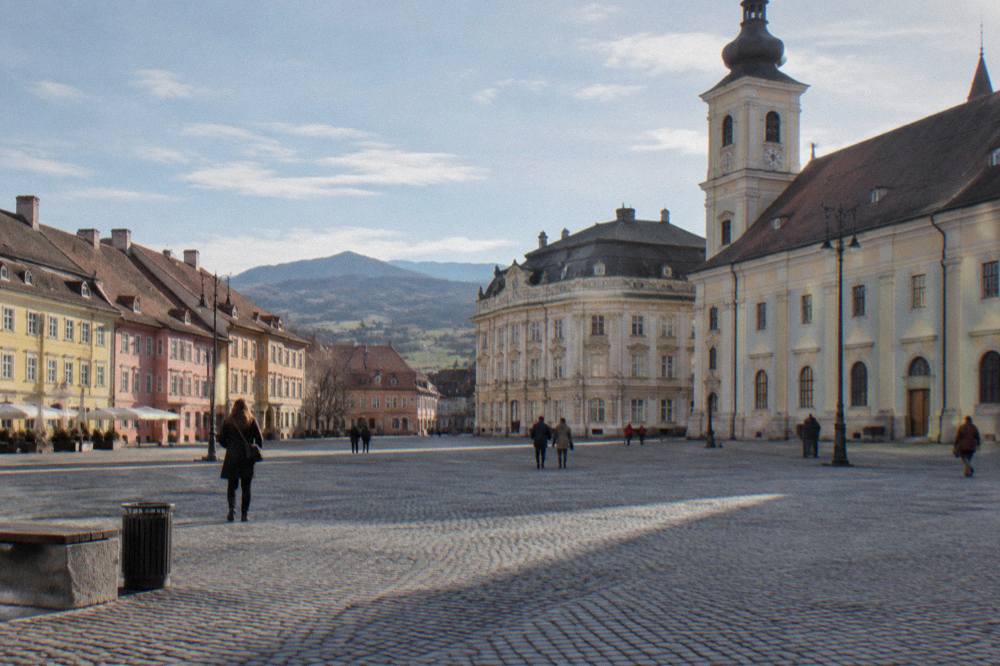
Sibiu is reached by air through Sibiu International Airport (SBZ), about 5 to 6 km from Piața Mare and served by the Tursib bus line 11 with a 60-minute ticket at 3.5 lei, or by train to Gara Sibiu, whose station sits about 0.8 km from the main square. Romania is a full Schengen member, so travel within the zone is treated like domestic travel, and the country's currency is the leu (RON).
The airport connection is unusually convenient for a mid-sized city. The airport's own transport page lists the public bus stop in front of the arrivals terminal and the 3.5 lei contactless ticket, and the ride into the centre takes minutes rather than hours; the details are laid out in how do I get from Sibiu airport to the city centre. Wizz Air dominates the schedule, with routes including London Luton, Memmingen, Dortmund, Nuremberg, Karlsruhe/Baden-Baden, Madrid, Rome and, from winter 2026-27, Birmingham; the winter schedule from 25 October 2026 runs 17 flights a week, down from 20. Austrian flies to Vienna.
By train, Sibiu connects through the national network: reported journey times are about 3 to 4 hours to Brașov, 2 to 2.5 hours to Sighișoara, 1 to 1.5 hours to Mediaș and 5 to 7 hours to Bucharest, and times and fares should be checked on cfrcalatori.ro before booking. Long-distance coaches call at the Autogara Transmixt, also about 0.8 km from Piața Mare, with FlixBus running to Bucharest from a reported fare of about 46 RON. One road warning for drivers heading to or from the capital: the A1 motorway towards Bucharest is unfinished, and the Sibiu to Boița section is closed from 5 October to 19 December 2026 with traffic diverted onto DN7, so extra time is needed on that corridor.
What Is The Geography And Climate Of Sibiu?
Sibiu stands at 415 to 431 metres above sea level on the Cibin river, with a temperate continental climate: the city's official figures give a mean annual temperature of 8.9 C and mean annual rainfall of 662 mm. The ERA5 reanalysis, 1991-2020, shows July mean highs of 24.2 C and January mean lows of -5.7 C, with snow falling from November to March. Inland placement means mountain weather, not maritime weather.
The altitude figures come from the city's own presentation, and they explain the town's physical logic: the Upper Town sits on the higher plateau, the Lower Town beside the Cibin, and stairways and lanes connect the two, most famously Pasajul Scărilor. Rainfall distribution follows the official page's pattern, with June the wettest month at 113 mm and February the driest at 26.7 mm, while sunshine in the ERA5 reanalysis ranges from about 5.6 hours a day in December to about 12.8 in July.
Seasonally, this geography produces snowy winters and warm summers rather than extremes. Winter visitors come for the Christmas market in Piața Mare, running 13 November 2026 to 3 January 2027, and for the ski season at Păltiniș, opening 28 November 2026. Summer visitors get long daylight and mountain access, subject to the Transfăgărășan's seasonal rules. Questions about the colder half of the year are covered at is there a Christmas market in Sibiu, Romania.
Common Questions About Sibiu's Location
Where is Sibiu in Romania?
Sibiu is in central Romania, in the historical region of Transylvania, on the Cibin river. It is the county seat of Sibiu County, about 250 km from Bucharest and about 142 km from Brașov, with the Carpathian mountains to its south.
Is Sibiu in Transylvania?
Yes. Sibiu lies in southern Transylvania, the region enclosed by the Carpathian arc in central Romania. It was founded as a Saxon town, Hermannstadt, by settlers reported to have come from the Moselle valley area in the 12th century.
Is Sibiu near the sea?
No. Sibiu is an inland city with no sea and no coast. The mountains south of the city, including the Făgăraș range, the Transfăgărășan road and the Păltiniș resort, are the nearest major natural attractions, and all are day trips.
What is the German name for Sibiu?
The German name is Hermannstadt, a legacy of the Transylvanian Saxon community that built the town. The city was first documented in 1191 as Cibinium, the seat of the free prepositure of the Germans in Transylvania.
How far is Sibiu from Bucharest?
Bucharest is about 250 km away by road. The A1 motorway between the two is unfinished, and the Sibiu to Boița section is closed from 5 October to 19 December 2026 with traffic diverted onto DN7, so drivers should allow extra time or check the road status before setting out.
For anyone weighing Sibiu against other Transylvanian stops, is Sibiu Romania worth visiting walks through what the city itself offers, and what is Sibiu known for lists the sights that made its reputation.