ESIM And Wifi In Sibiu
Staying online in Sibiu is straightforward once you know what the sources actually say: here is how eSIMs, local SIMs, Wi-Fi and offline maps fit together for a Transylvanian trip.
Short answer
An eSIM works in Romania on the same networks any local SIM uses, but no confirmed price for SIM cards, eSIM plans, roaming or Wi-Fi speeds exists in the sources for this page, so buy from a provider that states its coverage and confirm the price at purchase.
Sibiu, the Saxon-founded city in central Transylvania first documented in 1191 as Cibinium, is compact enough that a phone with offline maps can carry a visitor from Piața Mare to the city walls without any signal at all. Connectivity still matters here: a self-guided tour that runs from a phone, a bus ticket bought contactless on a Tursib line, and a navigation app for the Transfăgărășan day trip all depend on knowing what works, where. This page sets out what the sources say about eSIMs, SIM cards and Wi-Fi in Sibiu, and equally what no source confirms, so the plan survives contact with a weak signal in a Făgăraș valley.
Do You Need An ESIM For Sibiu?
An eSIM is a valid way to get mobile data in Sibiu, because Romania's mobile networks are the same whether the plan arrives as an eSIM, a physical SIM or a roaming add-on from home, and Romania has been a full Schengen member since land border checks with Hungary and Bulgaria were lifted on 1 January 2025. No confirmed figure for eSIM or SIM prices, roaming charges or data allowances was found for this page, so compare providers directly and confirm the price at purchase.
The practical question is not whether an eSIM works in Sibiu, it is which tasks actually need data. The old town is small: the historic core around Piața Mare, Piața Mică and Piața Huet is walkable end to end in well under an hour, and the main squares, the Bridge of Lies and the Stairs Passage are free open-air spaces with no tickets and no opening hours to check online. A day spent only in the old town can run comfortably on offline maps.
Data starts to matter the moment the trip leaves the centre. The Tursib bus from Sibiu International Airport takes a 60-minute ticket bought contactless on board, the airport's own transport page names lines 11, 112, 116, 117 and 118 at the terminal, and contactless payment is not the same as offline planning. A passenger who wants to check a live road status for the Transfăgărășan, or open a museum's ticket page, needs a working connection or a screenshot taken earlier in the day.
The honest summary of the sourcing: Romanian mobile networks exist, are widely used, and serve the whole country, and no source checked for this page publishes a confirmed SIM or eSIM price, a roaming rate or a Wi-Fi speed figure for Sibiu. Any page that quotes a specific leu amount for a tourist SIM in Sibiu is filling a gap. Buy from an operator or eSIM provider that states its Romanian coverage plainly, keep the confirmation e-mail offline, and treat connectivity in the mountains as a bonus rather than a plan.
Where Can You Get Online Around Sibiu?
Public Wi-Fi in Sibiu follows the pattern of any mid-sized European city: hotels, cafes and institutions provide it, but no confirmed list of free public Wi-Fi hotspots, SSIDs or speed figures for Sibiu exists in the sources for this page, so treat guest Wi-Fi as a convenience and carry a mobile data plan as the primary connection. The emergency number, 112, works from any phone regardless of SIM status.
Two things are confirmed. First, contactless payment works on Tursib buses, which means a phone with a working payment method doubles as a transit ticket on the airport line. Second, the city's official tourism ecosystem, the museum sites and the airport's own pages, is online, so anything time-sensitive (road status, museum hours, market dates) is worth capturing to the phone before leaving Wi-Fi for the day.
| Connection option in Sibiu | What the sources confirm | What to confirm yourself |
|---|---|---|
| Hotel and guesthouse Wi-Fi | Standard in the city; no confirmed speed figures exist | Speed and coverage at check-in |
| Cafe and restaurant Wi-Fi | Common in tourist areas; no confirmed hotspot list exists | Ask for the password when ordering |
| eSIM data plan | Romanian networks serve eSIM devices like any other | Coverage claim, price and validity at purchase |
| Prepaid physical SIM | Sold in Romania; no confirmed price for this page | Price, registration requirements and top-up terms at the shop |
| Roaming from an EU home operator | Romania is an EU member and a full Schengen member | Your own operator's roaming terms before travel |
| Emergency calls | 112 works without a paid plan | Nothing, this is confirmed |
One detail worth planning around: hotels in Sibiu have collected a 2 percent tourism-promotion tax on the accommodation value since 1 January 2026, and the checkout bill is one of those moments where a data connection helps reconcile the numbers on the spot. A screenshot of the booking confirmation, stored offline, does the same job without any signal at all.
For a first day in the city, a phone-based activity is a natural fit for the connectivity theme. The Sibiu Old Town exploration game runs from the device itself, and the same goes for a guided sightseeing walk such as the Daily Sightseeing Guided Tour, where a live guide replaces the need to look anything up mid-square. Both leave the phone free for photographs, which is arguably its best use in Piața Mare.

How Do You Stay Connected From Sibiu Airport Into The City?
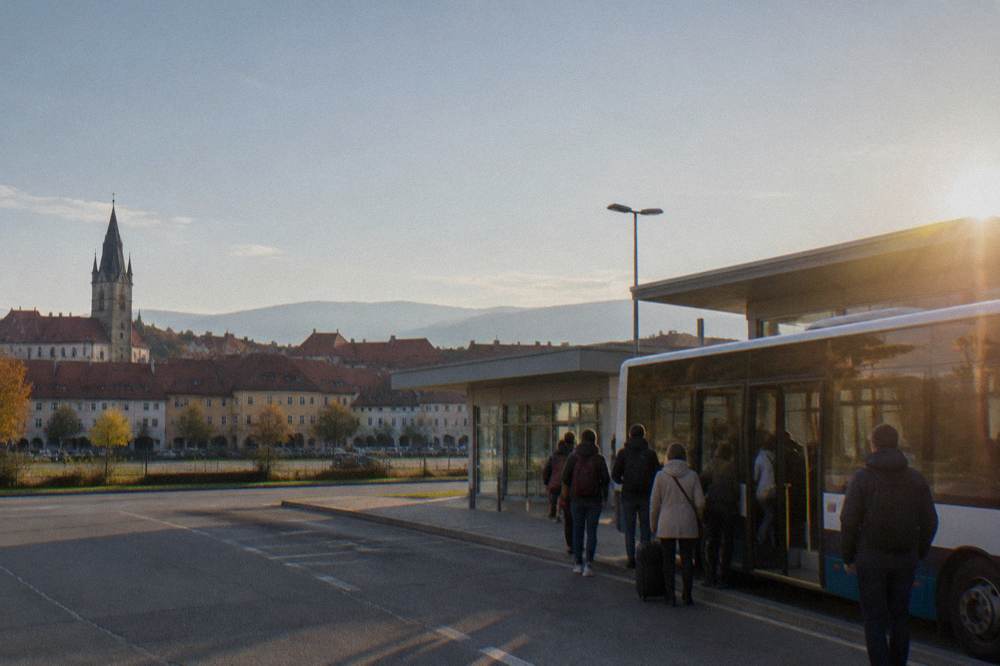
Sibiu International Airport (SBZ) sits about 5 to 6 km from Piața Mare, and the public bus connection from the terminal is confirmed: Tursib lines 11, 112, 116, 117 and 118 serve the AEROPORT TERMINAL stop in front of arrivals, with a 60-minute ticket at 3.5 lei bought contactless on the bus or in the Tursib app, so a phone with a payment method set up in advance covers the whole transfer without cash.
No confirmed description of the airport's Wi-Fi network appears in the sources for this page, so the reliable plan is to arrive with connectivity already working: an eSIM activated at the departure gate, or roaming enabled, or a physical SIM bought after landing if the shop is open when the flight arrives. The airport's own transport page is the place to confirm the current bus lines before flying.
| Tursib ticket type | Price | Validity |
|---|---|---|
| Internal ticket | 3.5 lei | 60 minutes |
| 1-transition ticket | 5 lei | 75 minutes |
| 2-transition ticket | 7 lei | 90 minutes |
The contactless detail is the one that changes behaviour. A phone that can tap to pay, with a plan already active, moves from arrivals to the old town for the price of a bus ticket and roughly ten minutes of riding, and the same phone then holds the museum ticket pages, the map and the day's bookings for the rest of the stay.
What Should You Download Before Leaving Wi-Fi In Sibiu?
The downloads that matter most for Sibiu are offline maps of the old town and the day-trip roads, screenshots of the Brukenthal price and hours pages, the Christmas market dates if travelling from 13 November 2026 to 3 January 2027, and the Transfăgărășan road-status page, because the alpine section can be closed any day from 20 October and no app can be relied on mid-mountain. Offline copies beat signal every time in the Făgăraș valleys.
The museum cluster is the clearest case. The Brukenthal National Museum runs several separate sites with separate tickets, and the main museums are closed Monday and Tuesday, facts a visitor wants stored before standing at a locked door on a Monday morning in Piața Mare.
| Brukenthal site | Adult ticket | Days open |
|---|---|---|
| Brukenthal Palace, Piața Mare | 50 RON | Wednesday to Sunday |
| History Museum, Casa Altemberger | 36 RON | Wednesday to Sunday |
| Natural History Museum | 20 RON | Wednesday to Sunday |
| Pharmacy History Museum | 16 RON | Wednesday to Sunday |
| Contemporary Art Museum | 15 RON | Monday to Friday only |
| Hunting Museum (August von Spiess) | closed indefinitely | Pre-booked groups only |
| Combined 48-hour ticket | 120 RON | Valid at open sites |
Screenshots serve a second purpose here: the Council Tower has been closed to visitors since 19 January 2026 for a restoration planned at about 24 months, and the open viewpoint is the Evangelical Cathedral tower at 10 RON for an adult. A cached copy of the cathedral's hours (Monday 12:00 to 17:00, Tuesday to Thursday 10:00 to 17:00, Friday and Saturday 10:00 to 20:00, Sunday 11:00 to 17:00) turns a mid-square decision into a five-second glance instead of a hunt for signal.
For orientation, the Sibiu map guide and the roundup of free things to do in Sibiu are both worth saving to the phone's reading list while on hotel Wi-Fi, together with the Sibiu airport guide for the arrival and departure days.
How Does Connectivity Work On Day Trips From Sibiu?
Mountain day trips are where any Sibiu data plan earns its keep, because the Transfăgărășan's alpine stretch (Bâlea Cascadă to Piscu Negru) runs only 07:00 to 21:00 in season and can be closed any day from 20 October, with fines of 10,000 to 30,000 lei for driving the closed section, so the road-status page and an offline map of the route are the two downloads that genuinely protect the day. Coverage in the high Făgăraș should be assumed patchy.
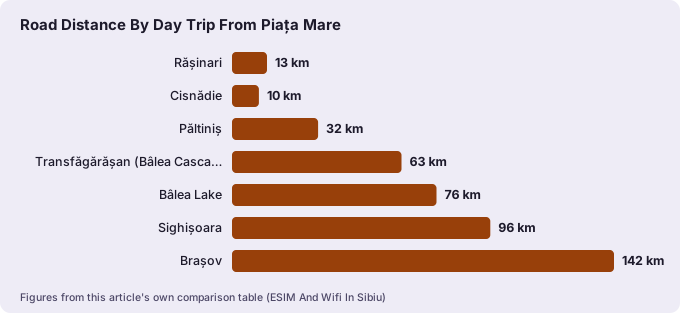
The drive times below are computed from OpenStreetMap routing in free-flow conditions, not a timetable, and they define how much offline content a day trip needs: the longer the drive, the more sense it makes to have the map, the ticket screenshots and the lunch stop saved before the phone leaves Wi-Fi. More of these guides are collected on Sibiu Travel Guide.
| Day trip from Piața Mare | Road distance | Approximate drive time |
|---|---|---|
| Rășinari | 13 km | about 18 minutes |
| Cisnădie | 10 km | about 14 minutes |
| Păltiniș | 32 km | about 40 minutes |
| Transfăgărășan (Bâlea Cascadă) | 63 km | about 69 minutes |
| Bâlea Lake | 76 km | about 88 minutes |
| Sighișoara | 96 km | about 102 minutes |
| Brașov | 142 km | about 154 minutes |
Two 2026 details belong in the offline folder for any southern route. The A1 motorway towards Bucharest is unfinished, and the Sibiu to Boița section was closed from 5 October to 19 December 2026 for overpass works, with traffic diverted onto DN7, so a navigation app that assumes a clear motorway can mislead on a winter itinerary. And Păltiniș opens its ski season on 28 November 2026, which makes late November a busier window on the road south than the calendar suggests.
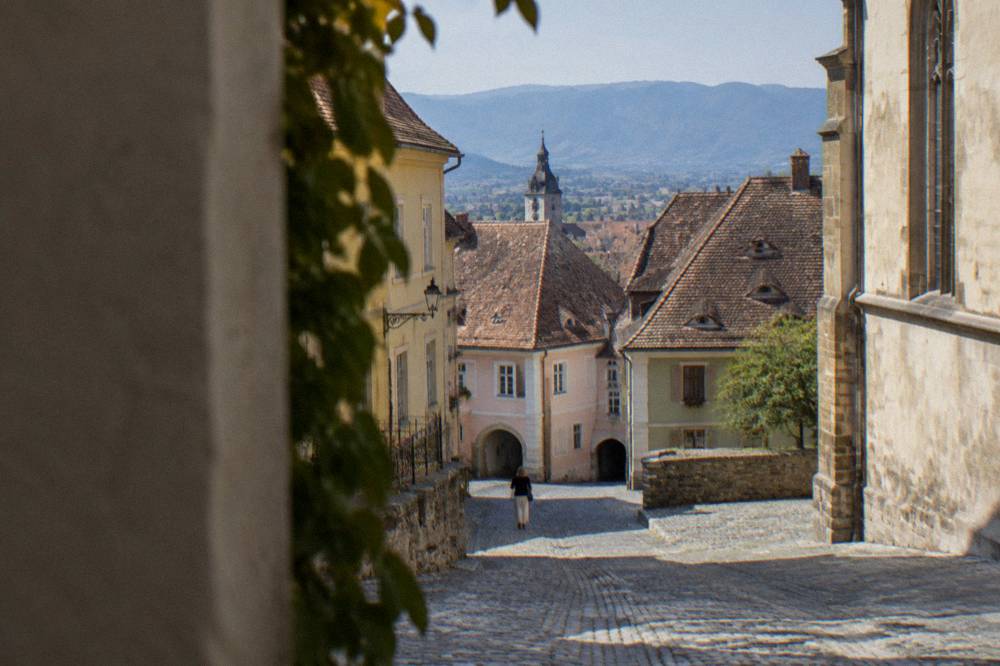
For trips towards Sighișoara and the Saxon villages, connectivity is easier but the planning problem shifts: the Sighișoara Clock Tower museum closes on Mondays and runs shorter hours from 16 September to 14 May, and the Biertan fortified church keeps a lunch break from 13:00 to 14:00 in the shoulder season. Those are screenshot facts, not live-lookup facts, because a village church square is exactly the kind of place where the phone shows one bar and a spinning wheel.
A guided day trip removes most of the lookup burden at a stroke. The Sighișoara, Mediaș and Biertan tour from Sibiu covers the UNESCO-listed fortified church country with the logistics handled, and the same logic applies to the Alba Iulia and Corvin Castle guided tour, where the guide, not the phone, answers the questions on the road.
How Much Data Does A Sibiu Trip Actually Use?
No confirmed data-consumption figure for a Sibiu trip exists in the sources for this page, and honest planning therefore works by task rather than by gigabyte: navigation and map use are light, ticket pages and museum sites are lighter still, photo backups and video calls are the heavy items, and a traveller who saves maps offline and uploads photos on hotel Wi-Fi can run a whole old-town stay on a small plan. Confirm allowance terms at purchase rather than trusting a number quoted online.
What can be said with figures is where the data-relevant moments cluster. The ASTRA Museum sits in the Dumbrava forest on the city's southern edge, about 5.5 km from Piața Mare, and its autumn 2026 schedule ran to 26 October with last entry about 16:00, with the winter schedule not yet announced, so a visit there is a check-before-travelling event, best done on morning Wi-Fi. The same is true of the temporary Brukenthal exhibition running to 31 December 2026.
| Sibiu activity | Data needed on site | Better done on Wi-Fi in advance |
|---|---|---|
| Old town walking, squares and walls | None | Offline map download |
| Museum ticket pages | Light, if buying on the door | Screenshot of prices and closed days |
| Tursib bus contactless payment | None (payment, not data) | Payment card set up in the wallet app |
| Transfăgărășan road status | Small, but signal-dependent | Screenshot of the status page |
| Christmas market visit, 13 Nov 2026 to 3 Jan 2027 | None, free entry | Dates and the rink location saved |
| Photo and video backup | Heavy | Hotel Wi-Fi at day's end |
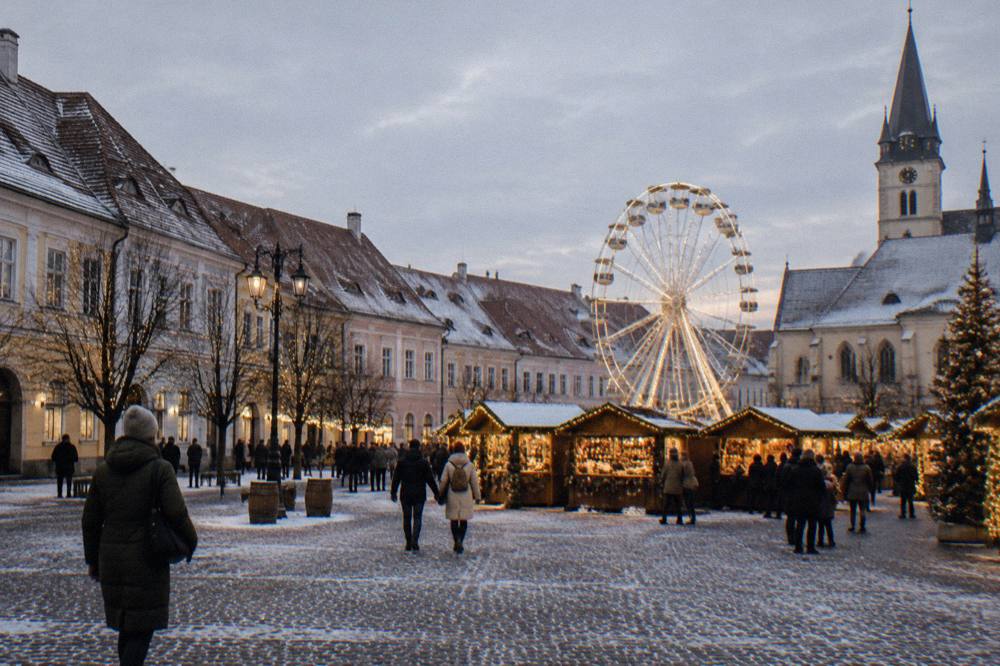
The Christmas market deserves its own note in any connectivity plan, because it inverts the usual logic. Entry to the market in Piața Mare is free and needs no app, no ticket and no signal; the market's Golden Ticket, reported at 100 lei for the wheel, carousel and mini-train, is bought on site. The phone's job there is photographs and, on 31 December, keeping a meeting point agreed offline with companions in a crowd.
Is Wi-Fi Enough, Or Should Every Traveller Carry Data?
Wi-Fi alone is a fragile plan for Sibiu. No confirmed public hotspot network, coverage map or speed figure for the city exists in the sources, guest networks vary property by property, and the moments that genuinely need a connection (a live road status, a contactless bus fare, a rebooking) rarely happen within range of a cafe's router. A small eSIM or roaming plan layered on top of hotel Wi-Fi covers every scenario this page can source.
The authorless, evidence-based position is simple. Romania's networks serve the city well by every general account, Sibiu's tourism infrastructure from airport buses to museum ticketing is increasingly app-mediated, and the only unconfirmed element in the whole chain is the price of the data itself. That makes the purchase decision, not the technology, the thing to research.
Three practical habits close the gap. Download the offline maps on the first evening of hotel Wi-Fi, for the city and for every day-trip road. Screenshot the hours and prices of anything with a door: museums, towers, churches, the market. And keep the booking confirmations, the emergency number 112 and the hotel address in the phone's offline notes, so that a dead SIM in the Făgăraș foothills costs nothing but convenience.
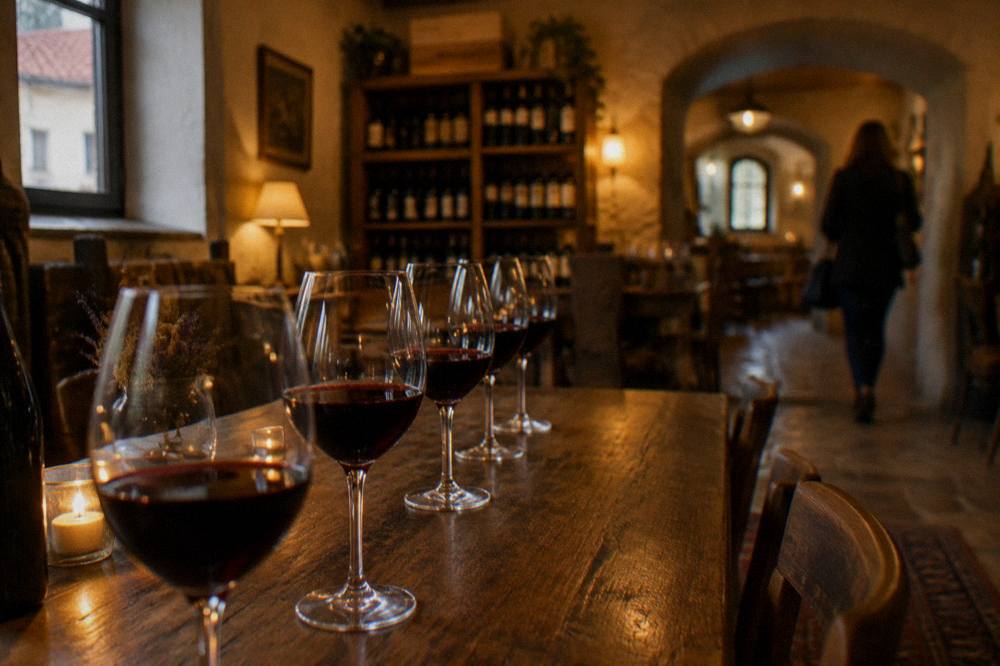
Between the offline-planning sessions, the city rewards the opposite behaviour: putting the phone away. The tasting rooms of a Romanian wine evening and the squares of the Upper Town at dusk are the parts of Sibiu no connectivity article can improve, and the things to do in Sibiu roundup lists them by category for the days when the plan, not the signal, is the scarce resource.
What About Weather, Season And Signal Together?
Winter changes the connectivity equation in Sibiu more than any app setting does: snow falls from November to March, January brings a mean low of -5.7 C under the ERA5 reanalysis 1991-2020, phone batteries drain faster in the cold, and the mountain roads that most need a live status check are the same roads that close, so winter travellers should treat a power bank and offline copies as part of the same kit as the eSIM.
The seasonal picture, labelled for what it is, looks like this.
| Month (ERA5 reanalysis, 1991-2020) | Mean high | Mean low | Modelled sunshine, hours per day |
|---|---|---|---|
| January | 2.2 C | -5.7 C | 6.2 |
| April | 14.6 C | 4.0 C | 10.4 |
| July | 24.2 C | 14.6 C | 12.8 |
| October | 14.5 C | 5.7 C | 8.0 |
The city's own official figures give a mean annual temperature of 8.9 C and 662 mm of rainfall, with June the wettest month at 113 mm. None of that touches the radio network, but cold fingers and short winter days shorten the window in which a phone is pleasant to use outdoors, which pushes more of the day's lookups back onto morning Wi-Fi. The winter itinerary guide covers the seasonal programme in more depth, and the best time to visit Sibiu page weighs the months against each other.
Common Questions About ESIM And Wifi In Sibiu
Does an eSIM work in Sibiu?
Yes. eSIM devices run on the same Romanian mobile networks as physical SIMs, and Romania is a full Schengen member with nationwide network coverage. Confirm the coverage claim and the price with the eSIM provider before purchase, as no confirmed price figure exists for this page.
Is there free Wi-Fi in Sibiu?
Hotels, cafes and public institutions in Sibiu commonly provide guest Wi-Fi, but no confirmed public hotspot list or speed figure for the city exists in the sources. Treat Wi-Fi as a convenience and carry mobile data as the primary connection.
Can I buy a SIM card at Sibiu Airport?
No confirmed list of airport SIM shops or prices exists for this page. Confirm at the arrivals hall on landing, or buy an eSIM in advance so the connection works from the moment the plane doors open.
How do I pay for the airport bus without cash?
Tursib buses accept contactless payment on board. A 60-minute internal ticket costs 3.5 lei, and lines 11, 112, 116, 117 and 118 serve the AEROPORT TERMINAL stop in front of arrivals, per the airport's own transport page.
Will my phone work on the Transfăgărășan?
Signal on the high stretch should be assumed patchy. The alpine section runs 07:00 to 21:00 in season and can be closed any day from 20 October, with fines of 10,000 to 30,000 lei for driving the closed section, so check the live road status on Wi-Fi first and save it offline.
What should I download before a Sibiu trip?
Offline maps for the city and the day-trip roads, screenshots of museum prices and closed days, booking confirmations, and the emergency number 112. The main Brukenthal museums close Monday and Tuesday, which is exactly the kind of fact better stored than searched on a Monday morning.
A final note on the whole toolkit. Connectivity in Sibiu is a solved problem in every direction except price transparency: the airport bus takes a tap of a phone, the museums publish their prices, the market needs no ticket, and a guided walk such as the Upper Town landmarks tour outsources the last of the lookups to a person. Choose the data layer that states its terms plainly, download the rest, and the old town takes over from there.