Sibiu Photography Spots: Rooftops, Bridges And Golden Hour
Sibiu photographs well because its old town was built as a stage: two stacked squares, a wall of towers, iron bridges and roof windows that seem to watch you back. This guide maps the spots that reliably produce frames, tells you which viewpoint is actually open, and breaks down the light month by month.
Short answer
The core Sibiu photography spots are Piața Mare and Piața Mică, the Bridge of Lies, the Evangelical Cathedral tower (the only open rooftop viewpoint, 10 RON), Pasajul Scărilor, the city walls and the Lower Town streets. The Council Tower is closed for restoration until about January 2028.
Sibiu, in Transylvania, Romania, is a city that was designed to be looked at from above and below at the same time. The Upper Town squares sit on a plateau roughly 16 metres above the Lower Town, and the connecting stairways, gates and bridge crossings create natural framing devices a photographer would otherwise have to wait hours for. The old centre is compact, walkable end to end in under half an hour, and almost every major composition is free to shoot from public ground. The one thing this desk will say plainly before anything else: the Council Tower, the postcard viewpoint, is closed to visitors since 19 January 2026 for a restoration expected to run about 24 months, and the Evangelical Cathedral tower is the open alternative.
This page walks through the frames in shooting order, from the rooftop question to the golden hour calendar to the day trips that justify a second or third day. Practical planning background, including parking and arrival logistics, is covered in how to get to Sibiu and parking in Sibiu, and the wider sightseeing picture lives on the site's things to do in Sibiu page.
Which Sibiu Rooftop Viewpoint Can You Actually Climb?
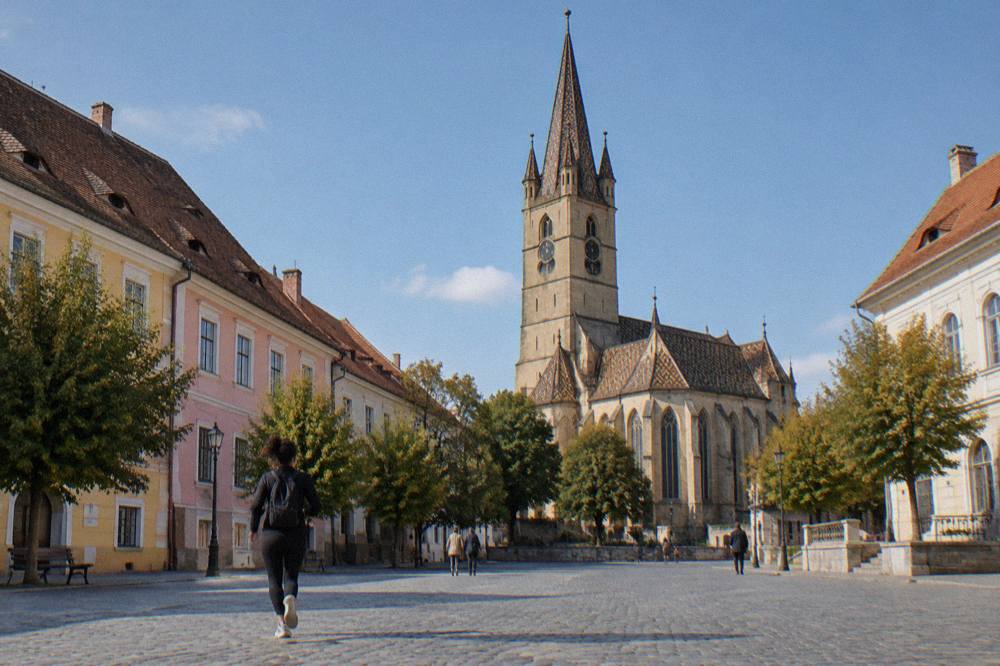
The only open rooftop viewpoint in central Sibiu is the tower of the Evangelical Cathedral in Piața Huet, at 10 RON for an adult ticket and 5 RON for pupils, students and pensioners, per the Sibiu county tourism site. The Council Tower, the classic alternative across Piața Mare, has been closed to visitors since 19 January 2026 for a restoration planned at about 24 months, with completion expected about January 2028, so no ticket, price or view from it applies until then.
That closure reshapes every photo plan for the city. The Council Tower still works as a subject: seen from Piața Mare, wrapped in scaffolding and stripped of its copper roof as of September 2026, it is a document of the restoration itself, and framing it against the Jesuit Church and the Brukenthal Palace facade gives you the standard wide shot of the square. What you cannot do is shoot the rooftops from inside it. The Evangelical Cathedral tower picks up that job. Its published hours are Monday 12:00 to 17:00, Tuesday to Thursday 10:00 to 17:00, Friday and Saturday 10:00 to 20:00, and Sunday 11:00 to 17:00, with guided visits on request in Romanian, German and English. The Friday and Saturday evening slot, open to 20:00, is the one that overlaps evening light in summer.
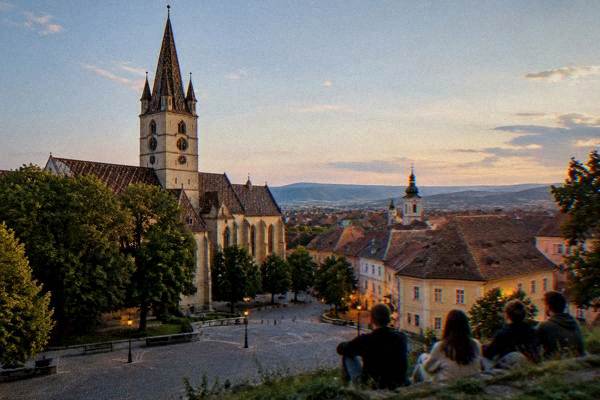
Beyond the cathedral tower, the honest answer is that Sibiu's roofscape is mostly photographed from ground level, from the ramparts, or from the hills across the Cibin valley. The Gusterița side of the river gives a raised panorama of the whole old town silhouette at dusk, and there is a dedicated evening tour to that hill in the site's roster, covered further down this page. For a fuller picture of the squares themselves, the site's Piața Mare guide and Piața Mică guide break down the individual buildings and their histories.
Where Are The Best Street-Level Photography Spots In Sibiu?
The strongest street-level frames in Sibiu cluster around five free public locations: Piața Mare for the baroque facades and tower alignment, Piața Mică for the Bridge of Lies and arcade compositions, Piața Huet for the cathedral and its slate-and-tile surroundings, Pasajul Scărilor for the stairway connecting the two town levels, and the city walls with the Potters' and Arquebusiers' towers for defensive masonry. All of these are open-air and free, with no tickets and no published hours, so they can be shot at any hour the light cooperates.
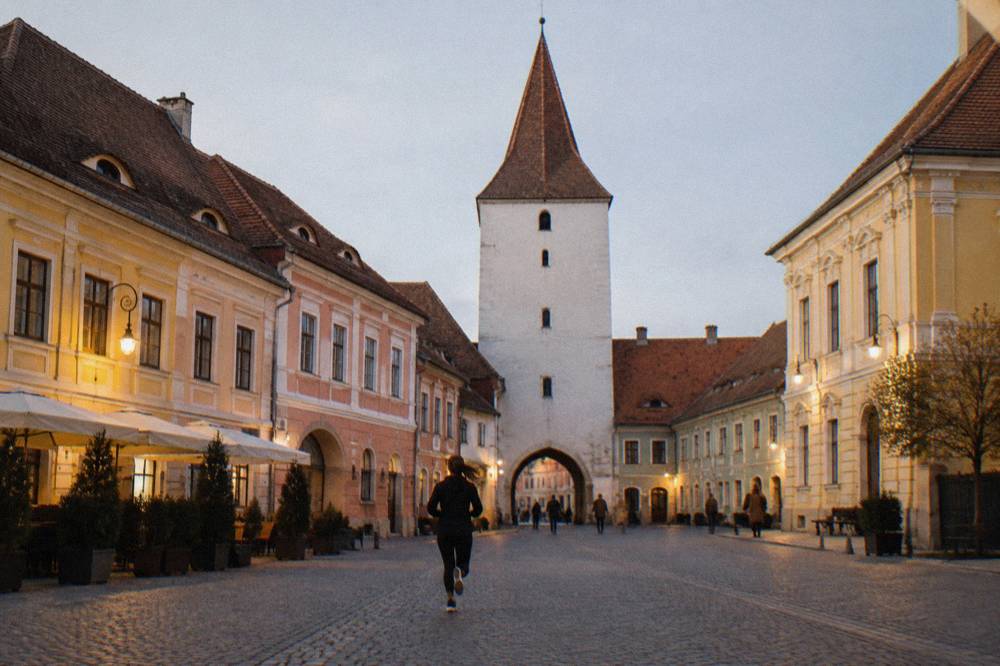
Piața Mare is the opening frame for a reason. The square is large enough that a wide lens from the Council Tower end captures the full range of coloured facades with the Brukenthal Palace on the left, and a longer lens from the same position compresses the towers behind the roofline. The square also changes character completely twice a year: it hosts the Christmas market from 13 November 2026 to 3 January 2027, with a 600 square metre ice rink, and in summer it becomes an open-air stage for events such as the Artmania Festival on 24 and 25 July 2026. A shoot planned around those dates gets a square that no guide photo shows.
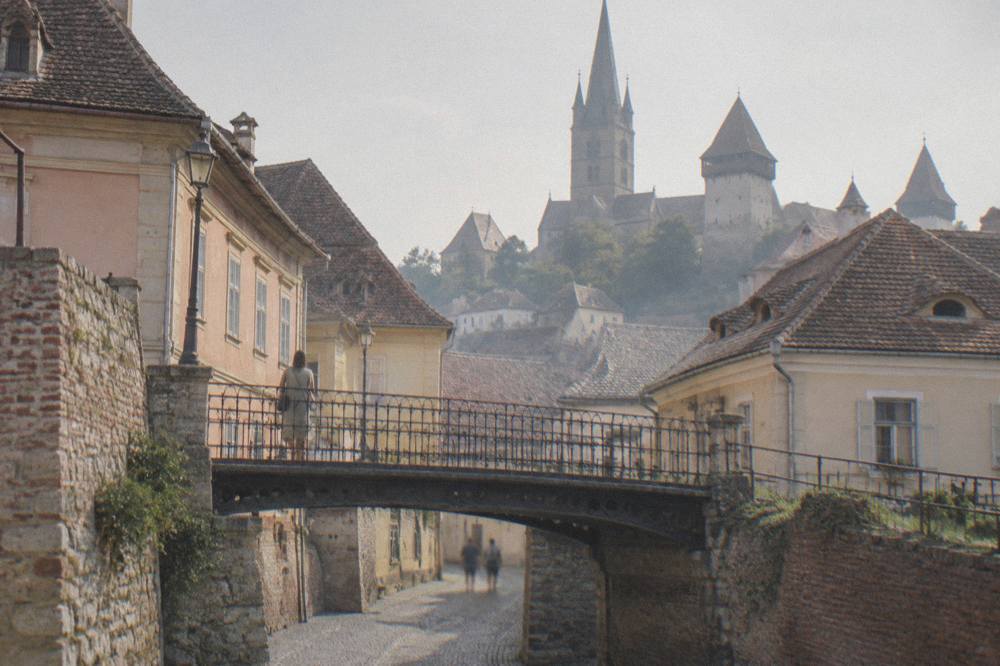
Piața Mică is the more photographic of the two squares for detail work. Its arcades, the Bridge of Lies crossing to Piața Huet, and the Pharmacy Museum facade at number 26 give tight, layered compositions. The Bridge of Lies itself, an iron bridge reported to have been built in 1859 to 1860, is the single most shot object in the city after the Eyes of Sibiu, and it reads best either at blue hour with the square's lamps lit or early in the morning before the cafes fill the arcades. The site's dedicated Bridge of Lies guide covers the legends and the structure in detail.
Pasajul Scăriluilor, the Stairs Passage, deserves a specific mention because it solves a real photographic problem: it gives you a diagonal. Sibiu's old town is built on flat plateaus connected by walls and stairs, and the passage, dating from the city's defensive works, runs the height difference between the Upper and Lower Town in a single stone stairway framed by arches. Shoot it upward from the Lower Town end in late afternoon light. The Lower Town guide and the city walls and towers guide map the rest of the walking circuit.
| Photography spot | Access | Cost | Best light window | What it gives you |
|---|---|---|---|---|
| Piața Mare | Open square, always | Free | Early morning, blue hour | Baroque facades, tower alignment, event staging |
| Piața Mică | Open square, always | Free | Morning, blue hour | Arcades, Bridge of Lies, dense detail |
| Piața Huet | Open square, always | Free | Afternoon | Cathedral tower, slate roofs, statuary |
| Pasajul Scărilor | Public stairway | Free | Late afternoon | Diagonal stairway, arches, level change |
| City walls and towers | Public ramparts | Free | Morning and sunset | Defensive masonry, tower silhouettes |
| Evangelical Cathedral tower | Ticketed, published hours | 10 RON adult, 5 RON reduced | Friday and Saturday to 20:00 | The only open rooftop panorama |
| Council Tower | Closed since 19 Jan 2026 | No access | Not applicable | Subject only, seen from the square |
How Do You Photograph The Eyes Of Sibiu?
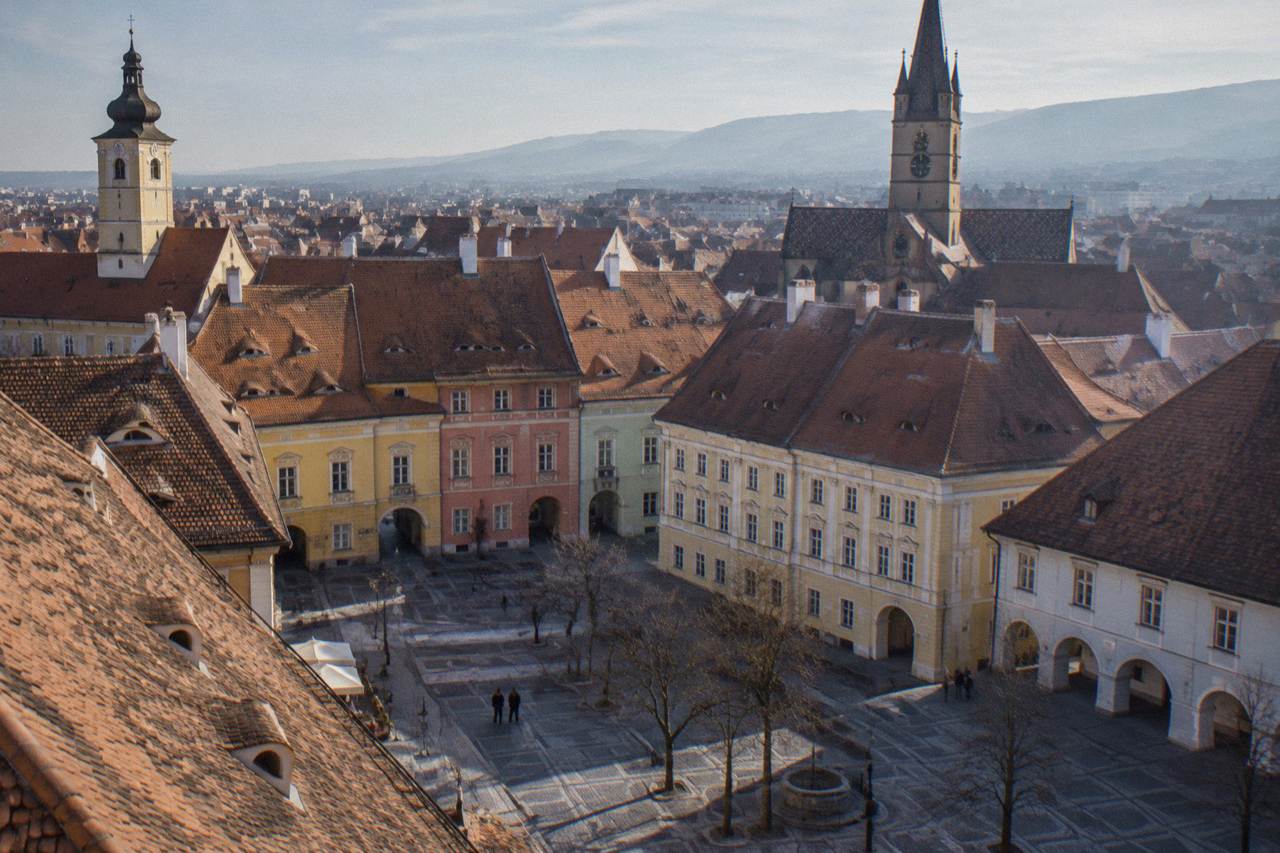
The Eyes of Sibiu, the small dormer roof windows set into the city's tile roofs, are shot best with a telephoto from Piața Mare or Piața Mică aimed at the rooflines, or from street level on the Upper Town side streets using the slope to raise your angle, and they need side light to read as eyes at all. They are an architectural feature of the old houses, free to view and photograph from any public street or square, and no tour, ticket or access permission is involved.
The technical point matters more here than anywhere else in the city. The eyes are small, dark openings in steep tile planes, and in flat overcast light they flatten into generic roof texture. Low sun raking across the roofline, so mid-morning or late afternoon depending on which side of the square you stand, gives each window a shadowed socket and a lit lid, which is what creates the watching effect. A lens in the 100 to 200mm equivalent range lets you isolate three or four eyes against tiles without distortion; a wide lens from directly underneath works only when the roof plane fills the frame.
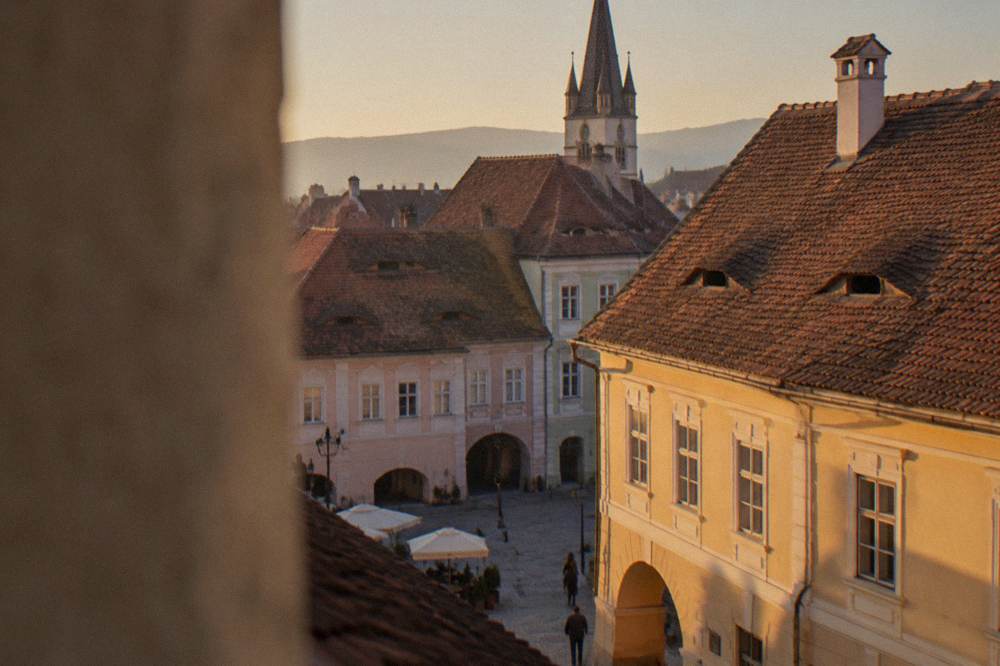
The best hunting streets are the lanes running off Piața Mică toward the Council Tower and the rows facing the square's south side, where the roof planes tilt toward the afternoon sun. Pair the hunt with the Upper Town guide, which walks the same lanes. If the walk itself needs structure, the self-guided option in this site's roster covers the essential landmarks at your own pace: Check availability for the Sibiu Self-Guided Walking Tour.
When Is Golden Hour In Sibiu, Month By Month?
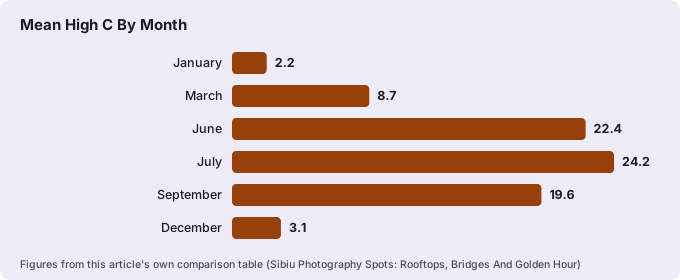
Golden hour in Sibiu runs roughly 19:30 to 21:00 in midsummer and 16:00 to 17:30 in midwinter, tracking the city's daylight span of about 15.7 hours in June down to 8.7 hours in December, according to the ERA5 reanalysis for Sibiu, 1991 to 2020, and blue hour follows immediately after each window. The same dataset puts modelled sunshine at 12.8 hours a day in July against 5.6 in December, so winter shoots are short but the low sun angle is a gift for the Eyes and the stairways.
The practical takeaway is that Sibiu rewards two very different trip styles. A summer visit gives long evenings, the cathedral tower open until 20:00 on Friday and Saturday, and open-air events in Piața Mare. A winter visit compresses everything into a tight window: the light never climbs high, the shadows stay long all day, and if the Christmas market is running, from 13 November 2026 to 3 January 2027, the blue hour coincides with the market's lit stalls and the ice rink in Piața Mare, which is the single most productive hour of the winter calendar. Snow is a real factor too, with modelled snowfall of 23.3 cm in January and 20.8 cm in December across the season.
| Month | Mean high C | Mean low C | Modelled sun h/day | Snowfall cm | Light strategy |
|---|---|---|---|---|---|
| January | 2.2 | -5.7 | 6.2 | 23.3 | All-day low sun, snow cover, market tail |
| March | 8.7 | -0.8 | 8.7 | 18.2 | Thaw textures, longer afternoons |
| June | 22.4 | 12.9 | 12.4 | 0.0 | Longest evenings, tower open to 20:00 Fri-Sat |
| July | 24.2 | 14.6 | 12.8 | 0.0 | Peak light, festival staging in Piața Mare |
| September | 19.6 | 10.5 | 9.7 | 0.1 | Warm tones, thinner crowds |
| December | 3.1 | -3.9 | 5.6 | 20.8 | Christmas market blue hour, snow chance |
Figures are ERA5 reanalysis, 1991-2020, a modelled grid cell near Sibiu, not a weather station record; the city's own official page gives a mean annual temperature of 8.9 C and 662 mm of annual rainfall. For the full seasonal breakdown, see the site's Sibiu weather guide and best time to visit Sibiu.
Which Sibiu Photography Spots Work In Rain Or Bad Weather?
Rain in Sibiu pushes the shoot indoors to the Brukenthal sites, which are open Wednesday to Sunday and charge 50 RON at the Palace, 36 RON at the History Museum in Casa Altemberger, 20 RON at Natural History and 16 RON at the Pharmacy Museum per the Brukenthal National Museum's own price page, or outdoors to the arcades of Piața Mică and the covered stairway of Pasajul Scărilor, which gain texture in wet conditions. The main Brukenthal museums are closed Monday and Tuesday, and the Contemporary Art Museum is the reverse, open Monday to Friday only, so a two-day wet spell can still be covered by alternating them.
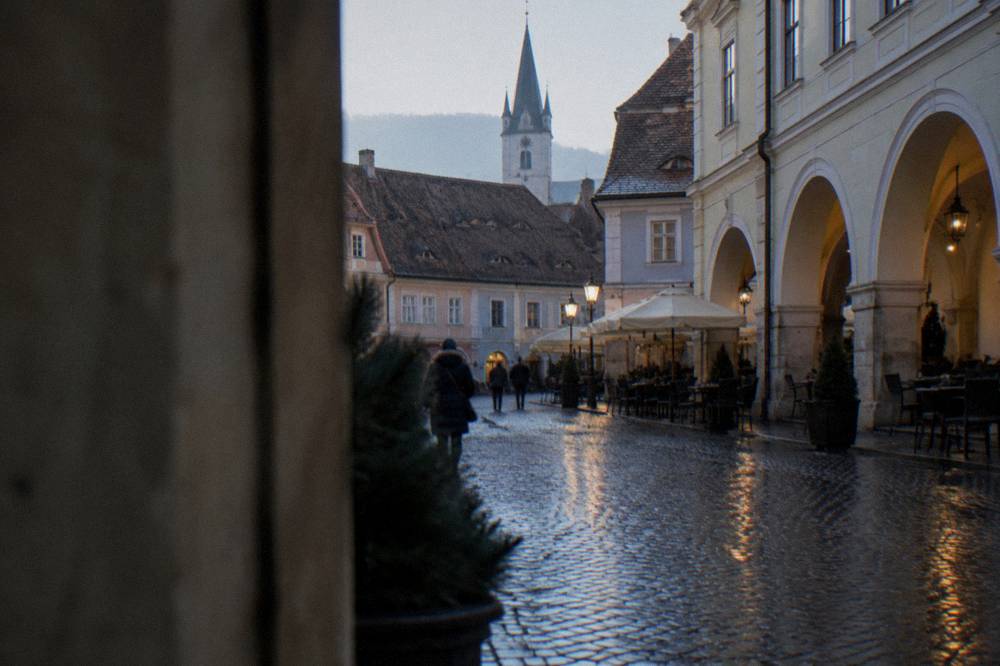
Interior photography rules are set by each museum and can change, so confirm camera policy at the ticket desk before planning a shoot inside. What the sources do support is the architecture: the Brukenthal Palace in Piața Mare, Casa Altemberger on the walls, and the Pharmacy Museum under the Black Bear sign in Piața Mică 26 are all shootable as buildings in any weather, and wet cobblestones in Piața Mică double the lamps and facades in reflection. The sibiu in the rain guide has a full wet-day plan, and the Brukenthal guide covers the collections.
The ASTRA Museum of Traditional Folk Civilization in Dumbrava Forest is the other wet-weather candidate that turns good in poor light: an open-air museum of farmsteads and mills where overcast conditions remove the harsh contrast that plagues timber and thatch in full sun. Adult entry is 50 RON per the museum's own ticket page, and its autumn schedule ran to 26 October 2026 with last entry about 16:00, with the winter schedule not yet announced, so confirm hours before travelling out there. The ASTRA Museum guide and Dumbrava Forest guide cover the logistics.
| Indoor or covered spot | Open days | Adult ticket | Photographic value |
|---|---|---|---|
| Brukenthal Palace, Piața Mare | Wed to Sun, 10:00-18:00 | 50 RON | Baroque palace, gallery interiors, courtyard |
| History Museum, Casa Altemberger | Wed to Sun, 09:00-17:00 | 36 RON | Medieval house on the city walls |
| Pharmacy Museum, Piața Mică 26 | Wed to Sun, 09:00-17:00 | 16 RON | Historic apothecary interior |
| Natural History Museum | Wed to Sun, 09:00-17:00 | 20 RON | Exhibit interiors |
| Contemporary Art Museum | Mon to Fri only | 15 RON | Modern gallery spaces |
| ASTRA open-air museum, Dumbrava | Daily, hours seasonal | 50 RON | Overcast-friendly timber and thatch |
| Piața Mică arcades and Pasajul Scărilor | Public, always | Free | Reflections, covered diagonals |
The 48-hour combined Brukenthal ticket at 120 RON, listed on the museum's price page, makes sense for a photography trip that wants several interiors across two days. Prices and hours can change, so confirm on the museum's own site before you go. The rest of the planning pages sit on Sibiu Travel Guide.
Where Can You Photograph Sibiu's Panorama From A Distance?
The raised panorama of Sibiu's old town skyline is shot from the Gusterița side of the Cibin valley, where the hillside lifts the camera above the roofline and the cathedral and remaining towers stack into a single silhouette, best at dusk when the city lights come up. The site's tour roster includes an evening tour built exactly around this view, and it is one of the few products in the city aimed squarely at photographers rather than general sightseers.
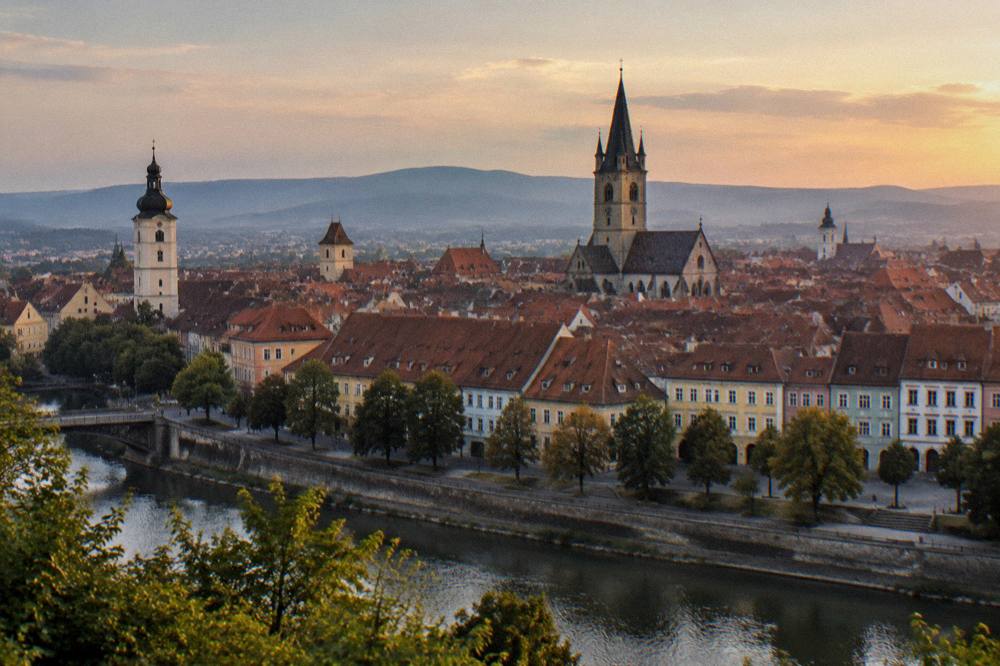
The other distance frame that costs nothing is from the city walls themselves: the rampart walk between the towers looks inward over the Lower Town roofs, and the towers of the wall, including the Potters' and Arquebusiers' towers, give foreground mass against the skyline. Shoot the wall towers at dawn when the streets are empty and the light comes in low across the Cibin valley.
What Day-Trip Photography Spots Sit Within Reach Of Sibiu?
The strongest day-trip photo locations from Sibiu are the Transfăgărășan road and Bâlea Lake at 2,034 m, about 88 minutes and 76 km from Piața Mare by road; the UNESCO fortified church at Biertan, about 76 km and roughly 1 hour 15 to 1 hour 30; the Sighișoara historic centre, about 96 km and about 102 minutes; and the Saxon villages of the Mărginimea Sibiului. All drive times are computed free-flow routings, not timetables, and one big caveat applies to the mountain option.
The Transfăgărășan must never be treated as a guaranteed shot. The 2026 season opened on 12 June with daily hours of 07:00 to 21:00 on the high stretch, and by rule the alpine section can be closed on any day from 20 October, with fines of 10,000 to 30,000 lei for driving it closed. Check the live road status before committing a day to it, and treat the Bâlea cable car, which runs on its own schedule, as the fallback. The Transfăgărășan guide and Bâlea Lake guide carry the current rules.
| Day-trip photo location | Distance from Piața Mare | Free-flow drive time | Key frame |
|---|---|---|---|
| Rășinari, Mărginimea Sibiului | 13 km | About 18 minutes | Village streets, pastoral foothills |
| Cisnădie and Cisnădioara churches | 10 to 13 km | About 14 to 18 minutes | Fortified churches on hillocks |
| Sibiel | 25 km | About 36 minutes | Village lanes, icon museum |
| Păltiniș | 32 km | About 40 minutes | Mountain resort, ski season from 28 Nov 2026 |
| Bâlea Cascadă, Transfăgărășan | 63 km | About 69 minutes | Waterfall, road switchbacks |
| Biertan fortified church, UNESCO | About 76 km | About 1 h 15 to 1 h 30 | Fortified church ensemble, 20 RON entry |
| Bâlea Lake, Transfăgărășan | 76 km | About 88 minutes | Alpine lake at 2,034 m |
| Sighișoara historic centre, UNESCO | 96 km | About 102 minutes | Clock Tower, coloured burgesses' houses |
Biertan is the compact choice: a UNESCO-listed fortified church with an adult ticket of 20 RON, open Nov to Mar Tuesday to Sunday 11:00 to 15:00, hours per the county tourism site, so a winter shoot needs the afternoon window. Sighișoara's Clock Tower museum is 50 RON with hours listed at cetateasighisoara.com, and the town itself is free to shoot from the streets. The Sighișoara guide and the fortified churches near Sibiu guide map both circuits, and the site's Saxon heritage page covers the history behind the walls.
What Gear And Practical Planning Do You Need For Shooting Sibiu?
A practical Sibiu camera kit is one body, a wide lens for the squares, a telephoto in the 100 to 200mm range for the Eyes and rooflines, and a tripod for blue hour in Piața Mică, plus a paid-plan awareness of three logistics: the old town is largely pedestrian, the airport is about 5 to 6 km from Piața Mare with Tursib bus line 11 at 3.5 lei for 60 minutes, and hotels add a 2 percent tax on the accommodation value since 1 January 2026. None of the street-level spots listed on this page charges entry, so the only certain costs are the cathedral tower and any museums you enter.
Distances inside the old town are short, which argues for travelling light: the whole circuit from Piața Mare through Piața Mică, Piața Huet, Pasajul Scărilor and the walls is a walk of well under an hour without stops. If the trip is built around dawn and dusk shoots, basing yourself inside the old town removes the transport question entirely, and the where to stay in Sibiu guide breaks down the areas. Arriving by air or rail is covered in the Sibiu Airport guide and the Sibiu train station guide, both within walking distance of the centre at about 0.8 km each.
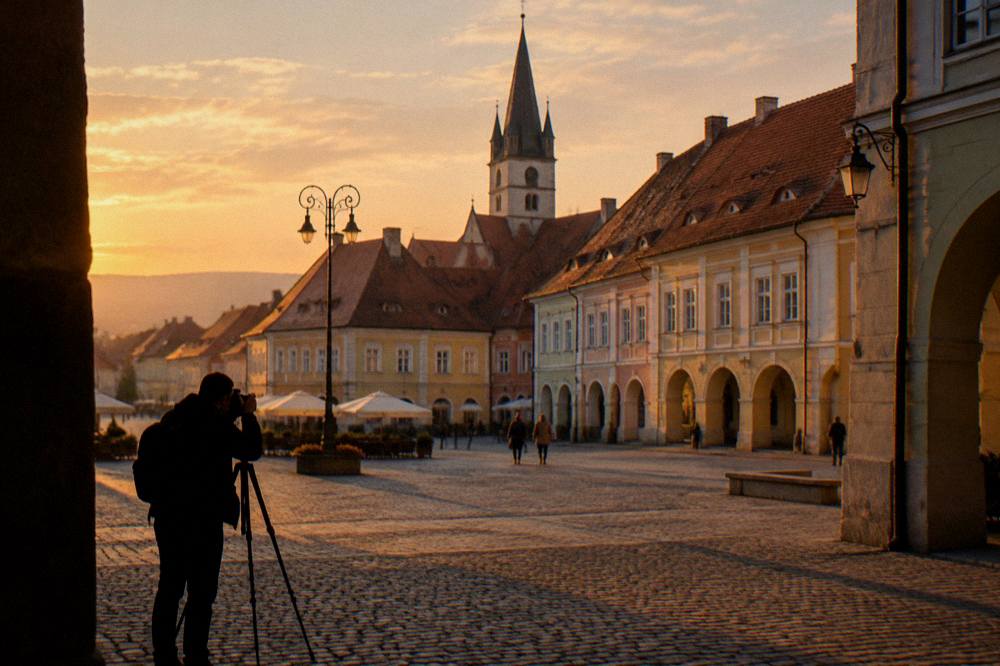
One seasonal note for the winter half of the year: the Christmas market from 13 November 2026 to 3 January 2027 both crowds Piața Mare and lights it, so dawn shoots of an empty square only work outside those dates, while evening shoots gain the market's stall glow and the 600 square metre ice rink. The Sibiu Christmas market guide and Sibiu in winter guide plan those weeks in full. For the hills in snow, the guided hiking option below reaches the high country with someone who knows the conditions:
Common Questions About Sibiu Photography Spots
Can you climb the Council Tower in Sibiu for photos?
No. The Council Tower has been closed to visitors since 19 January 2026 for a restoration planned at about 24 months, with completion expected about January 2028. Photograph it from Piața Mare as a subject, and use the Evangelical Cathedral tower, 10 RON adult, as the open viewpoint.
Is photography allowed inside the Brukenthal museums?
Interior camera policies are set by each museum and can change, so ask at the ticket desk. The buildings and courtyards are shootable in any case, and the museums are open Wednesday to Sunday, closed Monday and Tuesday.
Where do you shoot the Eyes of Sibiu?
From Piața Mare and Piața Mică with a telephoto aimed at the rooflines, or from the sloping side streets off Piața Mică. Side light in mid-morning or late afternoon is what makes the dormer windows read as eyes.
When is the best light for photographing Sibiu?
Golden hour runs roughly 19:30 to 21:00 in midsummer and 16:00 to 17:30 in midwinter per the ERA5 reanalysis for Sibiu, 1991 to 2020. In the Christmas market season, 13 November 2026 to 3 January 2027, blue hour over the lit stalls in Piața Mare is the most productive window.
Can you photograph the Transfăgărășan and Bâlea Lake on a day trip from Sibiu?
Yes, Bâlea Lake is about 88 minutes and 76 km by road from Piața Mare, but the alpine section can be closed on any day from 20 October under the standing rule, so check the live road status before you commit. The 2026 season opened 12 June with daily hours 07:00 to 21:00.
Do you need a permit to photograph in Sibiu's squares?
No permit is needed for personal photography in Piața Mare, Piața Mică, Piața Huet, Pasajul Scărilor or the city walls; all are free public spaces with no tickets or hours. Commercial shoots should confirm arrangements with the city administration.
Sibiu repays a slow camera: the squares change with every event, the rooflines change with the light, and the closed Council Tower is a reminder that even a postcard city keeps moving. Plan around the open cathedral tower, the seasonal light table and the free public layer underneath it, and the frames will keep coming.